
I want to say a little bit about why it’s OK for scientific ideas to be wrong. And when I say wrong, I don’t mean incorrect. I mean incomplete. Think about it: Why do we learn about the Bohr model of the atom in chemistry courses, only to find out that it’s not terribly useful and not very precise? It isn’t incorrec t- it’s just incomplete. The Bohr model is remarkably accurate when it comes to describing hydrogen, but it lacks the necessary pieces to maintain accuracy when you bring heavier elements with more electrons into the mix. What does the scientific community do then? Adopt a new, more accurate theory and work from there. No problem; society seems to be OK with atomic theory so far, but sometimes when the scientific consensus changes, it means war. For example, everything changed in 2006, when nine planets in our solar system became eight.
Let's talk about Pluto.
In early October of last year, various memes circulated the web hinting that Pluto’s status as a planet might be reinstated. Generations of people worldwide cheered for Pluto to get back in the ring after eight years of retirement. These people were likely raised learning about the nine planets in the solar system, but is Pluto's planetary status actually being reinstated?
Simple answer: No.
Because of its location in the solar system and also because of its size, Pluto’s new status as of 2006 is “dwarf planet,” which is distinctly different from planets like Earth, a terrestrial planet, and Jupiter, a gas giant. How did Pluto get "demoted," and should society reject science “changing its mind?” From planetary science to evolutionary biology, people seem to dislike it when terms change and theories evolve. Let's look briefly at Pluto's history.
The search for an elusive “trans-Neptunian object” began in the latter half of the 19th century after astronomers observed perturbations in the orbit of Uranus. Neptune’s contribution to the perturbation was ruled out, so astronomers started looking for something past the orbit of Neptune. Some politics got in the way, and the search for this TNO halted until 1929. After more than a year of searching and comparing photographs of the sky, Pluto was officially classified as the ninth planet in the solar system in 1930 after its discovery by Clyde Tombaugh.
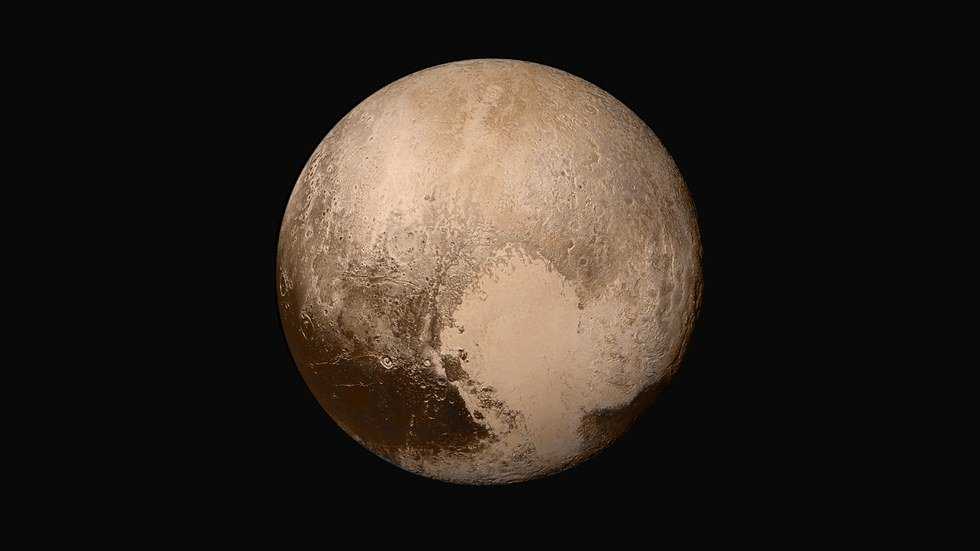
This year, we've been privy to an amazing amount of never-before-seen information regarding Pluto. On July 14, 2015, NASA's, "New Horizons" interplanetary space probe flew by Pluto at a distance of 7,800 miles, closer than any man-made object has ever come to the dwarf planet to date. The probe has observed jagged mountain ranges and vast, icy plains across Pluto's surface, with unprecedented detail. New Horizons also took some photos of Pluto's orbital neighbors, namely its closest and dearest moon, Charon. Charon is pretty big compared to Pluto, and it isn't alone. This is where we get into choppy waters.
What does it take to be a planet? As an object floating around in space, you have to meet three criteria if you are to consider yourself a planet:
- You are in orbit around the Sun.
- You have sufficient mass to assume a nearly round shape.
- You have to “clear the neighborhood” around your orbit.
If you meet all three, the International Astronomical Union (IAU) considers you a planet. So what happened to Pluto? It certainly orbits the Sun. Judging by the recent photos from the New Horizons mission it is certainly round enough. But wait - Pluto shares its region of space with hundreds of other similarly-sized objects, which none of the other eight planets do! And there’s the kicker: Pluto has a vast neighborhood full of other objects.
Pluto occupies a region of space called the Kuiper Belt, which is home to a huge number of dwarf planets, planetoids, minor planets, and other interesting objects. As mentioned before, Pluto has a moon. Well, it actually has several moons: Charon, Nix, Hydra, Kerberos, and Styx (neat names, eh?). These moons are not that much smaller than Pluto, and there are so, so many more objects just like them scattered throughout the Kuiper Belt. This information is somewhat new, and it has changed the way astronomers and planetary scientists perceive the very fundamentals of the solar system, leading to a paradigm shift of sorts with regards to planet classification, and the sad demotion of dear Pluto.
I hear funny sentiments about Pluto every once in a while, like "I can't believe Pluto got demoted" and "Pluto isn't even good enough to be a planet anymore," but I don't think these people quite see the big picture. Dwarf planets aren't inferior to planets, nor are any astronomical bodies inferior to any others. When we change the classification of an object in astronomy, it's seldom the case that science is giving up or changing its mind. Rather, our science is getting more precise, and that's something we should all be excited about.
My dad is a Public Health professional and he gave me a short summary on the usefulness of science that I think about frequently. He said: “The pursuit of knowledge is an effort to gain new information and an effort to make existing information better.” Science isn't absolutely true, and it never claims to be, but it is always the best assemblage of knowledge of the natural world, and thankfully we get to witness this.
At the end of the day, Pluto will continue orbiting the Sun just as it always has, joined by its neighbors, and they will forever be what they are, no matter what we choose to call them.