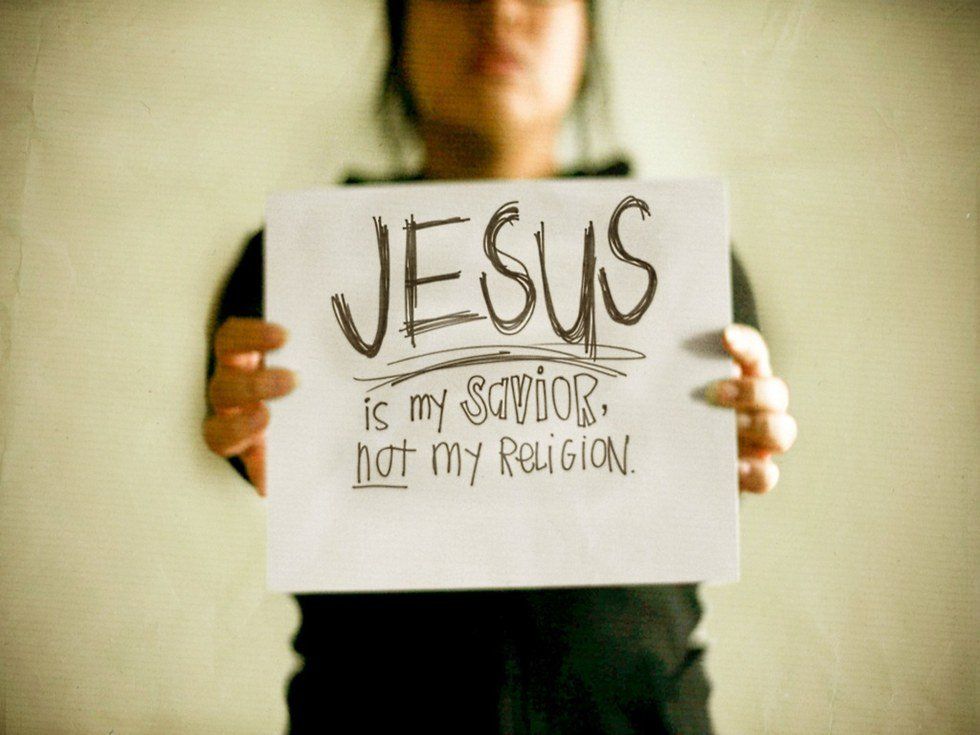
I am a Christian and I no longer want to have a religion.
Now, before you cry, “Heathen” and quickly exit, hear me out, remember this vulnerability thing, just stick with me and then you can yell if you want.
Today, the word "religion" has quite a negative connotation. It is now common to associate religion with hypocrisy, radicalism, bigotry, naivety, and the list goes on. It is devastatingly fascinating how religion, what people had once connected with hope, love, comfort, and peace, has made almost an 180-degree change.
So, what is the reason for this reversal of connotations and my seemingly indignant statement? The answer just might be found in the word’s denotation. I turn to Merriam-Webster's Dictionary online for the answer, and it says that religion is, “an organized system of beliefs, ceremonies, and rules used to worship a god or a group of gods; an interest, a belief, or an activity that is very important to a person or group.”
In other words, religion is synonymous to monotony and routine, it can be the very thing that wrings out the actual reason behind the “interest” or “belief,” which is to love and honor God, isn’t it?
In the first definition, we see words such as “organized system...ceremonies, and rules.” How boring does that sound? Is it really a big shocker that so many people are disillusioned by religion? To reiterate, I stick by my earlier statement, I do not want to have a religion, because what I want, is a relationship.
I crave a relationship with God and I would readily choose to have a faith than an institution to rely on. Underneath “Religious Affiliation” I would gladly choose Christ follower over Christian or even worse, selecting a denomination.
Hold tight, we are taking a quick detour, why are denominations so set in their ways?
They argue over details that seem trivial such as kitchens, bread, juice, wine, instruments, and one of my favorite points of argument, the role of women (but that’s for another time).
Does it matter? Your immediate answer might be an overwhelming, "Yes it absolutely does matter" but like I asked before, please hold your yelling until the end.
Now, before conservatives begin to light torches and search for me, I absolutely agree with certain traditions. I believe that traditions are a tie from the past to the present and remind us of the reason why we perform such acts. Traditions serve as a reminder that God transcends all, they connect us with those who have performed the same acts before us and will connect us with those who will come after us. People are greater than material things (I know that may seem like a duh statement but wait…) and if this is true, why are we more apt to tear people down instead of agreeing to disagree about approaches toward material items that seem to tear congregations apart?
God is with and in those who attend church five times a week and those who casually discuss theology with friends and family. Does God love those who attend church in their Sunday best more than those who attend an inner-city church in dirty clothes riddled with holes? My answer: absolutely not.
So why then do all these little things matter?
That detour may have been filled with turbulence but it has to lead us back to the main point. If we argue over every minute detail of how we believe others should find their faith, do we solidify a system for our beliefs rather than solidify the beliefs for our systems?
Correct me, if I am wrong, but if what we do does not benefit the latter, we are wasting our time. We can build immaculate cities, and lavish systems of living, but if we lose our purpose and drive even the most elaborate designs lose its magnificence. Similarly, if we lose our love for Christ and our love for people, bread will always be just bread, juice just juice, instruments just instruments, etc. These things are just things and our religion is just something that prevents us from sleeping in on Sunday mornings, or making plans on Wednesday nights without our willingness to believe and have faith in something far greater.
Our dissatisfaction with religion should not result in blaming God, but ourselves. Isn’t our goal as followers of Christ to give love, respect, and acceptance to everyone, and not occasionally too but especially to the marginalized, the wrong-doers, the different ones, the “others” of the world.
If we stick to our goal, then we can eradicate the negative connotations I listed before, because by truly loving God, we will inevitably show love to others. This does not mean that Christians are perfect, nor should we feel pressure to not make a mistake, this fearful thinking can lead to a paralysis that is far more dangerous than trying to do the right thing.
Alright, I’ll wrap this up so you can get to your commentating.
When I searched for the definition of religion online in Merriam-Webster’s Dictionary, the thing that stuck out to me most were not the definitions, but a percentage. In light gray letters, it read: “Popularity: Top 1 percent of lookups.” Do you know what this means? To me it means that there are many people trying to understand religion, trying to define it since we have muddled the definition. I stand firm when I say that I do not want a religion, I want a relationship with God and by striving to live in this new lifestyle, I hope to lessen the schism between the denotation and connotation of what it means to have a religion.
Ok, you can yell now.