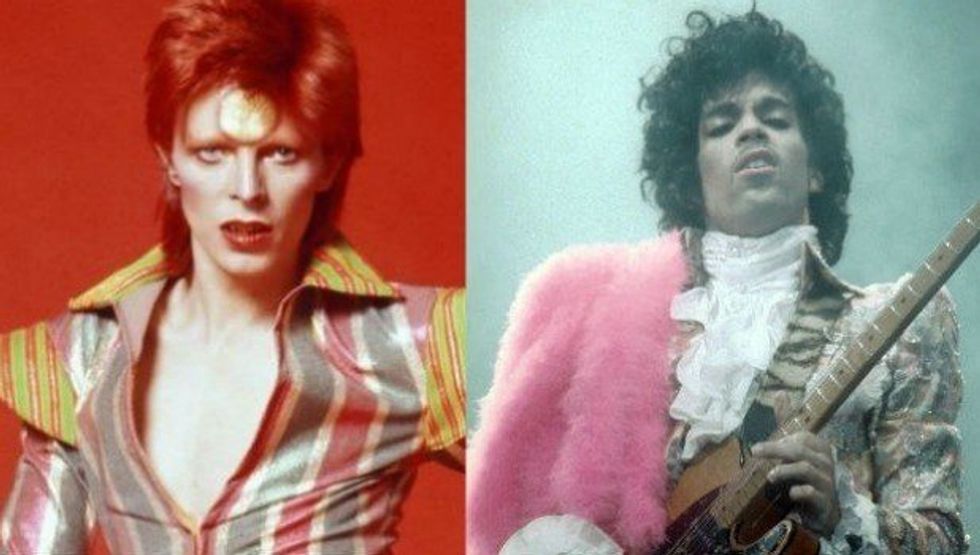
I’ve been thinking a lot about music lately. I’ve been thinking about how music affects our memories and emotions, and the ways in which music can alter both our physiological and psychological states. And I’ve been thinking about these things in relation to the recent deaths of so many influential musicians, from David Bowie to Phife Dawg (Malik Taylor) to Prince, and the reasons why we mourn the deaths of these distant celebrities as if they were family members.
What it all boils down to, for me at least, is the idea that music, or art in general, is a powerful force. Music has the ability to penetrate one’s emotions and memory, to catalyze change, to bring people together, or to serve as a source of comfort. There are many cognitive mechanisms that allow for music to have this control over people.
One article on Psych Central poses the question, “But why exactly does this experience of music distinctly transcend other sensory experiences? How is it able to evoke emotion in a way that is incomparable to any other sense?” The article goes on to explain how the perception of music is “more rooted in the primitive brain structures that are involved in motivation, reward and emotion,” and that it is an unconscious process of hearing and feeling. In fact, according to the article, the experience of listening to music and the emotional effect it has is often associated with theories about synesthesia, or a sense felt in one part of the body that is brought on through stimulation of another part of the body. This explains why we often experience altered physiological states when we listen to music; for example, many studies have shown that listening to heavy-metal music can increase one’s heart rate.
Because music is so heavily involved with emotion and often produces synesthetic experiences, it is no wonder that music plays a big role in memory production and recall. An article form Psychology Today explicates one study done by the University of Newcastle in Australia, in which two researched “used popular music to help severely brain-injured patients recall personal memories.” They examined “‘music-evoked autobiographical memories’ (MEAMs) in patients with acquired brain injuries (ABIs),” by playing songs from the Billboard Hot 100 from throughout the patients’ lifespans. They found that “the highest number of MEAMs in the whole group was recorded by one of the ABI patients,” and that “songs that evoked a memory were noted as being more familiar and more well liked than songs that did not trigger a MEAM.” These results shed light on song recognition demonstrated by Alzheimer’s patients as well. What these studies reveal is that music is very much tied to one’s autobiographical memories, and is perhaps part of what makes autobiographical memories stick more than others.
We all have those songs, whether few or many, that trigger various memories, emotions, or even just general states of being. When I hear a song by Mumford and Sons or the Shins or Bon Iver, I am immediately transported to driving in my car in the morning to my high school and listening to the first few mixed CD’s I ever made, since my car didn’t have a fancy audio-jack to plug my phone into. When I hear Avicii’s “Wake Me Up” or Beyoncé’s “Drunk In Love,” I am overcome with very visceral memories of my first few college parties from freshman year, when everything felt so new and exciting. People have songs from happy relationships, from breakups, from times of depression or celebration. A certain song can remind someone of a particular phase in his or her life, or from a very specific and brief moment in time. Music, in many ways, does things that words alone cannot, because in many ways, it leaves auditory footprints on our brains that travel down to our hearts and through our fingertips and stay there forever, oftentimes bringing back unsolicited feelings and memories that never seem to fade.
This is why when a favorite musician dies, we feel as though we have just lost a loved one. Music is just as powerful a community-builder as it is a source of personal refuge, and as we listen to an artist’s work, we build a strong relationship with it that may be individual or part of a larger group. I discovered A Tribe Called Quest just a few years ago, and in many ways, their music has gotten me through many hard times. Midnight Marauders helped me ride through my very first college finals week through rhythms, and I have listened to it so many times that it doesn't distract me from my homework, from this piece I'm writing right now, because its beats and rhymes sound as natural to me as white noise or a gentle rainstorm. When I encounter other Tribe fans, I feel an immediate connection to them, because I know that by listening to the same music, we have been touched by the same artist, even if this experience has a different effect for each person.
When Phife Dawg died, I mourned. Although he lives on through his music, the fact that his life had ended so suddenly and prematurely was upsetting and disturbing. Similarly, when I got the New York Times app notification about Prince’s death, I let out a huge gasp in the middle of class and had a hard time focusing for the rest of the day. I listened to the Purple Rain soundtrack on repeat that night in denial. Both of these artists not only had huge and lasting impacts on society at large, but they had a personal impact on me, my life, and the ways in which I express myself creatively, as I’m sure they did for many people.
This piece is a reflection more than anything else, but I suppose if there is one point I want to get across, it is to stress the importance of music for all of us, for our memories, and for our emotions. The impact music can have on our daily lives, and on our lives in general, is not something to take lightly, and that goes for artists and consumers alike. And so when a musician passes, it is important to honor and memorialize them, but more importantly, we must keep their legacy alive by continuing to listen to and share their art, and to see their work as inspiration for our own.