
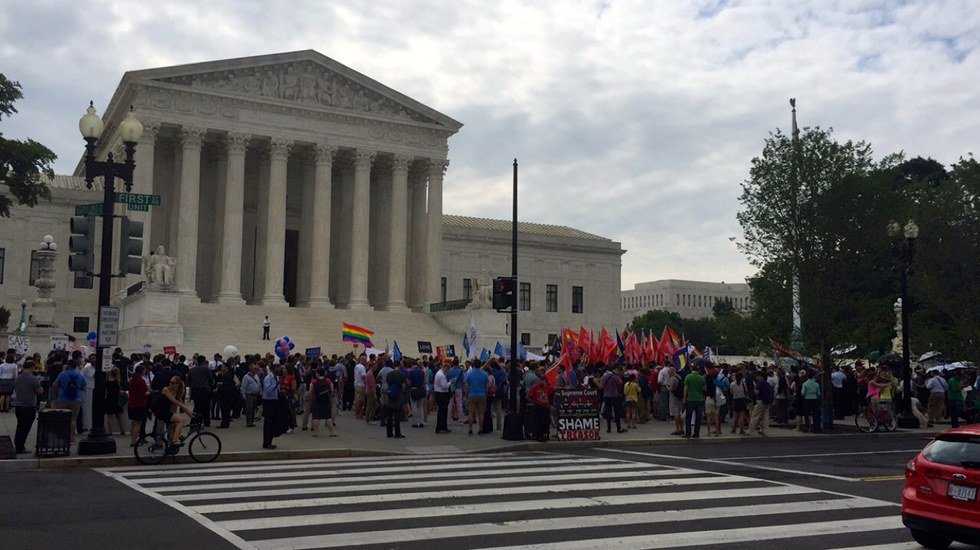
So, just in case you haven't heard yet and must be unable to connect to the Internet, or you're Marty McFly from Back to the Future and just hit 88mph to arrive in 2015, marriage equality has reached the United States in all fifty states.
In a landmark decision, the Supreme Court found that not only do states have to recognize all marriage licenses from other states, but that states cannot deny anyone the fundamental right to marry under the Equal Protections Clause and the Due Process Clause of the Constitution. The decision was delivered on the anniversaries of several very important cases: U.S. v. Windsor (2013), which struck down the Defense of Marriage Act, and Lawerence v. Texas (2003), which made it unconstitutional to create laws that banned sodomy between homosexual couples.
The vote came down 5-4; Justice Kennedy wrote the majority opinion and was joined by Sotomayor, Ginsburg, Breyer and Kagan while Chief Justice Roberts, Scalia, Thomas and Alito all wrote separate decisions. Justice Kennedy's majority opinion was pure poetry as he told the story of the plaintiffs in the case, focusing on how their inability to marry deprives both the couple and their families fundamental freedoms promised to them by our Constitution. Kennedy then outlines how the definition of marriage has changed throughout time and all of the work the LGBTQ community has put into getting to this point.
However, while this should be a day for celebration, love and marriages, the fight is not nearly over. While now everyone has the fundamental right to marry, there are still huge strides that need to be made to get us all closer to true equality. Since sexual orientation is not a protected class federally under Title Nine, people can still be legally fired for their sexual orientation. While 22 states have passed legislation that prohibits workplace discrimination based on sexual orientation, most states do not have such a provision. So while homosexual couples can now get married in all fifty states, they can also get fired for their marriage.
2016 GOP Presidential candidates have had mixed responses to the situation, and some responses have been more mild than others. Frontrunner Jeb Bush stated that the Supreme Court should have "left the decision up to the states" but urges everyone to respect and love each other. Meanwhile Governor Scott Walker has declared that an Amendment needs to be made to the Constitution stating that only states can define marriage and Senator Rick Santorum added that he would stack the Supreme Court with only conservative justices if he were President.
While Obergefell v. Hodges represents the most important case in the fight for LGBTQ equality to date, it is merely the starting point for a long fight to equality.
#LoveWins