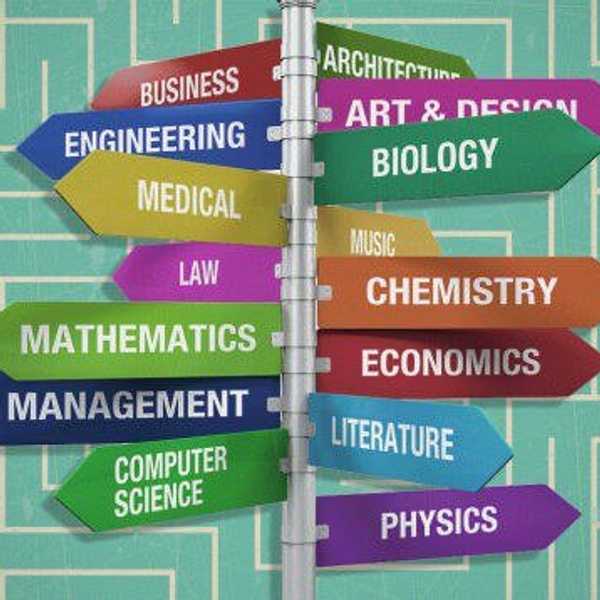


Why do people look at you like you have three heads when you tell them that you go to a liberal arts school? For some reason, there seems to be a negative connotation with the words "liberal arts"--it is misconceived that the coursework is not as rigorous, that the education is not as valid as that of a professional school, and you'll hear a lot of questions like, "What does that even mean, anyway?" But if you actually break it down, it is clear that a liberal arts education is actually the best type of education you could get.
At professional schools, you go in, do your coursework for your major, and get out; there's nothing wrong with that. That's what you're there for, right? However, at a liberal arts school, you study a little bit of everything. Surely the coursework for your major takes up the majority of your four years there, but there are also a bunch of courses from a ton of different disciplines (literature, history, philosophy, theology, natural science, and social science, just to name a few) distributed throughout your undergraduate years. You graduate as a more well-rounded individual, instead of having just studied, say, engineering for four years. This way, even though your degree is in accounting, you'll know a little something about Kant's Retributive Theory of Punishment when it comes up in conversation (because it usually does, right?).
Additionally, liberal arts colleges are known for having smaller enrollments than professional colleges. This leads to smaller class sizes, which results in more one-on-one attention from professors. A student can raise his or her hand and get a question answered in a lecture of 25, which is highly unlikely in a lecture of 150 plus. In most cases, students do better academically when they get a chance to get to know their professors better and are not "just a number." Further, classes in liberal arts schools are actually taught by professors--a lot of professional schools employ graduate students to teach undergraduate students. I don't know about you, but I'd rather be taught by someone with a Ph.D. in their discipline, rather than someone who graduated a few years before I'm supposed to.
All in all, any type of higher education will do nothing but better you as a person, and prepare you to enter the workforce. However, the well roundedness of a liberal arts education will do more than get you ready to do your job well. It will allow you to see the world a little differently, and you might know the answer next time there's a Jeopardy! category on the role of women during the Industrial Revolution.