


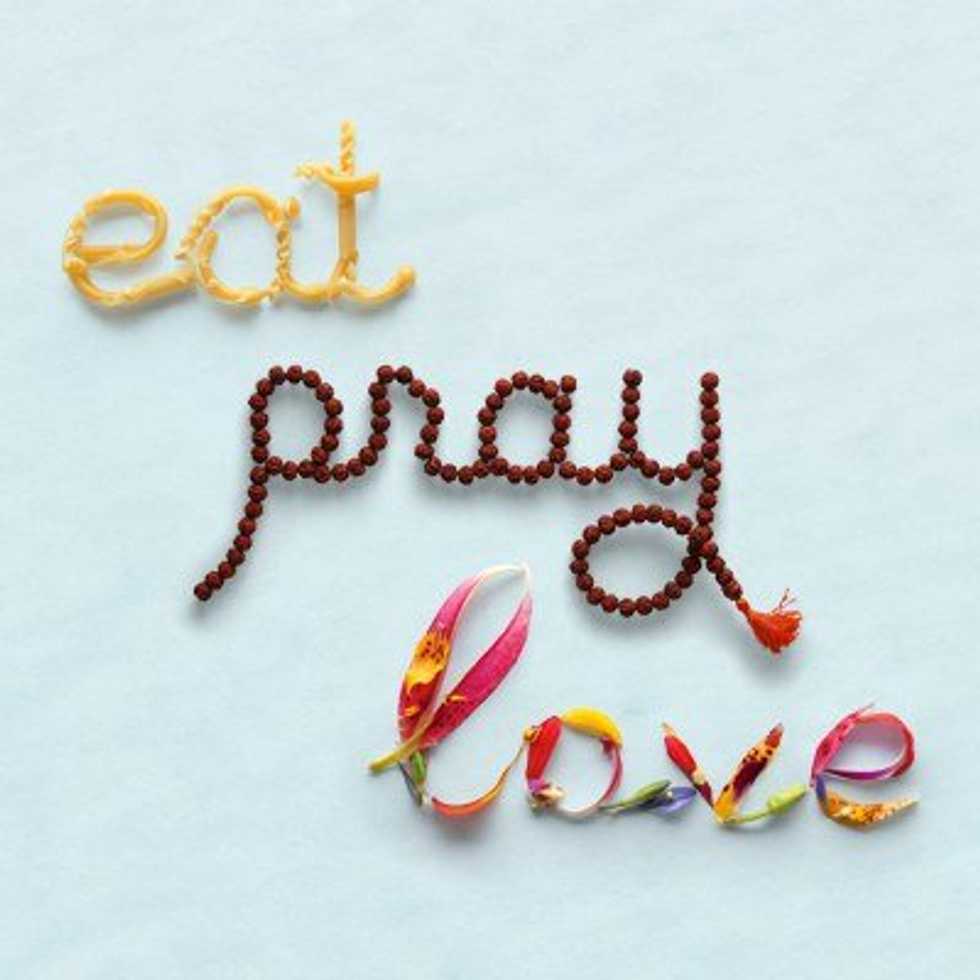
Eat. Pray Love.
Three words that take on a completely new meaning after reading Elizabeth Gilbert's memoir, or watching its movie adaptation.
As a young woman about to enter her early 20s, I have found myself in a constant struggle to maintain any shape or form of balance in my life. Recently, I found that my life tends to center around one concept, and that the weight of juggling more than one priority throws me for a loop. As a college student, my life is either completely dedicated to furthering my education, or it's a hectic mess of parties, all-nighters, and unwanted drama.
While this struggle to maintain balance already feels like a heavy, and sometimes lonesome burden to bear, adding the additional pressure of trying to figure out who you are, and what you want out of this life makes the journey even harder. However, readers see that this struggle is not one that is limited to a certain age group, it is an issue that can haunt even the most established adults. T
he truth of the matter is that trying to balance all that goes on in life, while also exploring your identity is a universal struggle that everyone, especially women, grapple with. I say especially women because unlike men, women have the added burden of defining themselves without solely referencing motherhood or wifely duties; society today still struggles with the concept that there is more to a woman than her marital and motherly duties.
The author, Elizabeth Gilbert, a woman who from the outside might have seemed as if she had it all, found herself no longer happy with the life she had once loved. In both the memoir and the movie, she states:
“The only thing more unthinkable than leaving was staying; the only thing more impossible than staying was leaving.”
It is in this moment of extreme anxiety and quiet desperation that Gilbert does something she has never really done before; she prays. Through this prayer and some thought she decides to make a terrifying jump into the unknown; the unknown being a search for her new self.
Gilbert spends a year abroad, traveling the world searching for ways to gain back the happiness she had so quickly lost. The memoir chronicles her time in Italy, India and Bali, where in each place she unearthed a new outlook and understanding about different qualities of life.
In Italy, she spent her time re-finding happiness in the little things in life. For Gilbert, Italy helped her to enjoy life, while teaching her that it's okay to spend your time eating delicious foods just because you want to; and that you don't need to worry about that pair of jeans that no longer fit.
In India, Gilbert spent time exploring her spirituality, outlook on life and learning that forgiveness begins with yourself:
"Waiting for [someone] to forgive you is a damn waste of time...Forgive yourself."
It is also in India that Gilbert realizes that no matter how hard you try, you can't control much of life, and that similarly to what F. Scott Fitzgerald said, you can either be a slave to your emotions or you can actively change and shape how you perceive things:
“You need to learn how to select your thoughts just the same way you select your clothes every day. This is a power you can cultivate. If you want to control things in your life so bad, work on the mind. That's the only thing you should be trying to control.”
Gilbert ended her year in Bali, where she searched for ways to create balance between enjoyment and spirituality. During her time in Bali she became close with Katut, a spiritual guru of sorts who helped her realize how to maintain a balanced life:
"To find the balance you want," Ketut spoke through his translator, "this is what you must become. You must keep your feet grounded so firmly on the earth that it's like you have four legs, instead of two. That way, you can stay in the world. But you must stop looking at the world through your head. You must look through your heart, instead. That way, you will know God.”
In addition to learning how to balance her life, during her time in Bali, Gilbert met a Brazilian businessman whom she falls in love with, and their relationship teaches her that in life, occasionally it is alright to lose balance for love.
Although Gilbert's journey ends with her being fully sure and confident of who she is, the memoir left me looking at my life wondering how I could achieve the same. While I do not know how and if my life will work out as beautifully as hers did, her memoir uncovered many new knowledge nuggets to me.
Gilbert's memoir is a must read for my fellow happy, free, confused and lonely 20-somethings because it taught me to embrace myself with love, to forgive myself for my past mistakes, to learn form my errors so that I may improve my path, to balance myself by planting my feet firmly on the ground. But most importantly it showed me that while everyone's journey is unique, we all struggle with the same burdens. It's a lesson that I found very comforting.

















