
I honestly have no problem with talking to people about race. I call people out for making comments I believe to be offensive or distasteful, and I promote the need for a conversation about racial issues. Other people actually bring up racial issues to me more often than I feel the normal person would be asked about it, and that’s probably due to me bringing it up often. My political views sit to the left, and I grew up in an area full of diversity. I’ve always tried to surround myself with more liberal thinking people so most of my conversations are about politics and social issues. However, most white people are afraid to talk about race for fear of being called a racist, or because they lack the interest and general knowledge about social issues affecting people of color. I believe if we, as a society, opened up the conversation to those not directly impacted by social barriers, we would benefit greatly from it.
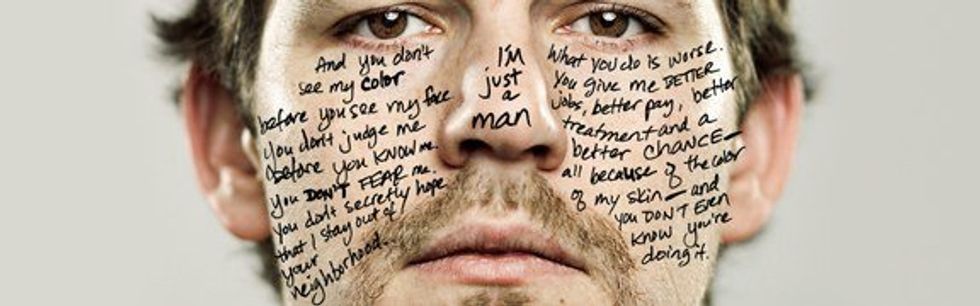
Two writers for the New York Times did start the conversation. A Conversation with White People by Blair Foster and Michele Stephenson is a five-minute documentary with a write up on the data found. Foster and Stephenson asked a group of white New Yorkers their opinion on racism, and if they thought that they were racist. The participants had generally optimistic views on racism, but the longer they talked, the more they realized the effects white privilege has on their lives. All of the participants discussed not feeling as if they had a racial identity. They were aware they were white, but it did not affect them in any way, at least not negatively. Foster and Stephenson were surprised that the participants had been living in a state of subtle racism. They concluded that most people don’t believe they are racist since they’re not flying Confederate flags. However, most participants found, and Foster and Stephenson agree, that racism occurs in the subtle things like not calling out others for making racists comments.
Like I mentioned before, I come from a very racially integrated neighborhood and there is, at least from what I’ve seen, only a small amount of racist attitudes. I thought that racism was a thing of the past because I had never seen it firsthand. When I began attending Drexel, I ran into a whole different type of white attitude from what I was used to. I realized that some people are racist and some whites refuse to acknowledge that fact. I actively discuss my political and social views and I’ve noticed white people are less likely to respond to my comments or they write them off as weird, liberal hippie views. (I’m not joking -- I get called a liberal hippie about once a week.)
The fact that I was lacking an intelligent conversation race and social justice led to searching the internet and I found the article I mentioned before. The most interesting part of it was not the article itself, but the comments people left. There seems to be two schools of thought employed in the comment section. The first group is angry that white people are always seen as the evil. They bring up a lot of black crime statistics as proof that African Americans are causing their own suffering. The other group acknowledges racism and commends the interviewees for talking about it. These people recognize dialogue as a healthy way to bring understanding between different races. Many commenters also brought up the fact that many white people feel uncomfortable talking about race because they don’t want to be seen as racist. Both groups comment on white privilege, but, again, the first group is angry and denies its existence while the second tries to define it and find ways to overcome it.
Eduardo Bonilla-Silva’s book, Racism with Racists, holds the perfect outline for analyzing the comments. The interviewees all admitted that they tend to overlook race, and one woman even admitted that she notices other’s racist comments, but does not speak out against them. One commentator said the following:
“I believe the difficulty white people have talking about race is that [there] is a disconnect between racist institutional barriers and individual racism. I like to think of myself as not being racist, but then in the news, it is "white people," which includes me, that perpetuate racism. Reconciling these too sides of the same coin is very difficult because of the inherent logical fallacy of component parts. Moreover, most white people like myself don't know other white people that are clearly racist and so it further complicates reconciling.”
Bonilla-Silva discusses how whites often see racism as an individual issue while blacks see it as institutionalized. The above comment exemplifies this theory. They don’t see themselves as racist or anyone they know as racist so it confuses them when whites as a whole are seen as racist. However, it’s not enough to say “some people are perpetuating racism.” As long as a white person is not actively trying to end racism and fight social injustice, they are playing into the institution. To quote something I heard a Black Lives Matter rally, “white silence is white consent.”
Bonilla-Silva also discusses the issue of individualized prejudice. This theory states that whites tend to judge people based on their moral character in relation to Anglo-Saxon tradition. People who fall into this category often blame blacks for not trying hard enough to overcome the difficulties of oppression. For example, a commentator concluded that:
“Black Americans could take a lesson from other oppressed peoples from other cultures and historical examples and take the steps they need to get their own house in order. To pretend that they don't need to do that is delusional and usually prompts cries of racism. But it's just a simple painful truth. Racism doesn't explain all the violent crime and fatherless children. In fact, there were far fewer fatherless children in 1920 then there are now. That's 60 years after the emancipation proclamation. Slavery doesn't explain everything.”
While this person did include facts, they ignored the bigger picture. There may or may not be more fatherless children now, but did they research why families are being taken apart? The institution of racism causes many bumps in the road for black families. Other commentators attempted to use facts to back up their thinking as well. Many commented on black-on-black crime statistics, but, again, they failed to provide the background for those facts. While black-on-black crime is an issue, it's much more complex than the average white person would think. Not only is it an issue the is deep rooted in the racial segregation of our nation, it is one that the black community actively tries to solve.
A lot of people brought up the fact that other groups have been oppressed and continue to thrive. One woman picked up on this and decided to leave her opinion:
“No one is asking whites to apologize for being white. Just empathize a little. If you look at the Confederate flag as a symbol of Southern "heritage pride," then feel free to fly it on your own property. If this were a flag of a swastika, it would have been taken down long ago. Don't ask blacks to "get over" the legacy of slavery, any more than you would ask the Jews to get over the Holocaust, or the Japanese to get over internment. Most blacks I know have succeeded in spite of their race.”
Bonilla-Silva introduces a perfect example of white people playing into this. He interviewed a man about his opinions on reparations for slavery and the man replied by saying that the Jews or the Japanese deserved reparations more than blacks did. His thinking was backed by the time frame in which those horrific circumstances occurred.
Bonilla-Silva goes on to argue that many whites agree that government assistance should be given to organizations and programs that are free of racial boundaries and not ones that specifically aid minorities. The woman who left the comment, while not saying that blacks need assistance, brought up how other oppressed groups are given sympathy for the crimes put against them. They are able to thrive because they aren’t constantly being told to be quiet about their sorrows. These other groups are treated in the opposite fashion that blacks are. African Americans are constantly reminded of their history and are put down when they attempt to speak out about it.
A few commentators focused on class issues:
“It would be better to talk about class rather than race. A poor white person and a poor black person have a lot in common even though they have different color skin. To pretend that all whites have the same problems and all people of color have the same problems is simply not true.”
Bonilla-Silva argues against this to some extent. He believes that while other factors may impact a person’s life, race is the largest. Even if someone were born in a low socioeconomic household, if they are white, they are more likely to employ the benefits of being white. This theory also holds true for other oppressed groups like women or the LGBT community. Again, this ties into the institution upholding Anglo-Saxon values.
I agree with this commentator to some extent, probably more than Bonilla-Silva does. There are so many factors that affect one’s life, and the media should bring attention to other groups who are suffering as well since social scientists have talked about class longer than they have talked about race (try Marx or Weber). However, most people who are economically disadvantaged are minorities so class and race are very much intertwined.
White privilege came up quite often in the comments. Perhaps the best definition given was the following:
“White Americans quickly become uncomfortable, or annoyed, or defensive, talking about race precisely because they have relatively little or no experience thinking of themselves, of having to think of themselves collectively, or having to deal with being thought of, or treated, collectively… Black Americans and other non-White Americans are compelled to think of themselves collectively, from an early age, because they are thought of collectively, and treated collectively, by White Americans. Black Americans and other non-White Americans learn to expect to be thought of collectively, and treated collectively, by White Americans.”
In the article by Bonilla-Silva, it struck me how often the people quoted referred to blacks as a whole, and to their own suffering as individual. While he didn’t explicitly state this fact, I feel as if it was implied in his writing. Oftentimes, when race comes into conversation, it’s a mix of the phrases “black people” and “but, I’m not racist.” There is an overwhelming sense of individual account for whites, but when it comes to minorities, they are grouped as a whole. It reminds me of a story my mother once told me in which a group of people were asked to describe how they see themselves. The first person, a white man, stood up and said “I am a person.” The second, a white woman, said “I am a woman.” The third, a black woman, said “I am an African American woman.” Privilege is about not feeling like you belong to a group. Oppression is feeling the burdens associated with a group you identify with.
I found it shocking just how many people made it into a white versus black disagreement. Only one commentator politely inquired about the New York Times interviewing people of different backgrounds. Everyone else who pointed it out made it clear that they thought the New York Times wanted to make all white people seem racist. They refused to have a calm and intelligent discussion. Instead they angrily used a lot of racial slurs and further negative language, said there cannot be a conversation because their views would just be shut down for not being politically correct, but of course, no one’s going to talk to you if you’re constantly belittling people and refuse to look into the issues enough to not sound ignorant.
The documentary and article made me realize just how little white people think about race. Everyone thinks racism is bad. Using race interchangeably with the word racism characterizes race as a bad thing, too. Since white people don’t want to branded as racists, they tend to ignore race altogether. When someone acts different from white culture, it brings up the topic of race and the cultural differences between each race which makes white people uncomfortable. Like a lot of the more positive comments, I believe a healthy dialogue will foster a better understanding of different cultures and bring them together in a way in which they can coexist. However, that dialogue cannot start until we all learn about the reason why things have become the way they are.