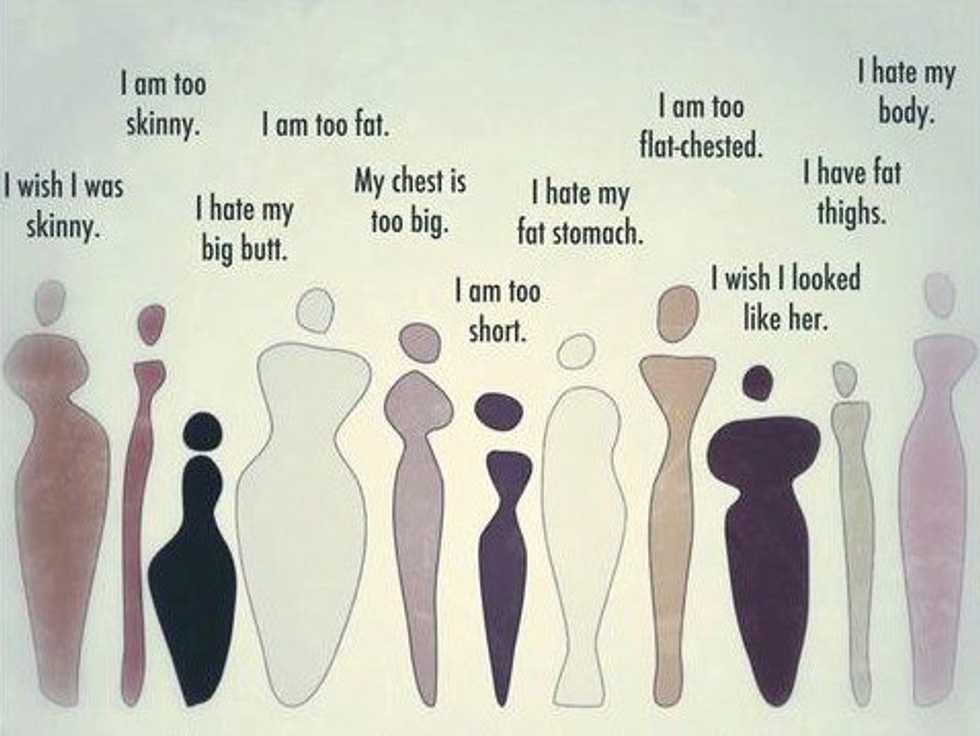
We here at Merrimack College are proud to announce that the first Love Your Body Week at Merrimack will be taking place next week. Beginning Monday, February 8th, the committee and I have planned out events for each day up until Friday, February 12th. We have events working in collaboration with MC Fit Rec, Active Minds, The Psychology Club, The Department of Communications Arts and Sciences, and The Writer’s House. Each event has been planned by a member of the student-led committee. With Love Your Body Week approaching, I wanted to write up a quick article about what exactly body shaming is and why it needs to stop.
According to bodyshaming.org, the definition of body shaming is “.. defined as inappropriate negative statements and attitudes toward another person's weight or size.” There is a multitude of evidence that this is a common, day to day activity taking place within conversations of friends. Mostly, it happens within teenage girls, but young men are also privy to body shaming. The interesting part is that the rates of body shaming yourself is typically higher with females, whereas the rate of body shaming others can be almost equal between males and females. It doesn't matter the gender of the person, because either way, body shaming is wrong. It's wrong to discriminate against anyone for any reason.
It's normal for us to feel out of place, out of shape, or feel like we just aren't good enough. However, these actions have been proven to lead to more unhealthy habits in the future. Specifically, it can lead to stress and weight gain. Yes, you read it correctly. By body shaming yourself repeatedly, it's been shown there's a connection between the act of shaming another and weight gain. On average, weight discrimination has been proven to lead to obesity. So, if you shame yourself for the body you are in, you’re more likely to become obese in the near future. The same goes for the people that are being discriminated against for their weight - embarrassing someone does not lead them to change. It actually boosts depression rates, there's cases of weight gain spiraling out of control, and these victims of body shaming have a higher mortality rate.
Girls will sit and complain about how they're gaining weight, how they're breaking out, how they're just not pretty. So much of a person's confidence levels relies on how comfortable they feel in their own body, and with their own outer appearance. As friends, we either try to build the person up, or start chiming in about our own insecurities. From there, it becomes a circle of unhealthiness and dissatisfaction within ourselves. Why we let things get this far, nobody will know.
The media and society has taught us how to put a strong emphasis on our physical appearances. This, in turn, creates more insecurities within a person because it teaches us at a young age that our physical appearance matters more than who we are on the inside. This is wrong, but it's been written off as the way of society for so long that it's difficult for anyone to believe otherwise. Discrimination and shaming someone else for any reason is wrong, and especially when it comes to things a person can develop an insecurity about. Our words make a lasting impression on others, whether we take account of it or not. Nobody should be unhappy with the body they are in, and nobody should be making others feel bad for what they look like.