
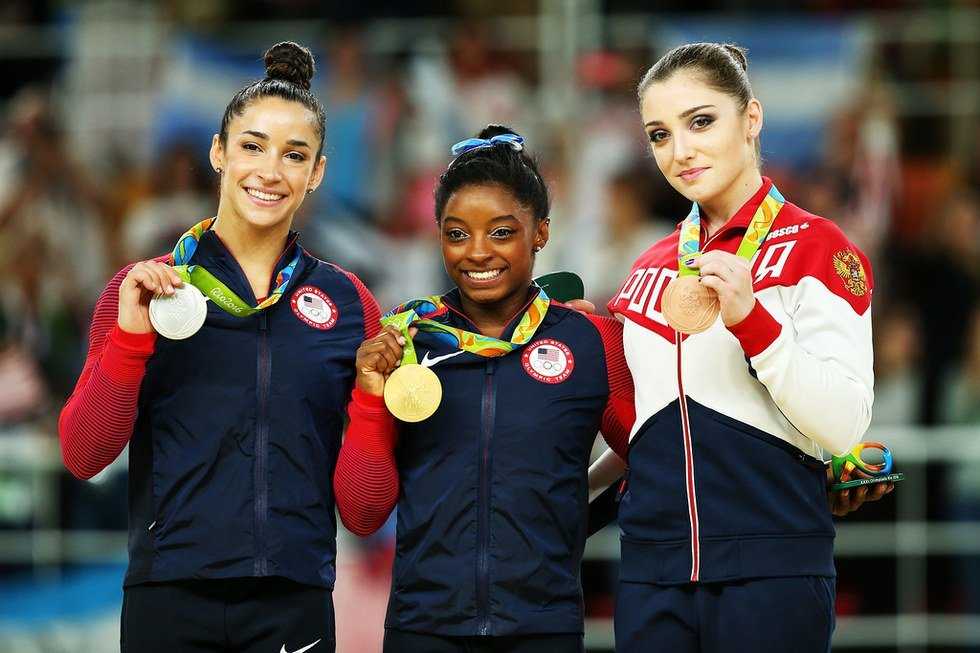
If you've vaguely followed women's gymnastics for at least two weeks every four years, you'll know that a stereotypical female gymnast usually appears in the form of a white, svelte, Romanian/Russian/Chinese girl who probably hasn't finished puberty but has the grace of a ballet dancer and flexibility of a Cirque de Soleil star. That was the frame of every girl who graced the Olympic podiums- before the turn of the 20th century. If you were to turn on your TV now, it would be filled with muscular, bouncy, multi-racial Americans who fly and tumble above the ground and stick it with a smile, knowing that a gold medal isn't too far off. Teams from China and Russia can only hope to compete for the next best spot. Romania didn't even qualify as a team in the 2016 Olympics.
Our nation usually prefers to relish in our wins rather than question them, but it is worth a moment's speculation: why is Team USA so consistently unbeatable?
Some might immediately give credit to superheros such as Gabby Douglas and Simone Biles, but the talent goes back further than that. American Carly Patterson won the women's all-around in 2004, and the Americans have not let go of the gold since then. This is mostly thanks to the leadership of Martha Karolyi, official coordinator of the Olympic Women's Gymnastics Team since 2001. She brought a no-nonsense coaching approach from Romania in the 80s, along with former Olympic coordinator and husband Bela Karolyi. Most in the gymnastics world solely credit her with America's sudden rise in the sport, her meticulous critique and national training programs giving her a wide variety of young girls of which she picks the cream of the crop to take under her wing.
There have been changes in the sport itself that Americans have embraced quicker than their European counterparts. Until the 21st century, gymnastics was scored under a 10 point system basely only on execution, meaning that everyone was scored out of 10 points, and if you executed your skill perfectly- whether it be a cartwheel or an Amanar- you could get a perfect 10. Instead of pushing gymnasts to the limits, this pushed them back, creating an environment of simplistic, graceful, soft acrobats that earned many perfect 10s.
The sport took a double backflip when a new scoring system was put into place: 10 points earned on execution, indefinite points added for difficulty of skills in the routine. So while a graceful cartwheel could earn a perfect 10, it could easily be beat out by an imperfect Amanar that could score up to 16.2.
Europeans still show remnants of the way the sport once was, including one too many ballet moves in routines that can only score up to 13.4, while Americans have fully embraced and engineered high scoring tumbling passes. Simone Biles could fall out of bounds twice and still earn a score higher than a 13.4 on one of her floor routines.
American dominance of women's gymnastics is partially right place, right time, but those in charge have strategically put themselves there. Embracing new strategy has served gym culture well, and Simone Biles' singlehanded power over competitors only comes as one example of how great the payoff is.