
Everyone knows Dr. Seuss for his nonsensical rhymes and distinctive cartoons. Children’s books like "The Cat in the Hat" and "Green Eggs and Ham" have made the eccentric author famous but most people don't know about the author's previous work during World War II.
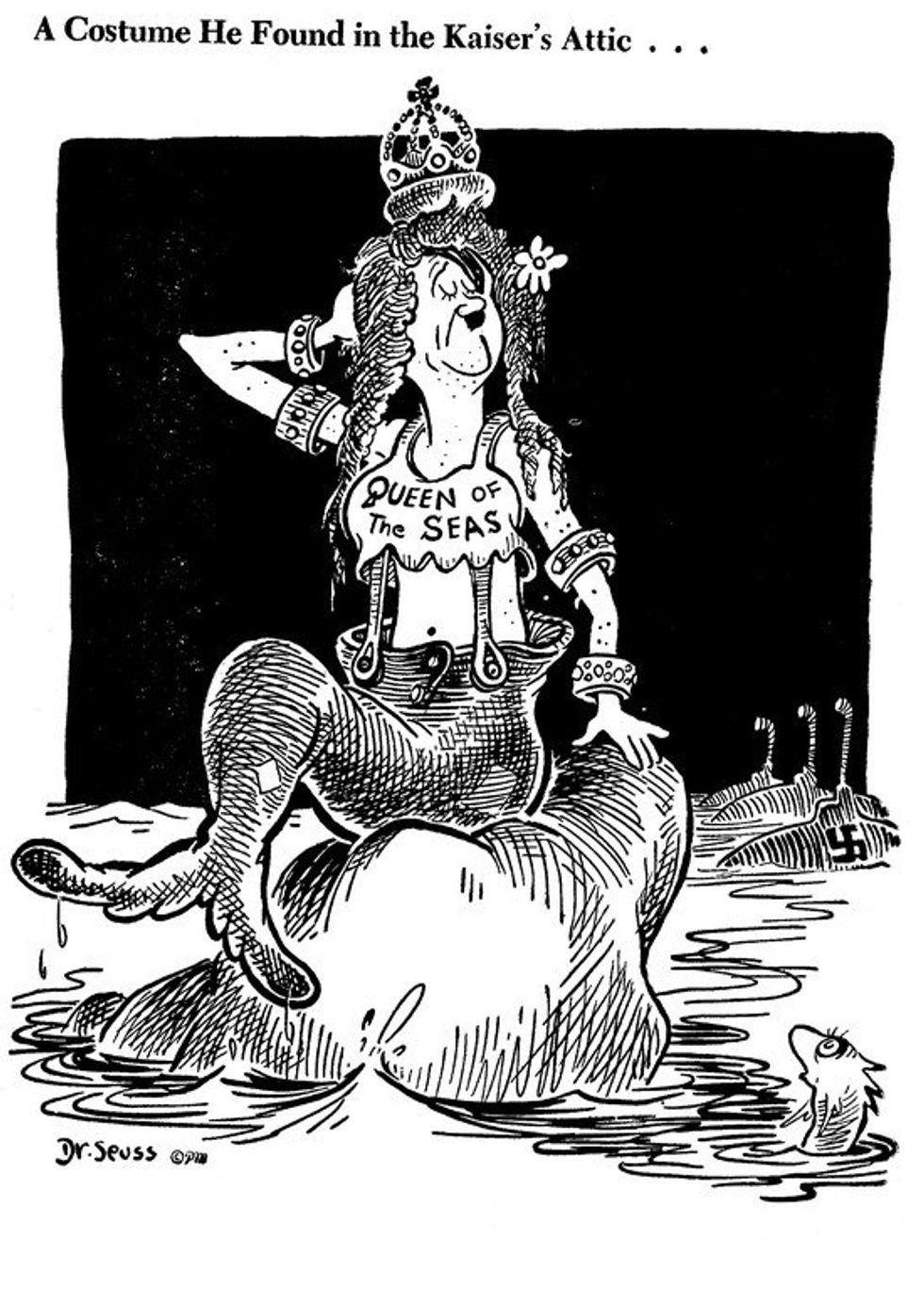
According to an excellent biography by Judith and Neil Morgan, Geisel worked for an obscure Democratic newspaper called "PM" during the beginning of the Second World War. He made political cartoons in his classic Seussian style. He held nothing back in his work, willing to call a Senator a horse’s ass and harshly depicted isolationists as idiots who were opening the door to the apocalypse. Even Hitler was not off limits for the cartoonist. In his cartoons, Hitler was depicted a naughty and cruel moron pulling silly pranks and going on mischievous adventures. In one cartoon, Hitler is a baby burning the foot of the stork delivering him. In another, he plays a doctor looking over the body of an ill-looking character representing Japan. And in another, Hitler dresses in a mermaid costume he found “in the Kaiser’s attic.” There were lot more of Hitler’s Seussian antics shattered throughout the pages of "PM" and you should see them for yourself. I'll bet that you won't be able to help but crack a smile or two while you wonder why did Dr. Seuss felt it was okay to portray one of history’s most evil mass murders with such cartoonish spirit
According to the book "Dr. Seuss to Goes War" by Richard H. Minear, in a 1980 interview, Dr. Seuss explained that he doesn’t “deal in tragedies” and that he tells kids who when faced with dark times to “forget it and move on to the next tragedy.” Dr. Seuss didn’t take Hitler seriously because he refused to look at dark subjects in that way. Instead he interpreted these things through the lens of fantasy and whimsy. “Fantasy,” he said, “is a necessary ingredient to living. It’s a way of looking at life through a distorted telescope, and that’s what makes you laugh at the terrible realities. Whimsy, which is a deliberate contradiction of reality, is pure escapism. And without whimsy, none of us can live.” In other words, Dr. Seuss no only believed that it was okay to poke fun at very not fun things, but also that it might be the main way we keep ourselves sane.
So where do we draw the line with this principle? Was Seth Macfarlane’s joke about the Lincoln assassination just an extension of that all necessary whimsy or was the awkward silence well-deserved? Was College Humor’s Stormtrooper’s 9/11 a healthy coping mechanism or was it completely insensitive and inappropriate? How far is too far? Or is anything too far? Whatever the case and whatever barriers need to be established, I think people should be less quick to attack the character of those who make jokes about tragic situations. Maybe they should be more sensitive but that doesn’t make them heartless. In fact, it may be that the tragedy hit them so profoundly that they have to make jokes just to cope with it. Or they could be just complete jerks. Beats me.