
As is oft-recycled, rhetoric is the art of ruling the minds of men; but it’s also a volatile substitute for real argument and conceptualization. I have long held that skill at oration is exclusive from skill at thinking, which is good. Hypothetically speaking, we should be able to rest assured that speaking skills are equally distributed among the wise and not-so-wise, and that, eventually, the truth will find a way of coming out. But this is dangerously naive on my part. What do we make of a case of what the judicial system calls a “concurrent opinion,” where the same conclusion is reached, but for different reasons? A great rhetor might diss declawing (which by the way is thoroughly skewered here) with stylish arguments to make Quintilian proud; but if he reaches his conclusion because he thinks claws are the tastiest part of stir-fried feline a la mode, we seem to have encountered a critical difference of opinion - they taste better roasted. Or if you prefer a more likely scenario, let me offer this: I’m in full support of detailed labelling of foodstuffs, only because people have a right to know what they’re eating. Yet people conflate food labeling with the separate issue of genetically modified food, a separate and complicated issue on which (short version) I stand pro-GMO. Never mind which side of the argument you or I stand on. If we disagree, our conversation and our debate have to reflect that, but rhetoric runs the risk of painting enemies and allies with the same brush.
Just as bad: what if rhetoric itself is the problem? What if it uses dubious, misleading, or flat out wrong info to turn people onto its side? Even if I agree, I want people fighting for the same cause as me because they’re all info’ed up. This, I feel, is even more rampant right now.
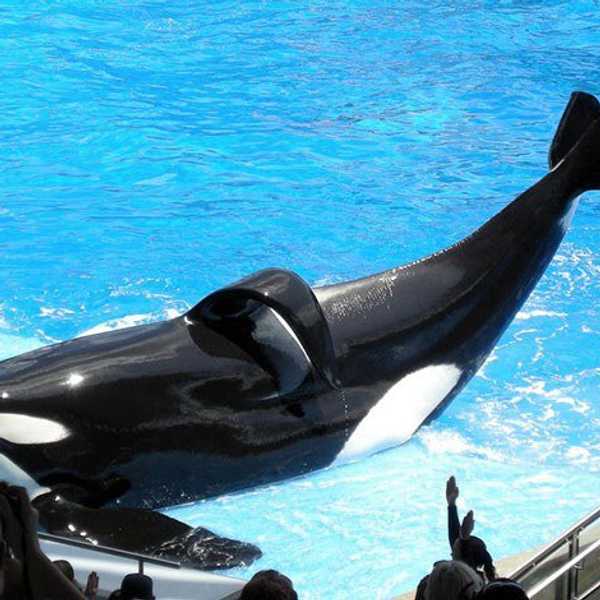
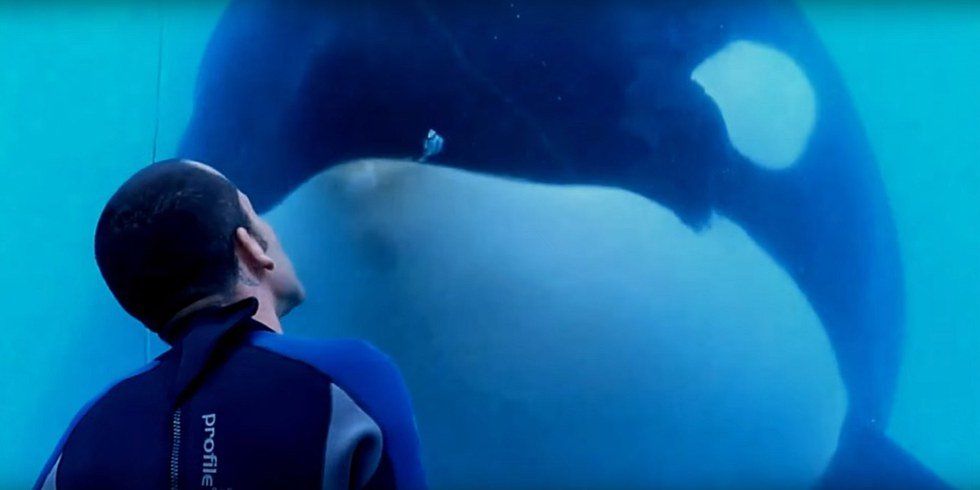
All of this, I hope, introduces the problem with Blackfish nicely. Blackfish was released in 2013, and it describes the illicit and oftentimes illegal acts of SeaWorld over thirty or so years. In short, they’ve neglected their whales, and abused whales lash out, and lash outs have killed people. Technically speaking, the movie is sound. It’s fine. The visuals are pleasing enough, the footage is edited acceptably, it’s dotted-i-crossed-t stuff. The actual content of the movie, though, is where things get troublesome, maybe even risky.
There are people who would call Blackfish a “reactionary” documentary (a criticism I’ve never understood in general - don’t things have a tendency to be reactions to other things?). This glazes over the real issue at hand: Blackfish’s arguments are almost entirely emotionally-driven. For people looking only for something to hold their interest, this might tie you over, even more so if you’re highly empathetic toward animals. The problem is that it uses emotional appeals as a substitute for logical claims. Sure, there are a few facts and figures jostled about, but a good way of determining the strength of an argument is to look at what it gives the most weight. For Blackfish, practically all of the argument is piloted by emotions, not facts, and this isn’t even a secret to its fans. One IMDb review, for instance, reads:
“While SeaWorld naturally refused to be interviewed, the films perspective mostly derives from former trainers/employees of SeaWorld and other various experts. Their experience working with Orcas - most having dedicated their lives to it - is truly heart breaking. […] I want to go through every point made by the movie but I won't. You need to see this for yourselves. The facts aren't what drive this film, the emotion behind them do.”
You see what I mean?
The documentary’s main point is that keeping whales captive is wrong. That makes logical enough sense. Wild animals, especially ones as large and as wide-roaming as orcas, need space, and captivity affords them anything but. The only defensible excuse for bothering to put on in a cage or a tank in the first place is for its own protection, or for the protection of its entire species. But it’s the way it supports this initial assumption that irks me, and that rots away at the stability of the movie’s entire argument. To me this is unacceptable from a purely qualitative standpoint. Even if the movie was enjoyable - which it isn’t, not really - its goal is not just to argue but to persuade, and not to make a point known but to explicate precisely why you have to accept it. Once you’ve done that, you have a responsibility to make sure your arguments are presented fairly and that those arguments are correct in the first place, and in Blackfish, they just aren’t.
Here’s where the movie goes astray: it doesn’t stop at “animals are living things, and it’s bad for living things for suffer, because we’re people and we hold empathy and their suffering makes us suffer a little, too.” It goes on to suggest that orcas are the most important, most majestic, most awe-inspiring animals ever to have graced the Earth, more or less, and that their exploitation isn’t just a minor negative vibe but a crime against God, the Universe, and all it entails. It’s fair to like killer whales, but to argue that they’re innately a spiritual being with which us silly mortals mettle with at our peril is pretty silly. We haven’t had any run-ins with frog, blood, boil or darkness plagues so far, have we?
Even the title of the movie promotes the idea that killer whales cannot be viewed as anything less than awe-inspiring creatures - the “blackfish” moniker is an Alaska native name for the animals, which they held in great esteem. I mean, I have nothing against orcas, but whether we think of them as yin-yangs with dorsal fins or the mammalian equivalent of sharks is arbitrary. (There are a handful reported incidences of wild whales disrupting or attacking people, whereas my research uncovered no cases of orcas healing the sick, opening chakras, or anything remarkable to any other established form of spiritualism. Technically speaking the scales should weigh in favor of the latter outlook.) There’s even a point in the movie where a clip from a trailer for the movie Orca, a mimic of Jaws that changes every little, gets used. Blackfish admits that the way we look at the orcas is our prerogative and subject to change, but the correct way is to see them as strong animals because… because that’s what Alaskans think, and Alaskans are statistically the most correct population on Earth.
The movie gets even worse than simply peddling a weak-but-ultimately-harmless ideology, though. To me the most objectionable part of the movie comes when it discusses the limbic system of orcas. As the movie details, MRI scans have shown that orcas have parts of the brain that other emotionally-advanced species, including humans, don’t have. Specifically the limbic system of an orca - which among other things regulates basic emotions like fear and happiness - is larger than that of a person’s. Apparently, this is all the scientific evidence needed to show that orcas are clearly more emotionally intelligent than people. Let’s apply a paragraph’s worth of scrutiny to this, though, and see how weak this reasoning is. I’m not an expert on the brain, but I know enough to say that a system in the brain - one with several functions, including controlling what drives an organism - isn’t “better” just because it’s bigger. This is why phrenology was debunked almost a century ago. We hardly understand what the limbic system does to people. How can we possibly make inferences about its effects on distant species? It’s the suggestion of the filmmakers that “higher emotional intelligence” means “getting even sadder than a person would,” but that’s not a found argument. Who’s to say that killer whales aren’t even more motivated than people? Or that a bigger limbic system is a vestigial evolutionary quirk that doesn’t help the species, like a neurological appendix.
The really sinister thing about this argument is that it’s equating human worth with that of an animal. Make no mistake about it: YOU ARE A HUMAN BEING. Your primary concern ought to be yourself, and after that other people. It is no accident that a common behavior expressed in outright sociopaths is placing more value on the lives on animals than on people. Certainly you are welcome to empathize with animals all you like, and certainly you are welcome to place them third on your list of priorities. As an animal lover myself, I understand completely the appeal animals hold. But to go so far as to imply that people are bad because they hold members of their own species above those of another - that this is a somehow selfish attribute - is crossing a line. A quick thought experiment: if an orca whale were given the opportunity to save you or an orca it had never interacted with before, which do you think it would choose? There is a fundamental difference between swallowing all the resources on a planet to no avail and using some of them for the gain of you and yours (in this instance, all of yours), in the same way that there is a difference between helping a member of your frat house move before you help the frat house next door.
Then there’s an interesting vein of hypocrisy that trails through the movie. Repeatedly, SeaWorld is condemned for its corporate practices, placing a great deal of weight on cutesy-cuddly Shamu to sell as much merchandise as possible. Obviously, as an upstanding citizen, I oppose corporatism, but we have to ask ourselves how SeaWord’s marketing is any different from that of Blackfish’s! Whether you see killer whales as majestic, adorable, or savage is up to you, but if it were really wrong to exploit any one of those outlooks for your own gain, it is surely equally wrong to exploit any of the others.
Blackfish also falls victim to another problem with rhetorical fetishism. Not all media is consumed equally, nor at equal rates. As a culture, we have chosen not to read, which means that for all its press releases, open letters, and record-resetting, SeaWorld might as well not bother writing anything giving its side of the story. Advertisements might be even worse, since any ads longer than 30 seconds are guaranteed to strain people’s attentions, and strain is the last thing anybody wants (most websites will even give you a chance to skip past them). What SeaWorld really needs is a ninety-minute documentary, released on Netflix, with an attractive, contemporary poster and a name that invites a just-right amount of the viewer’s curiosity (too much curiosity would mean that they’d have to exert themselves to find answers, and that won’t do; just-right means that not knowing becomes more unpleasant than the act of finding out).
I pray I’ve made it mind-rendingly clear the fragility of the eggshells I’m walking on. If not, let me reiterate: I despise what SeaWorld did to its animals and its people. I despise having to defend them on this, when a great body of evidence exists that, no really, animals as circus jesters are bad bad bad. But that’s ultimately what makes Blackfish an excellent study in the dangers of an enticing argument:. Let yourself get lured in and you’ve got only yourself to blame for your ensnarement.
Ultimately Blackfish is dangerous in both of the ways I outlined. Although it supports a correct position, it does so because orcas are somehow more valuable than human beings, and that we should promote their care above ours. The movie is right, but for the wrong reasons. And, although the movie supports the correct position, it does so by means of hypocritical fallacies and emotional exploitation. The movie is right, but in the wrong way.
Let’s close on two chestnuts that, as this case proves, need some serious rethinking:
“The ends always justify the means.”
“The enemy of my enemy is my friend”
Source on the IMDb review is here. The review is at the top of the page, by user "thejoshl." You can watch Blackfish on Netflix.