


Everyone knows Barbie: as kids, we brushed her hair and smoothed her clothes to get her ready for a different made-up event every five minutes. We played princess with her. For a short time during our early lives, we wanted to be like her -- or did we?
The original purpose for creating Barbie was to help ease girls through the most vicious stages of their development, which often comes with its own slew of sexist stigmas and expectations. Though the vision of Mattel (the company that produces Barbie) is vastly different today, there has been one constant throughout the many decades of Barbie: beauty. Each decade has produced a new variation of the impossibly thin, blonde beauty that every little girl learns to aspire to. Even worse, girls feel often restricted in their abilities due to some of Barbie’s coded messages; for one, Barbie has suggested that men are better off working in jobs concerning technology than women.
Adding to this, Barbie’s fixation on beauty gives rise to sexist undertones. That Barbie is always made up, with zero visible flaws only perpetuates the traditional belief that women are meant to constantly look perfect. If continuing to adhere to this sexist agenda, we are also expected to rear children, cook, clean, and exhaust ourselves -- yet, we are supposed to do so while looking as effortlessly put together as Beyoncé.
It is no surprise that the messages sent by Barbies are harmful. By the standards of Barbie, we have essentially taught young girls that beauty equates to white skin, blonde hair, blue eyes, and disproportional body measurements -- and also that that is the norm surrounding ideas of the typical American female. While almost 40 percent of Americans identify as a minority, it is clear that we are implanting false perceptions of reality into the minds of our young. As a result, many young girls end up eventually rejecting the warped ideals put forth by Barbie.
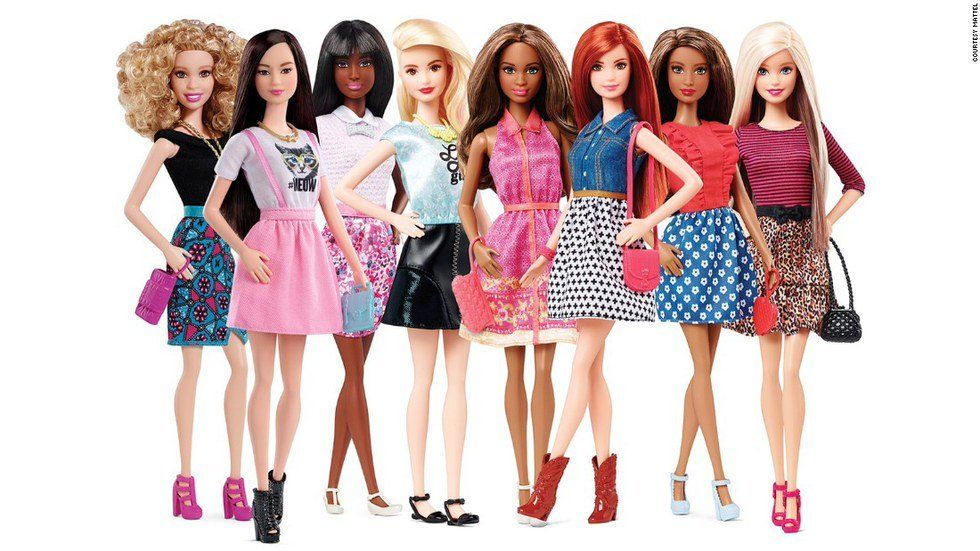
I know that as a five-year-old girl with brown skin, black hair, and glasses, I certainly could not identify with any of the Barbies presented to me during my childhood. However, Mattel has finally decided that they ought to sell Barbies with a little diversity: ones with curvier hips, diverse hairstyles, and varied skin tones. The motive for spackling variety into Barbie’s typical characteristics is questionable -- declines in Barbie’s popularity, coupled with recent discussions of virtually nonexistent minority representation are likely the driving forces behind Mattel’s decision. Even so, this does not diminish the new message being delivered to girls everywhere: You are beautiful enough, in your own skin. You do not have to look a certain way or conform to impossible standards in order to be acknowledged.
To remember the damages Barbie has created in practice, though, we must note that Barbie does not typically bolster confidence in young girls. As mentioned before, it is apparent that many young girls develop a false sense of reality from Barbie, which is followed by an outright rejection of the physical doll. These rejections may come in the form of somehow distorting, destroying, or dismantling the Barbie. This is alarming, and it suggests that the very core of Mattel’s values strike a cognitive dissonance with the small children who tend to absorb them.
This is a larger, deep-seated issue that needs to be addressed on a broad level, and I do not dismiss its importance. I take small joy in knowing that at least Mattel is moving in the right direction. I feel a little more confident that, someday, I can hand my son or daughter a Barbie knowing that it at least resembles them at least more than the former Barbies; maybe they will even identify a bit with the doll. But even if this is the case, Barbie is still far from being beyond reproach; instead of painting pounds of makeup onto her face, why not produce Barbies that are more true to the appearance of real humans? Real humans have what society interprets as imperfections: acne, bags beneath tired eyes, birthmarks, and more. It is not enough to just splash a darker shade of paint onto the doll.
To reach the minds of little girls in an optimally realistic way, we should strive to give them toys that make them feel empowered by the unique ingredients of their identities. If girls are taught that the only "beautiful" is the kind that teenage boys would rate a 10, they will hardly be able to develop the confidence they need to survive in a patriarchal world.
Let’s take steps to expand the imaginations of young girls -- not confine them.

















