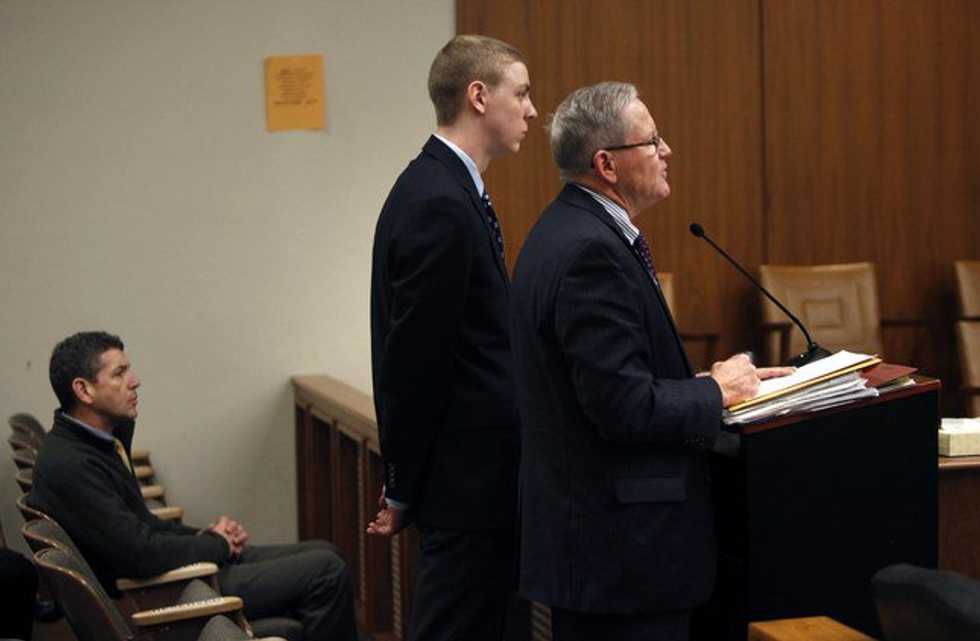
Brock Turner, a former student on a swimming scholarship at Stanford University, was convicted of three felony counts of sexual assault on March 30, 2016 after two bystanders discovered him raping an unconscious woman back in January. The sentencing in this case has been widely scrutinized as a slap on the wrist given that the maximum sentence is between 10 and 14 years behind bars. The prosecution cut the maximum sentence in half, aiming for six years, thinking that would be certainly justifiable.
On June 2, 2016, Turner was sentenced to a mere six months in a county jail, three years of probation and was also required to register as a sex offender. Not only is this a light sentence, but according to the Associated Press, Turner will only be required to serve three months of his six-month sentence, because inmates at the Santa Clara County jail are able to serve only 50 percent of their sentence if they keep a clean disciplinary record. So in a nutshell, after already receiving an incredibly mild sentence, Brock Turner now gets to walk free three months early. This almost entirely defeats the purpose of the justice system. According to the National Center for Victims of Crime, the criminal justice system is the set of agencies and processes established by governments to control crime and impose penalties on those who violate laws. Where is the justice for the young woman who was raped? Is serving three months in a county jail paired with probation really a fitting punishment in this case? No amount of punishment will truly be able to compensate for what he's done, but this sentence ensures that justice will never be served.
Judge Aaron Persky, identified by The Guardian as a Stanford alumnus himself, stated, "A prison sentence would have a severe impact on him. I think he will not be a danger to others." I wonder if Judge Persky considered the severity of the impact that the attack will have on the young woman for the rest of her life. It amazes me how quickly people are willing to completely undermine the physical and psychological effects that this will undeniably have on the victim, by instead focusing on how they should shelter the attacker from potential future discomfort. Simply put, who cares how the conviction or the sentence makes the violator feel? Brock Turner should have considered the repercussions of his actions before he violently assaulted someone. The court's duty is not to coddle the attacker, but to exact justice on behalf of the victim.
Turner's father wrote a letter that quickly gained media attention, advocating that his son should receive probation in lieu of jail time. According to the Washington Post, Turner's father said, "His life will never be the one that he dreamed about and worked so hard to achieve... That is a steep price to pay for 20 minutes of action." First of all, is it not awfully presumptuous to insist that Brock is entitled to an untarnished, prosperous future when there is a chance that he has taken away the possibility of that young woman having the same future? It is extremely damaging to sexual assault victims to have their voices so openly neglected, which is what clearly happened in this case. Not only does the previous statement detract from the hardships the victim now faces, the fact that this horrifying act was diluted from a rape to "20 minutes of action" by the attacker's father is absolutely disgusting. This comment proves that the attacker and his family refuse to believe that Brock participated in any wrongdoing, therefore, no real responsibility was taken.
Turner has stated numerous times that he consumed a significant amount of alcohol the night of the assault, as did the victim, and the encounter was consensual. I'm here to tell you, even if alcohol is involved, that does not determine whether or not the encounter was considered rape. In this case, the young woman was unconscious. Where was the consent? In no way, shape, or form does the fact that she was not awake to stop him translate to a "yes." The victim woke up in a hospital bed completely unaware of what had happened to her. She had to learn, along with the rest of the world, of the horrors she had undergone that night from an article she found online. At the bottom of the same article, the author included Turner's record-breaking swimming times, as if his extracurricular activities would somehow rectify the situation. Imagine you were her in this situation. How would you feel if you just found out why your clothes were stained with blood, why your body was bruised and why you woke up in a hospital bed, and just a few paragraphs down saw someone trying to vouch for your attacker's seemingly impressive record as if it was at all relevant? Every court ruling sets a precedent for future court cases of the same nature. Unless this case is later overturned, judges will be expected to look to this ruling for guidance in future rape cases. This is extremely frightening. Not only did the attacker's father write a letter, but the victim released a 12-page letter addressing her attacker. In the letter she said,
"The probation officer weighed the fact that he has
surrendered a hard-earned swimming scholarship. How fast Brock swims does not
lessen the severity of what happened to me, and should not lessen the severity
of his punishment. If a first-time offender from an underprivileged background
was accused of three felonies and displayed no accountability for his actions
other than drinking, what would his sentence be? The fact that Brock was an
athlete at a private university should not be seen as an entitlement to
leniency, but as an opportunity to send a message that sexual assault is
against the law regardless of social class."
She is right. Brock Turner's future has been deemed more valuable than her own by far too many important figures, including the judge who wrote this incident off as insignificant. Why is it that people in today's society have the audacity to question what the victim was wearing at the time of the incident, how much alcohol the victim consumed and other factors that have nothing to do with the fact that they were assaulted? Why is our first inclination to interrogate the victim rather than ask questions, such as, "Why did the attacker think he could rape an unconscious woman and come out of the situation completely unscathed?" Shouldn't the most pertinent question be in regard to the attacker and his own intentions, instead of what the victim might have done to provoke his actions? I'm tired of reading stories dealing with sexual assault that are geared towards blaming the one who suffers rather than questioning why the attacker made the conscious decision to violate that person. The law should not be subjective. The severity of someone's sentence should not rest on where they go to school, how prominent they are in their community or any other factor besides the fact that they committed a crime. Brock Turner holds a silver spoon, and that has been made abundantly clear through the negligently biased sentencing in this case.
The fact that Judge Persky handed Turner, a convicted rapist, a sentence that only required him to serve 1/12 of the sentence that the prosecution was fighting for shows how far our society is from adequately protecting the victims of sexual assault. This ruling is a major step back, not only to the victim of this particular case, but also to those who have yet to come forward because they are afraid of the scrutiny that they will undoubtedly face. This ruling sends a message that if you are assaulted, and there are even two witnesses to support what you've said, you will be questioned and your attacker will inevitably prevail. This case is just one example of why many victims of sexual crimes simply don't see the point of coming forward.
This needs to end. Victims of sexual assault should not have to be hesitant to come forward because there is a 50/50 chance that they can convince a courtroom that what happened to them was cause enough for action. When did we start chalking up cases that deal with sexual assault as simple negligence rather than calling them what they are? Let's stop treating the victims of sexual assault as the culprits, and start pointing our fingers toward the real perpetrators.