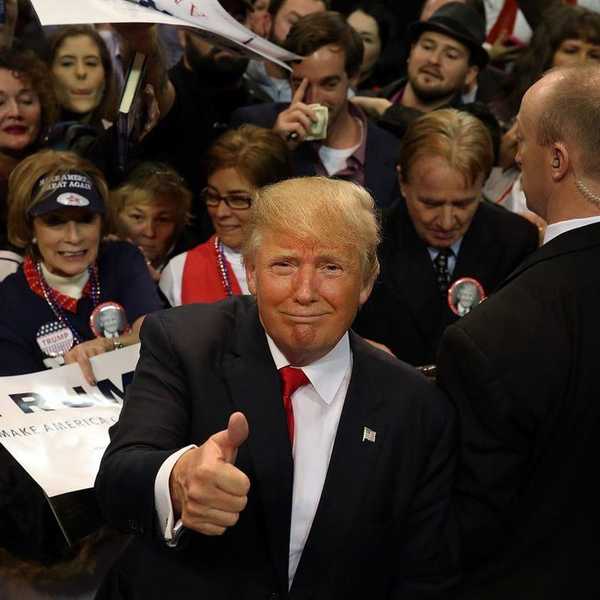


From the beginning of his tumultuous campaign for President of the United States of America, Donald Trump has projected one slogan over all others: "Make America Great Again", emblazoned in stark white text upon the now ubiquitous scarlet hats his supporters equip in shows of dogmatic conservative solidarity. This is a comfortable talking point for the candidate as well - he frequently wiggles his way from any given topic back to this central theme, promising that through his leadership, "we will start winning".His childlike rhetorical methods aside, it behooves us as concerned political citizens (and normal human beings, considering some of his radical authoritarian promises) to consider what "Make America Great Again" represents as the thesis of Trump's candidacy.
Let's start with a literal reading. The slogan bears three immediate assumptions: 1) The concept of 'greatness' is not merely an ideal, but a realizable goal, 2) America was at one point possessing of 'greatness', and 3) America is no longer possessing of 'greatness'. So far, these are familiar conservative platforms. The next step is determining exactly when greatness ceased to be in America's possession. Trump himself has been ambiguous about this, but has most consistently cited the presidency of Republican messiah-figure Ronald Reagan in the 1980s.
It is important to keep in mind that Trump isn't promising a realization of greatness. Most progressive Americans understand that the value of America as is one of potential, but Trump's slogan insinuates that America was in fact previously better then it is now. This means that whatever was going on during Ronald Reagan's presidency, in the eyes of Trump and his supporters, was unequivocally preferable to the state of things currently. Any other interpretation of the slogan would fail to fulfill all three of the points established above.
Trump's support base is statistically white, male, and working class. As it turns out, these are groups who also benefited (or imagined themselves benefited) by America's government during Reagan's presidency. An easy talking point for this burly swath of middle America is crime, which Reagan helped turn into a matter of race by leading the charge on minimum sentencing policies and the disastrous 'War on Drugs'. He was also firmly pro-life, campaigning against what he called "abortion on demand" (despite such a system being reasonably construed as a protected right under Roe v. Wade). He also opposed the Equal Rights Amendment, offering the incredible excuse that women were already adequately protected by the Fourteenth Amendment.
In other words, the America that Donald Trump promises to his supporters is one in which these very policies and perspectives are recreated. He doesn't simply want to return us to a human rights dark age, he and his supporters want to reverse the progress nearly thirty years have wrought on American society. We as a country have been largely consistent in holding him individually accountable for these views, but our criticism of the deplorable ideology championed by his supporters has been lacking. Consider the world a Trump supporter is consciously or even unconsciously pining to return to.
If there was ever a time to put aside our petty differences as progressives and work together, even briefly, for the greater good, it is now.