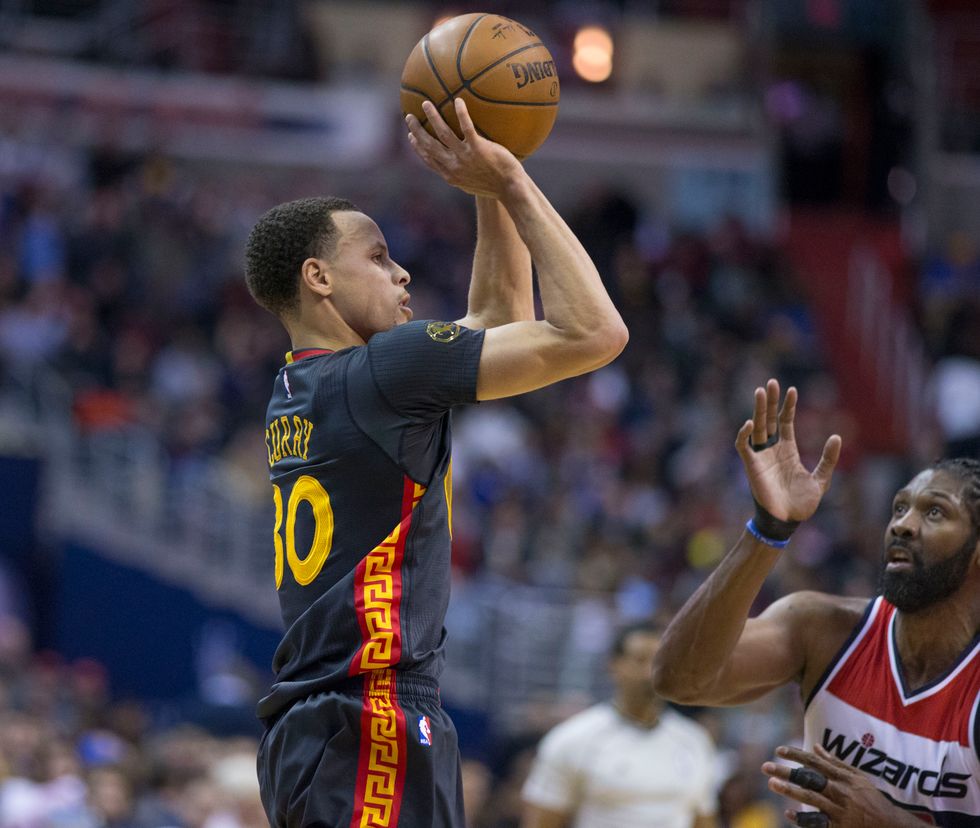
As a diehard fan of basketball, nothing gets my tootsies in a roll more than the phrase “Stephen Curry is one of the best shooters of all time.”
That sounds like a safe statement because it does justice to all the great shooters that came before him, but the underlying assumption behind it is that by being described as “one of the best shooters of all time” he isn’t “the best shooter of all time” because if that’s what the speaker was trying to say, he or she would have just said it. At the very least, the statement suggests there might be an argument.
Stephen Curry is the best shooter of all time.
It is not close.
Stephen Curry set the NBA record for three-pointers made in a season with 402 threes. The previous record was 286. That record was set by Stephen Curry. The record before that was 272. That record was set by Larry Bird. Just kidding, it was set by Stephen Curry. Additionally, in those three seasons ('13,'15,'16) in which he broke the NBA record for three-pointers made, he averaged 45% three-point shooting. The league average for those years averaged around 35%.
Undeniably, volume isn’t everything. The number of three-pointers shot in the NBA has skyrocketed for all players, but that is largely because it’s now a viable basketball strategy to hoist up threes, and that is because of one of the fundamental principles of any sport: over time, the players get better.
It used to be that shooting a three-pointer was usually a bad decision because there were so few players who could make them on an efficient basis. Intuitively, the futility of taking a shot from that far away for a measly extra point would make shooting them an unwise decision unless a player was ungodly good at making them. As time has gone on, basketball has seen a massive increase in players who are this stupidly good at making the shot, turning the three-pointer into a field goal attempt nearly as efficient as a layup.
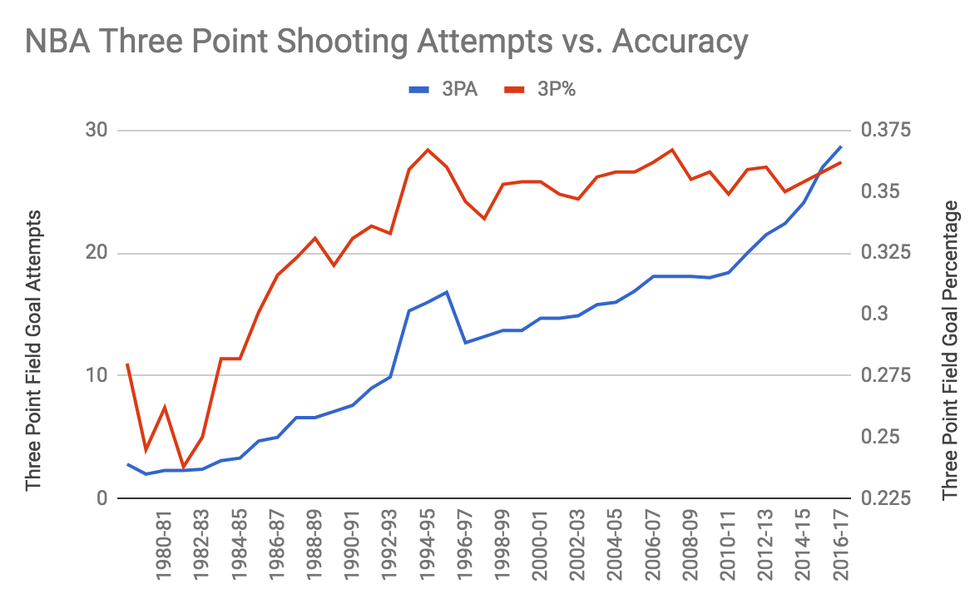
(Source: Basketball Reference)
On the barest grounds, take the case of Lebron James vs. Michael Jordan for greatest of all time. I’d argue that Lebron is a better passer, athlete, shooter, and overall basketball player than Jordan. However, even disregarding the metrics and the eye test, in the year Jordan was born, there were only 3.3 billion people on earth.
In addition, Jordan was drafted when only a small fraction of the NBA was born outside of the United States. When Lebron was born, the world’s population was 4.8 billion people, and when he was drafted, the NBA was drafting more foreign players.
Essentially, Lebron made it to the same league Jordan did and accomplished a comparable amount, but made it out of a significantly larger and thus more competitive pool of candidates. Lebron is doing what Jordan did against better players and against greater odds.
Along with the larger talent pool, sports training and knowledge has increased since Jordan. Players have been able to build muscle more effectively and efficiently. The technique behind shooting the perfect jump shot, and executing the perfect pick and roll have been studied and coaches across the globe had picked up on the advancements.
Watch any clip of basketball from the 1960s. The jump shot forms are slow, goofy, and inaccurate compared to what is seen in the modern NBA. Basketball is a science, and just as in engineering, and medicine, we simply know more now than we did ten years ago.
These are good things. It means that as fans, we are in all likelihood going to watch the career of the next “greatest player of all time” unfold more than one time. As the overall talent level of the league increases, so will the level of competition and the entertainment value of the sport.
The 90s weren’t the golden age of basketball, and neither were the 60s, the 80s, or even the early 2010s. The golden age of basketball is today, and in ten years from now, basketball fans will get to say the same thing. Get hyped.