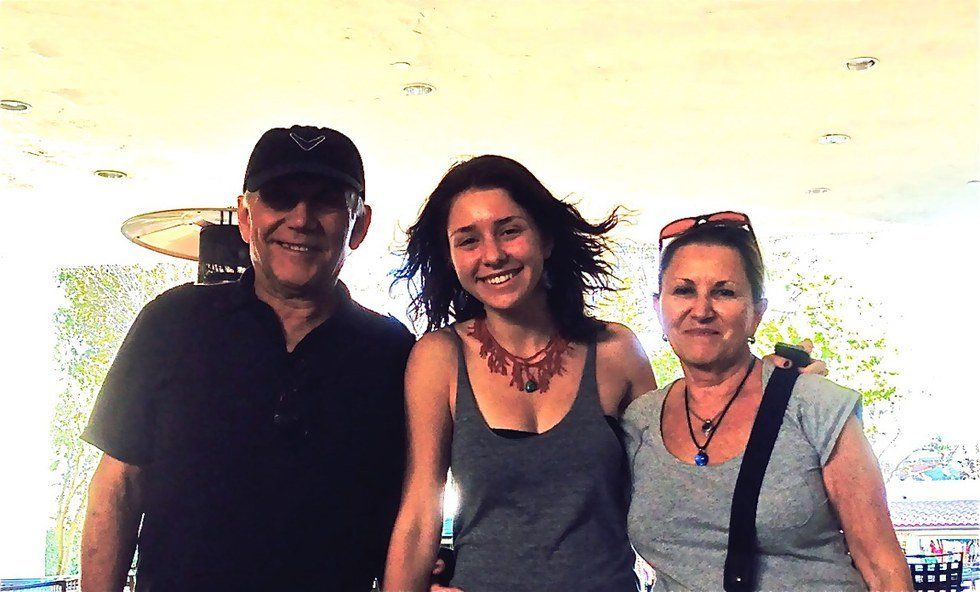
I recently had one of the best nights of my summer. In anticipation of my impending departure to New York City, I decided to spend some time with my grandparents at their house, an hour away from my own Los Angeles suburb. After wowing them by ordering our dinner at an Indian restaurant (hint: Punjabi in Manhattan has taught me everything I can claim to know), we settled down to watch a film similar to my own grandfather’s adolescence. "Baba Joon" is a 2015 Israeli film, now available on Netflix, about an Iranian-Israeli family and their turkey farm.
For those who have not seen it, it is a deeply complex and sincere look at family dynamics, whose plot revolves around the relationship between a loving yet strict father, (Baba means father or grandfather in Farsi), and his brilliant son Moti, who longs to escape from the family business. After watching the film with my own Baba, here is what I learned.
The main conflict in the film stems from the expectations that Moti’s father, Yitzhak, places on him. While, of course, Yitzhak wants Moti to have the best life possible, it is difficult to separate the concept of success from the family turkey farm business, which has allowed them — if not to prosper — at least to survive in this new land. This pressure is exacerbated by Yitzhak’s own Baba, a formerly successful turkey farmer in Iran who had to emigrate due to anti-Semitic persecution. Baba, while a sincerely loving grandfather, used force to have his two sons work in the farm and make it successful, although neither son enjoyed it. Yitzhak is therefore driven by the conflict between his desire for success and his memories of his childhood hardships.
My own grandfather dealt with similar struggles, as his parents and eight brothers and sisters emigrated from Iran to Israel. However, the lack of legacy in their chosen life as animal farmers and the large size of the family both led to a less relatively stressful life for my grandfather. While both families struggled to debeak poultry and survive in Israel, my grandfather looks back on his adolescence as a difficult but warm time in his life. Although he was expected to help his family prosper, he was never tied to the land as Yitzhak was, never forced into an occupation he wouldn't also find happiness in. While my grandfather empathized with how necessary the chores are that Yitzhak tried to force Moti to do, he also empathized with the boy who shied away from hurting the turkeys in any way.
Yet, life as a new Israeli immigrant was difficult in other ways for my grandfather. In the fifties and sixties, their rural kibbutz, or communal farm, had no running water, electricity, or plumbing. The only thing keeping his family alive and prosperous was their tremendous hard work, a lesson that has followed my grandfather throughout his life. I once asked him, “If you could have had any job, what would you have wanted to be?” Instead of saying artist, director, or pilot, responses I think of as typical, he only said, “Anything that would have helped my family be healthy and happy together, anything that would have let me provide for them.”
I have never heard an answer like that before, and while it is not necessarily true that others I have asked the same question of, millennials who were born and raised in America, are more inherently selfish or lazy than people in my grandparents’ generation, it is true that perhaps individual success has become more important or more valued than group success. Very few of my friends have had to quickly evacuate one country, only to have to start fresh in a new country with a forbidding landscape and with a lot of hard work ahead of them. In contrast, my friends and I have grown up in states of relative stability, going to school and doing chores, but only rarely or in limited manners helping our parents with the family business.
As we grow up, we are encouraged to follow our own dreams,and to succeed on our own terms. And this is beautiful, an incredible privilege to be given, especially when our own immediate ancestors have had to work so hard to give it to us. In the end, I, too, empathize with Moti. The movie leaves him on his own precipice, ready to forge his own type of future — immediately away from family, yet still inherently intertwined.