


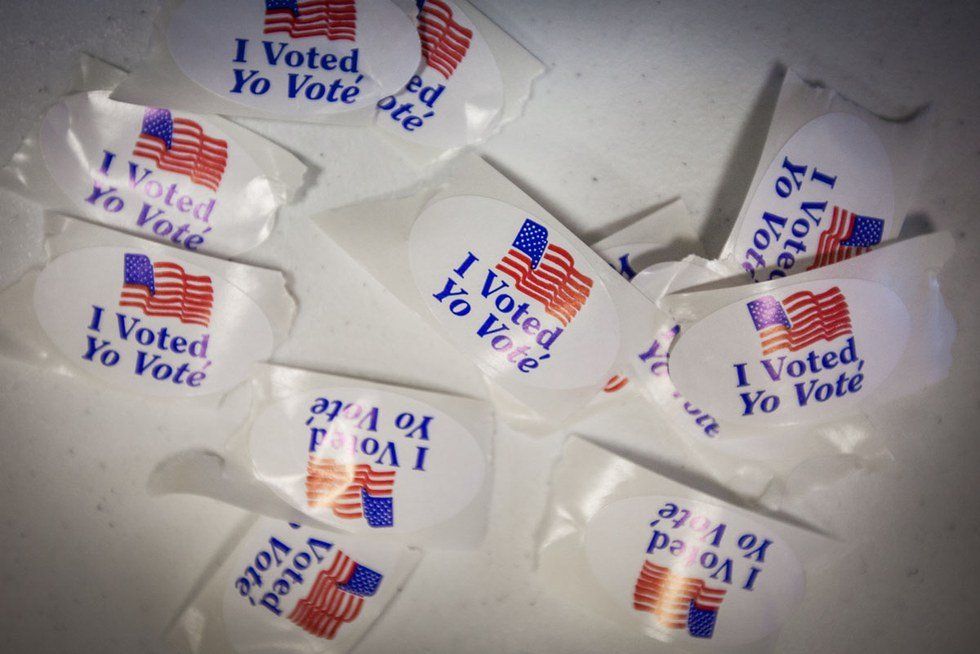
There are two stickers on my laptop and each one says “I voted - I made freedom count”. I often find myself rolling my eyes at that phrase. How valid is it, really?
One of the many reasons people give for choosing not to vote is that our democracy is a highly flawed one -- we don’t have any real choice in a two-party system, and the votes of the people hardly even matter. So is that really making freedom count?There are other reasons for not voting as well. Some people believe their one vote won’t make a difference. Other Americans don’t like any of the candidates, and would prefer not to have to choose between the lesser of many evils or vote for someone they do not even support. I can relate to the cynicism and disillusionment that often emerges during election years - the sentiment that corporations or special interests control the government, and every candidate will simply be a puppet to those controlling forces, not making any real change (a watered-down version of a complex ideology, but that is one version of the general idea).
Despite the above reasons, I still believe that voting is important. It is easy to brush it off as pointless, but especially in a year like this, everyone should vote. Even if you don’t vote in your state’s primary or caucus, I implore you to vote in the general election on November 8th. Some people, unfortunately, genuinely lack access to the polls. Others may truly believe no candidate will help them. I can’t make anyone do anything, but consider that there might be someone else that could be helped by your vote.
A vote between, say, a Democrat and a Republican could be the difference between easy access to abortion and the restriction of reproductive rights. It could be the difference between a liberal and a conservative Supreme Court justice appointee. It could be a vote condemning outwardly racist rhetoric in campaigns.
As we all know, Donald Trump is well on his way to winning the Republican nomination. For many, including myself, this election has mostly become about preventing Trump (or any Republican, really) from becoming president. The voices against him are strong: on Friday, a Trump rally in Chicago was cancelled due to a high number of protesters and subsequent safety concerns. (This shows that forms of political engagement other than voting, such as protests, can also be effective!) When it comes to the general election, it will require lots and lots of people not voting for Trump (or Cruz for that matter, since he’s just as terrible, if not worse).
Along with people who don’t plan to vote at all, there are a number of Bernie Sanders supporters who have claimed “Bernie or bust”: that is to say, they’ll either vote for Bernie Sanders or not at all. I find this somewhat understandable, but mostly ridiculous. Even if the thought of casting a vote for Hillary Clinton makes you shudder, the prospect of Donald Trump being president should scare you more.
If Trump becomes president, it won’t matter if his proposed ban against Muslims isn’t approved by Congress, or if his great wall doesn’t end up being built. What will matter is the fact that the legions of Americans who supported him for those reasons will not be condemned, and the message will be sent out that the foundation of racism that the U.S. was built on is allowed to live on.
In conclusion: voting is not mandatory, nor do I think it should be. All the arguments against voting make a fair amount of sense. But the reasons for voting, especially in a year like this, will hopefully be enough to convince every eligible citizen.

















