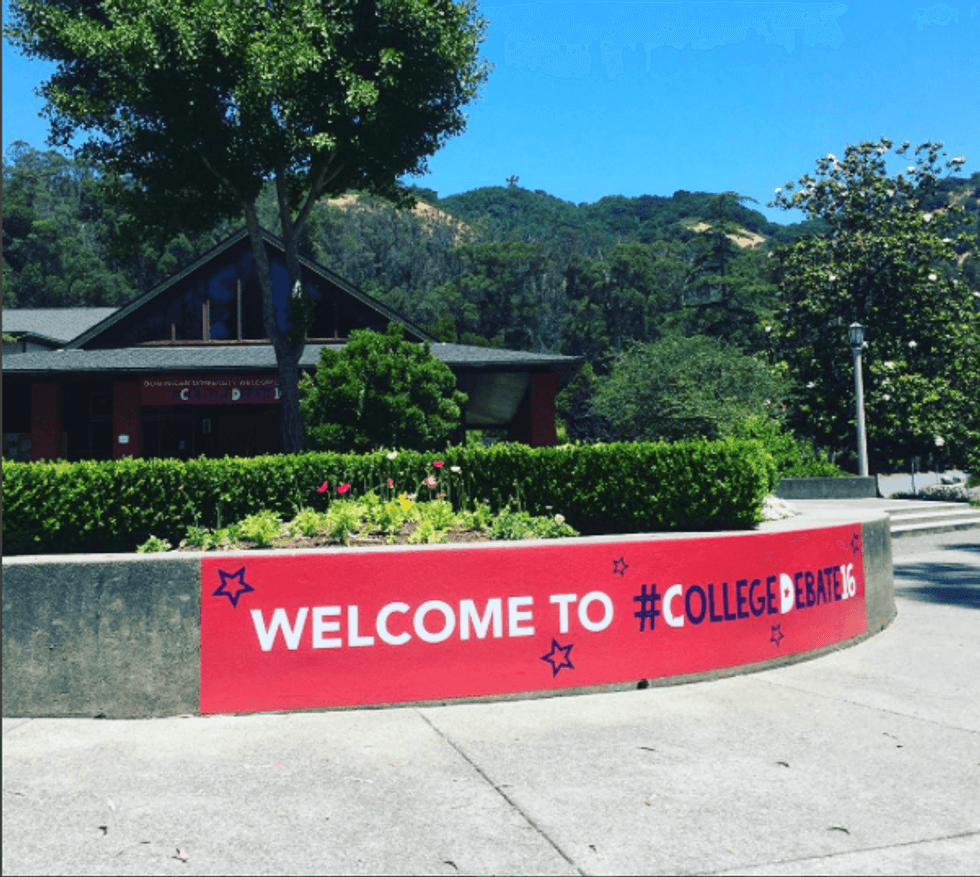
Last week I had the pleasure of joining a group of over 130 delegates to College Debate 2016, which was hosted at Dominican University in San Rafael, CA. On arriving, I was still rather unclear as to the reason I was there. What were the goals of this—for want of a better word—conference? How were the participating colleges and universities chosen? What were we going to learn here?
Truth be told, I still don't have the answers to all of these, but it was an incredibly valuable experience nonetheless for one main reason — The unstructured time between speakers and working sessions, turned out to be the perfect breeding space to produce organically formed conversations between college students who were passionate about politics. We were delighted to suddenly find ourselves in a space where everyone else was equally as passionate (crazy?) about the importance of politics. Personally, an unexpected surprise was that due to the diversity of delegates, I found it wonderful speaking to a number of people whose political ideologies were quite different from mine.
Normally, in a situation where someone disagrees with me, I am inclined to go on the attack, to denounce their views as misguided and morally unsound. Rarely do I take the time to understand their opinion, and why it is held so dear. In this environment however, I challenged myself to not take an offensive position, but rather ask to ask questions to delve deeper into the reasoning that had led a conclusion I so completely disavowed.
As it happened, this act of really listening, and not simply allowing a cascade of words to wash over one’s ears was the subject of the first speaker. Julie Winokur, the director of the film "Bring it to the Table," discussed the difficulties of being able to find the truths in other people’s opinions. She highlighted the need to be able to have a civil conversation and not a verbal war. This idea of the importance of civility was repeated by nearly all of the other speakers. Dr. Syb Brown, a professor at Belmont University and a journalist, centered her presentation around this notion, saying “Civility is a conversation, it’s an open mind.” and that “The spirit of civility has to survive.”
Despite the fact that I believe most people are aware of this, and that most of us present, if asked, would have said we were in favor of civil discourse among ourselves and our peers who may hold different beliefs from us, I doubt many of us engage in this. Instead we find ourselves reverting back to the easy form of argument—the kind that is done in raised voices, and allows us to go deaf to the shouts of our opponents. I think we were all forced to confront this reality as we listened to these lectures and entered into conversation between ourselves.
The effect of this new attitude was astounding. I myself had several discussions about women’s rights, immigration, and the environment. In every instance, I was coming from what one may call a “liberal” point of view, and debating with those not of that frame of mind. It took a decent amount of effort to not yell angrily, especially as one man insisted that he thought women to be superior, and for that reason, they needed to be protected from the harsh parts of the world, and defended his position by saying “I was raised this way.” But I didn’t attack, instead I listened, and I tried to understand what made him think this way, while at the same time suggesting that women do not want to be held in higher esteem, and that this “protector” view was in fact keeping us at a level in society below our male counterparts.
As it happens, something about his conversation with that group of us (all women), and most likely listening to some of the presenters, must have had some profound effect on him, because he announced to the assembled group of delegates that he had had this conversation, and had changed his stance on the matter. He even made the effort to come let me and my newly made acquaintance know personally that this change in his outlook had occurred. By listening to him, I opened him up to listening to me.
After speaking with other delegates, I think many of us agree that it was these exchanges that made this conference the most worthwhile. This was not I think, the immediate goal of the event, but I think it was one of the most important. As we return to our respective campuses in the fall, with the aim of getting as many of our peers to get themselves to the voting booths come November, we can take this other lesson as well. That listening, and that real conversation, has the power to change minds. That understanding another’s point of view is essential in civil discourse, and that it is a valuable tool in our fight for change. If there is one thing we all agreed on, it was that everyone wants what is best, our only disagreement lies in how we define what is best.