
F. Scott Fitzgerald’s "The Great Gatsby" is first and foremost a commentary on the “Jazz Age”— as anyone who has taken an 11th grade English course is aware. It is the novel’s ability to capture the mood and identity of the period, including its scathing criticism of the state of the American Dream, which earns it a place amongst the “Great American Novels.” Yet unlike other period pieces, the novel remains eternally relevant and popular; there’s just something more to it. For some reason, Gatsby appears to be even greater and ever more “American” than the other Great American Novels. But why is this the case? It is, in one’s view, because of the skill with which Fitzgerald was able to capture the essence of a philosophical divide that dates back to the inception of America. "The Great Gatsby" is not simply a critique of the decadence and depravity of the Roaring ‘20s, but also serves as an obituary for the Jeffersonian ideal— a vision that generations of Americans have sought to fulfill, even unto this day.
Jeffersonianism, as one can surmise, takes its name from Thomas Jefferson, and is the offshoot of classical republicanism, an ideology espoused by Jefferson, James Madison, and Benjamin Franklin, among others. At the core of classical republicanism is the belief that a society develops in stages, and it is during a nation’s agrarian, “adolescent” stage in which it is healthiest. The Jeffersonians believed that an agrarian society was best suited to maintaining the virtue of a republic, for it would consist of small landowners— yeoman farmers and craftsmen— ensuring a relative degree of independence and equality amongst the citizenry; even the poorest families would be able to produce all “necessaries” within the home. Classical republicans also championed the idea of a “natural aristocracy”— a nobility not of birth, but of ability; those who show themselves most able to govern would be selected to rule by their peers. A classical republic was to be a meritocracy in the purest sense.
A nation would be best able to survive in such a state as long as it remained small and agrarian. Overpopulation would result in industrialization and modernization— the excess people would require employment through manufactures which would produce “luxuries” as opposed to “necessaries”; industrialization would result in exploitation, and poverty, and would inevitably result in the death of a country as it progressed through the “old age” of its latter stage.
Jeffersonians believed that by encouraging free trade— to dispose of surplus agricultural yields— and by utilizing the vast frontier as a “safety valve” for any overpopulated localities, they could prevent the country’s progression into “old age,” corruption, and dependency. They sought to expand across space in order to “conquer time.”
The Hamiltonian ideology, however, painted a stark contrast to the Jeffersonian fantasy. Alexander Hamilton embraced all that his opponents deemed “corrupt.” He did not think the progression of a nation into a latter stage of society was evil; quite to the contrary, Hamilton believed that the modernization of a nation would lead it to become more cultured. He shunned the idea of a “Natural Aristocracy,” and instead believed that the nation would be best served if ruled by an elite class. Hamilton crafted his economic policy with the aim of cultivating this echelon of American nobles and to grow the power of those who would serve the government’s interest, proposing government subsidization of manufactures, a National Bank, and strong ties to British capital markets.
In brief (I would encourage anyone with an interest in the period to read Drew McCoy’s "The Elusive Republic"), Jefferson’s declining popularity in the Washington administration led to the bulk of Hamilton’s policies being adopted. Hamilton’s vision, however, would crumble with the demise of the Federalist Party, as republicans took over the government beginning with the Jefferson administration. The infant United States enjoyed a great deal of prosperity and it seemed to Jefferson and Madison that perhaps their dream of a “Christian Sparta” was within their reach; yet, their elusive classical republic existed for only a single, transitory moment before the War of 1812 convinced young politicians that the country had to be moved in a neo-Hamiltonian direction— although the Jeffersonian ideals of equality and agrarianism would not fade from the public consciousness entirely.
But what does any of this have to do with "The Great Gatsby?"
James Gatz was the child of yeoman farmers from North Dakota, but he possessed a “Platonic conception of himself. He was a son of God.” Gatz was a dreamer of unparalleled scope and proved himself a hard worker— following Gatz’s death, his father shows Nick Carraway a set of resolves and a daily schedule that his son had written within an old copy of Hop-along Cassidy. He was, as the elder Gatz says, “bound to get ahead.” Gatz ran away and christened himself Jay Gatsby, and it seemed as though all his endeavors ended in triumph: “If personality is an unbroken series of successful gestures, then there was something gorgeous about him.” Gatsby was a fine country gentleman of distinguished ability; in other words, he was the quintessential Jeffersonian, a true “natural aristocrat.”
Gatsby’s potential was limited only by the confines of his imagination— until he met Daisy Buchanan and “forever wed his unutterable vision to her perishable breath.” From then on, “his mind would never romp again like the mind of God.” Jay Gatsby sought, after that moment, to only realize his dreams through Daisy Buchanan.
But the problem with Gatsby’s romantic quest was that Daisy was simply incompatible with his vision. She was from old money; she had done nothing to earn her success or prestige; she represented a rich, luxurious lifestyle which Gatsby had never known— although the corruption ensnared him immediately. Daisy— as well as Tom and Jordan— was the archetypical member of the ruling elite that Hamilton had so hoped to cultivate. She was unvirtuous, “careless,” and consumed Gatsby’s dreams— and that ultimately proved fatal; Gatsby was murdered by George Wilson, as a result of Daisy’s actions. The Jeffersonian proved ill-suited to living in a Hamiltonian world.
As the tragedy comes to a close, we are left with Fitzgerald, through his narrator Nick Carraway, ruminating on what it all means, on the “elusive rhythm, a fragment of lost words, that I had heard somewhere a long time ago.” Nick notes that they were all westerners come eastward: Nick, for success; Gatsby, for Daisy, Daisy, for purpose; Tom, for “the dramatic turbulence of some irrecoverable football game.” But why had they come east? Because the midwest of the agrarian past was gone; upon analyzing census data, Frederick Jackson Turner declared the frontier closed in 1893. The frontier had always been a hotbed of egalitarianism and democratic pressures, for most who had settled the vast expanse had come from nothing in the east. Fitzgerald was obsessed with the closure of the frontier, and his initial concept of a third novel— which would later become Gatsby— was initially set in 1885 New York, just before the frontier’s closure; he wished to explore what would happen to American society without its “safety valve,” although soon decided that the time period for his novel felt wrong. The story had to be set a sufficient time after the phenomenon.
And so Nick explains at the end of the summer of 1922, his Middle West was “not the wheat or the prairies or the lost Swede towns, but the thrilling returning trains of my youth, and the street lamps and sleigh bells in the frosty dark and the shadows of holly wreaths thrown by lighted windows on the snow;" it was nothing like the “agrarian myth” that had so long been perpetuated. Only Gatsby, the son of a yeoman farmer, had any connection to the old Jeffersonian world.
While the frontier had closed in 1890, it was not until a full generation had grown in this new chapter of history that the changes in the American character were perceived— the country had grown “distinctively modern” by the time World War I ended. With the Great War came the end of the “first great era of American civilization;” and it is no coincidence that Gatsby’s first affair with Daisy ends with his deployment to Europe. The Jeffersonian vision was no more.
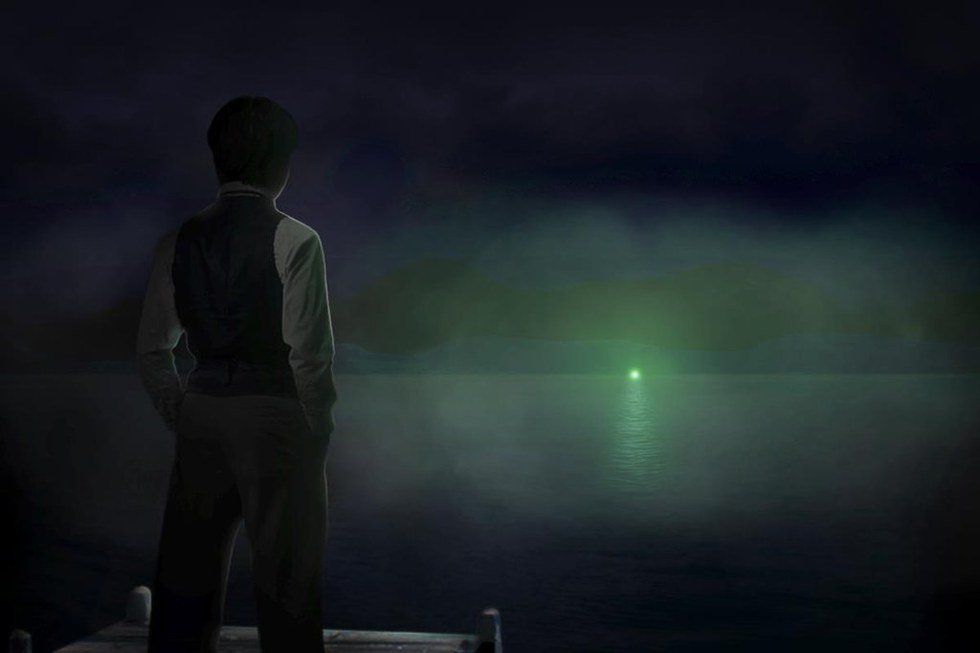
Yet still Gatsby held on to hope, and for a brief time had won Daisy back. So why had he failed? Because his dream was “already behind him, somewhere back in that vast obscurity beyond the city, where the dark fields of the republic rolled on under the night.” Once again, Fitzgerald hammers home that the sun had set on the agrarian past, and it was Gatsby’s refusal to let go that led to his ultimate demise.
By the end of his life, Jefferson had come to see his former followers abandon him for neo-Hamilton National Republicans. His “Empire of Liberty” had proved to be nothing more than a chimera, although his dream, like Gatsby’s, “must have seemed so close that he could hardly fail to grasp it.” Although his dream persisted until the closure of the frontier, Jefferson’s vision would never fully materialize, and it is this ideal America that Fitzgerald mourns for in "The Great Gatsby." When the novel was written, Wall Street was booming and American manufactures were bustling, but the frontier was no more; it was Alexander Hamilton’s final triumph, the victory of time over space.
Yet Americans today still cling to remnants of the past; while any idea of an agrarian republic is gone, Americans still hold aspirations for a reformed society that brings about greater prosperity, personal independence, and equality. "The Great Gatsby" remains significant because it serves as a requiem for what America ought to have been, “the last and greatest of all human dreams.” And despite Fitzgerald’s melancholic nature, it incites in its readers the awe that the Dutch sailors once felt when first setting eyes on the new continent. Perhaps we cannot repeat the past, but maybe, just maybe, we can recreate it. “And so we beat on, boats against the current, borne back ceaselessly” seeking the virtue of an ephemeral past.