“Abortion victim photos ahead.”
I hadn’t expected for my Thursday afternoon to contain anything so out of the ordinary; Spring Break was just around the corner, I had some work to finish up, and I was headed to the library. It was all fairly normal – until I reached that sign. It was about 100 feet from the library and stated, in big, bold font, “Abortion victim photos ahead.”
If you’ve been fortunate enough not to run into this kind of scenario on your college campus, here’s how it works. This organization known as the Genocide Awareness Project sets up massive signage in high-traffic areas of universities. These signs, which are often over 6 feet high, depict graphic images of the body parts of aborted fetuses in order to shock viewers. The information included on the images is often wildly inaccurate, but the organization themselves have credited part of the display’s effectiveness in its shock value rather than the validity of the information distributed.
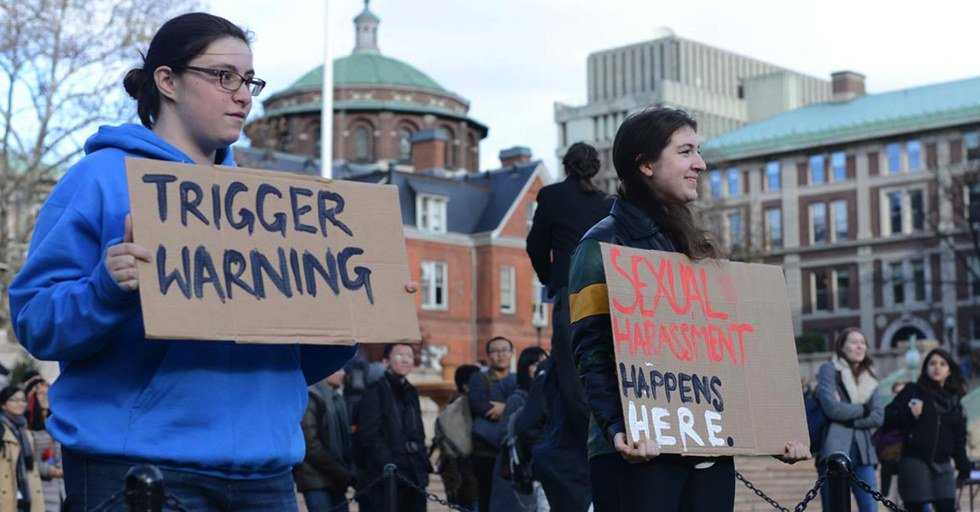
Nevertheless, the images are difficult to see, harder to digest, and not something I was planning on seeing during my Thursday afternoon trip to the library. It got me thinking about the sign I had seen before I’d had to walk through the Genocide Awareness Project exhibit that warned me about what I was about to see up ahead. I still had to look at the stomach-turning images, but I had at least been prepared for it, and I was thankful.
There’s been a lot of controversy recently over the idea of trigger warnings and safe spaces, especially in the setting of a college campus. The majority of naysayers claim that they hinder education by closing off discussions, which can be true in certain scenarios but is not an absolute. Others believe that we’re creating an overly sensitive culture by allowing ourselves to be shielded from the things that make us uncomfortable.
Trigger warnings began online, mostly in feminist discussion spaces, to allow for discussion participants to freely talk about heavy topics like sexual assault, abuse, and other things that have the potential to make others uncomfortable and, in some instances, mentally disturbed. Those warnings eventually drifted into real life as they began to escalate online, which made the line blurry for those who were just beginning to see them for the first time. Backlash ensued.
A recent example of that backlash involves blogger Lauren Southern starting #TheTriggering, which seems to be some sort of The Purge spin-off, where on March 9 of every year, people take to their online outlet of choice and post offensive or off-putting comments and opinions to “defend free speech.”
Now this is where I begin to not understand. Trigger warnings – while they have the potential to be blown out of proportion – aren’t intended to stop a conversation. They’re intended to help one prepare for it. No one is angry with the Motion Picture Association of America for rating movies as PG-13 or R based on the amount of violence, the type of language, and the level of nudity in a film. Trigger warnings work the same way in the sense that they evaluate content and let consumers know beforehand what they’re in for. They don’t censor.
Just because someone slaps a trigger warning on a magazine article or a class discussion doesn’t mean that the entire audience of that conversation is now gone. Furthermore, even if a trigger warning did result in a mass exodus of listeners, it’s not infringing on your rights to freedom of speech. Freedom of speech guarantees you the right to say what you’d like without persecution from the government; it doesn’t guarantee you the right to an audience.
At the end of the day, one of the most beautiful things about America is getting the opportunity to use your voice. As long as you’re using it in a way that’s conducive to society, efficient, and educated, whether that involves trigger warnings or not, that’s all anyone can ask of you.