Hell has frozen over, probably because I totally agree with Mitt Romney about something for once. While I don’t see myself supporting him from a policy perspective, I have a deep level of respect for him for refusing to endorse his party’s nominee because it would be discordant with his values, and I appreciate how he’s employed his platform of power to speak out about Trump. And his statements on Trump are spot on.
Splitting my time between the great state of Texas and North Carolina, the reality of Trump has a personal element to it. Trump supporters are a presence where I live, rather than an intangible concept that we disparage behind closed doors. I encounter people who are seriously prepared to vote for a man who wants to deport millions of people and ban an entire religion.
And honestly, the whole rise of Trump is terrifying. Not necessarily because I’m super afraid of the policies Trump will promulgate (though that’s certainly a salient thought), but because of a concept about which Romney has voiced concern: trickle-down racism.
When Trump uses his position of power and influence to endorse racist policies and make blatantly racist statements, he legitimizes this sort of discourse in the public sphere, thereby making racist undercurrents bubble to the forefront of this election cycle.
Instead of valuable debates on policy and values-driven decisions on politics, such as whether it’s the burden of private citizens or the government to shoulder healthcare costs, or if we should spend so much on the military that we’re literally having conversations over whether or not it’s ethical to ban Muslims from entering –– as if it's only “controversial.” This is a problem.
Many Trump supporters –– usually the educated ones –– disregard the possibility of a Trump presidency being as devastating as we think it may be, claiming his advisors will dissuade him from acting on his platform. Unfortunately, this doesn’t dissolve the threat he poses.
The assumption that he won’t follow through with his destructive policies being a pretty lame reason to vote for someone aside, the real danger of Trump does not come from the power concentrated in his hands, but rather in the power he disperses.
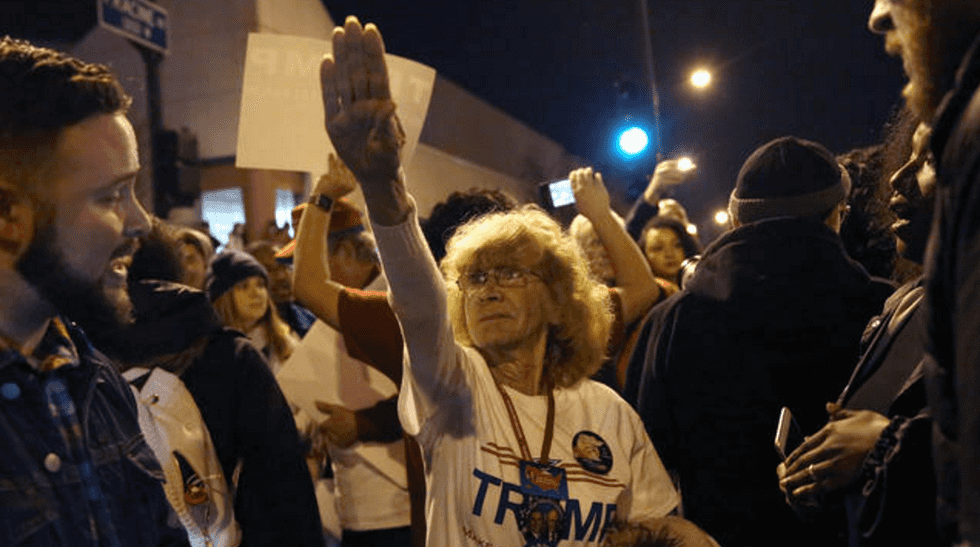
Trickle-down Trump is most striking at his rallies. Reading a series of tweets written by an observer at his Greensboro rally was chilling. Trump supporters called for violent action against protesters, called Hillary a “b*tch” multiple times, and were overtly racist. I advise everyone to read these tweets through –– this is the sort of “civilization” Trump will bring.
There is a reason you won’t see this sort of behavior at a Romney rally: He doesn’t endorse this sort of blatant disrespect. When Senator McCain was confronted back in the 2008 contest by a supporter who believed Obama was a foreign-born Muslim, he shut that down.
Likewise, while I take issue with numerous Romney policies (but that’s natural in a democratic society), Romney, as well as the flood of legitimate Republican contenders to precede Trump, differs from him in a few crucial ways, the most prominent being that Romney’s platform is values-driven. Big government versus small government, traditional family values versus 21stcentury modernity –– these issues have long plagued American politics, and while you can take moral issue with a number of them, Romney’s platform was not contingent on the disenfranchisement of minorities.
Trump’s policy-making may seem like an abstract, intangible concept––– we could go four years potentially unscathed, assuming his advisors keep him in check, and a gridlocked Congress won’t give the go-ahead for forced deportation. Yet, the sentiment he promotes will permeate our daily lives.
His populist approach, acting as the voice of the people, gives the illusion that he empowers the marginalized. There are arguments to be made about how his primary supporters, white working class men, experience economic disempowerment and exist on the fringe of society, many of which carry validity. However, the way Trump has characterized the issue is by positioning minorities as the inherent enemy to the white working class man.
In doing so, Trump has tapped into a volatile resource: his supporters’ belief that they are owed something. The way that Trump has openly and unapologetically disparaged and blamed minorities for problems in America has indeed trickled down to craft the narrative that not only are these working class whites owed something, but that they are owed it at the expense of minorities.
His harmful rhetoric does not exist in a vacuum. Trump’s inflammatory statements, and the fact he’s essentially getting away with them, places his racism out in the open and validates it. Racists who once operated behind closed doors and in hushed voices (this too is problematic, don’t get me wrong) now feel empowered to voice their concerns –– and a violent manifestation of racism is inevitable. Political correctness gets a bad rep. But if it means racists feel stigmatized for their beliefs, I’ll take it.
Envision 2017 with Trump in charge. Even if he accomplishes literally nothing he says he will, the discourse present in our country will take a sharp turn for the worst.
The next time we have a mass shooting, the conversation won’t revolve around gun control. Instead, it will focus on which minority group as a whole we ought to blame. Any foreign policy decision to “bomb the sh*t out of ISIS” will have domestic implications, further marginalizing minorities.
Next time you wonder if Trump really will be as terrible if we expect, consider the atmosphere he’ll create under his leadership. It’s a pretty scary thought.