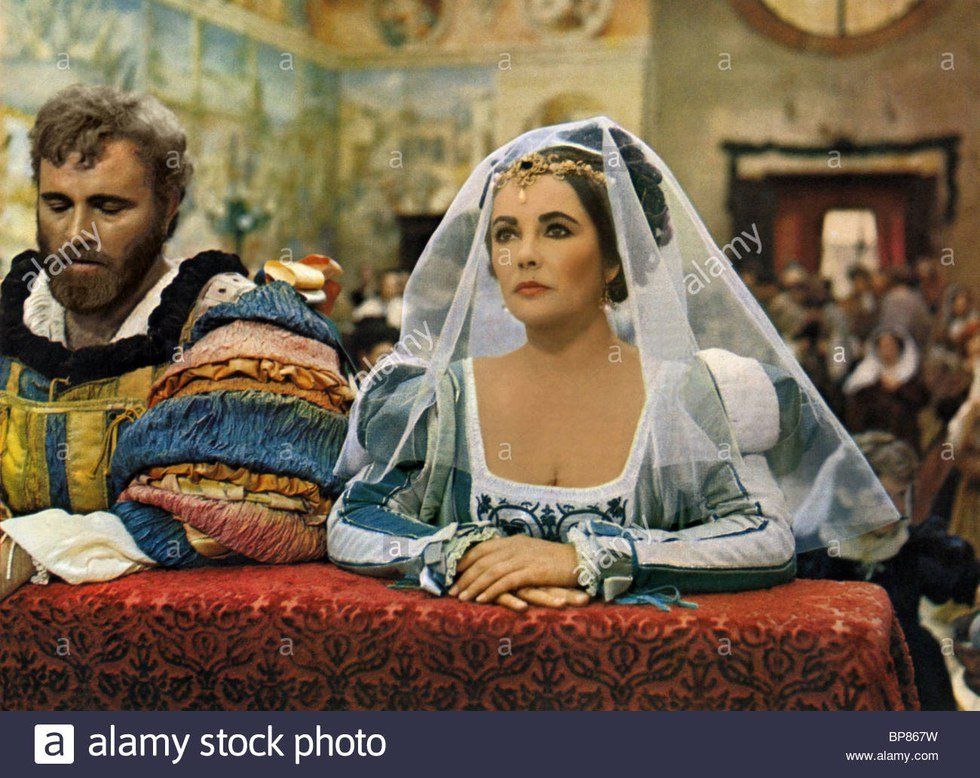
Allow me to introduce Katherine Minola. She is described as “mad,” “a devil,” “impatient,” and “having a hot temper”[1]. The daughter of a wealthy Italian man, and the main character in one of Shakespeare’s comedies, Katherine faces the challenges of being born a strong-willed woman in a patriarchal society.
Now, allow me to introduce Sara. She is seventeen years old and, 393 years after Shakespeare first published “The Taming of the Shrew”, is about to step into the shoes of one of the fiercest female characters known to the English language.
Doesn’t sound too complicated, right?
Playing a woman onstage and onscreen is unquestionably a challenge. My recent inauguration into theatre has taught me that to successfully portray a character one must embody their traits and experiences. From villains plagued by envious rage to comic reliefs who never cease to make the audience smile, each character brings attributes that continue to add new layers of depth. We know a character is well developed based on how they are written. And, unfortunately, when writing comes into play, so do gender roles; particularly the role and representation of female characters.
While male characters are allowed to experience profound character development, we women typically get the short end of the stick. Aside from the fact that women are usually placed into seemingly recycled roles (the mother, the wife, the caretaker, the sister, the lover, and so on), rarely do we see a female character who is complex beyond love triangles, or group drama, or struggles within her marriage. Rarely do we see a female character that is complex simply because of what it is to live as a female.
This coming November brings my school’s annual Shakespeare Festival, where students participate in 30-minute versions of Shakespeare’s plays. It is my last year as a member of my school’s drama club - or Stage Company, as we are now called - and I am fortunate enough to have been selected to play Katherine Minola in our adaptation of Taming Of The Shrew. Initially, this did not seem to be an immense challenge; I had played comedic characters before, seen “10 Things I Hate About You” (fun fact: the movie is based on this play!), and gotten into trouble more than a few times for having a big mouth.
To give a quick summary: “Taming Of The Shrew” tells the story of Katherine, the wild, strong-willed, and sometimes violent daughter of Baptista, a rich man who cannot seem to marry her off. Katherine refuses all suitors, preventing Baptista from offering her younger sister, Bianca, in marriage. While Bianca’s gentle characteristics reflect the ideal for a woman in her time, Katherine is her complete opposite. Because of this, Katherine is constantly rejected and isolated by her family and neighbors because of her personality. With the arrival of Petruchio, a man who seeks her hand in marriage, Katherine will have to adapt to the circumstances of a forced, potentially toxic marriage where she may just meet her match.
Initially, while I was excited to begin working on this new role, I still held doubts in mind. Admittedly – and I promise this has changed - being recommended to play a woman instead of a gender-bent character (common in my school’s Drama department) sometimes made me wonder if I was not considered enough to carry the stronger characterization we generally attribute to male characters. As acting taught me to analyze the characters of a text, my “bad feminist” self came to a realization: I have been prejudiced towards female characters because of how rarely we find one well developed by the writers, or the actresses who bring them to life.
I don’t want my Katherine to be one-dimensional, so I began to think about which qualities I could bring out to add depth. During this process, I realized something key: the majority of the “female” characters I’ve played have been gender-bent, meaning that I was portraying women living male experiences. While the originally male Malcolm in our production of “Macbeth” was turned into a princess, she did not face the obstacles of a woman earning a position in power upon being crowned Queen of Scotland. While the parrot Iago in “Aladdin” was given feminine traits, the villain Jafar never questioned why a girl dared to constantly ridicule his mistakes and speak out of turn. In short, being cast as Katherine made me ask myself what it truly is to play a woman.
To play a woman is to give it your best shot at not falling into a stereotypical mold; it is using your own experience as a woman to add the depth that every well-performed character demands.
I like Katherine because she is complicated in a way only a woman can be. Regardless of your take on the endless debate as to whether her final transformation indicates that she’s abused, playing her circumstances, or truly “changed for the better”, she lives an experience that many women can identify with today. Placing her attitude aside, Katherine is trapped by a family which condemns her outspoken qualities in favor of her sister Bianca; her only remedy may, in fact, be her marriage to Petruchio, which may offer her relief from the entrapments of her household. Though not every woman lives in a society as restrictive today, any girl who has ever been ridiculed for speaking or acting outside the expectations created for women is likely to identify, as did I.
There is still a long road ahead before we formally step on stage. Rehearsals are on, and we continue to work on this project. I am glad that I will be able to represent an unforgettable part of the female experience. It is a complex world, and I can only hope to do my best. Katherine, let’s do this.
[1] Shmoop Editorial Team. (2008). Katherine Minola in The Taming of the Shrew. Retrieved September 16, 2016, from http://www.shmoop.com/taming-of-the-shrew/katherin...