

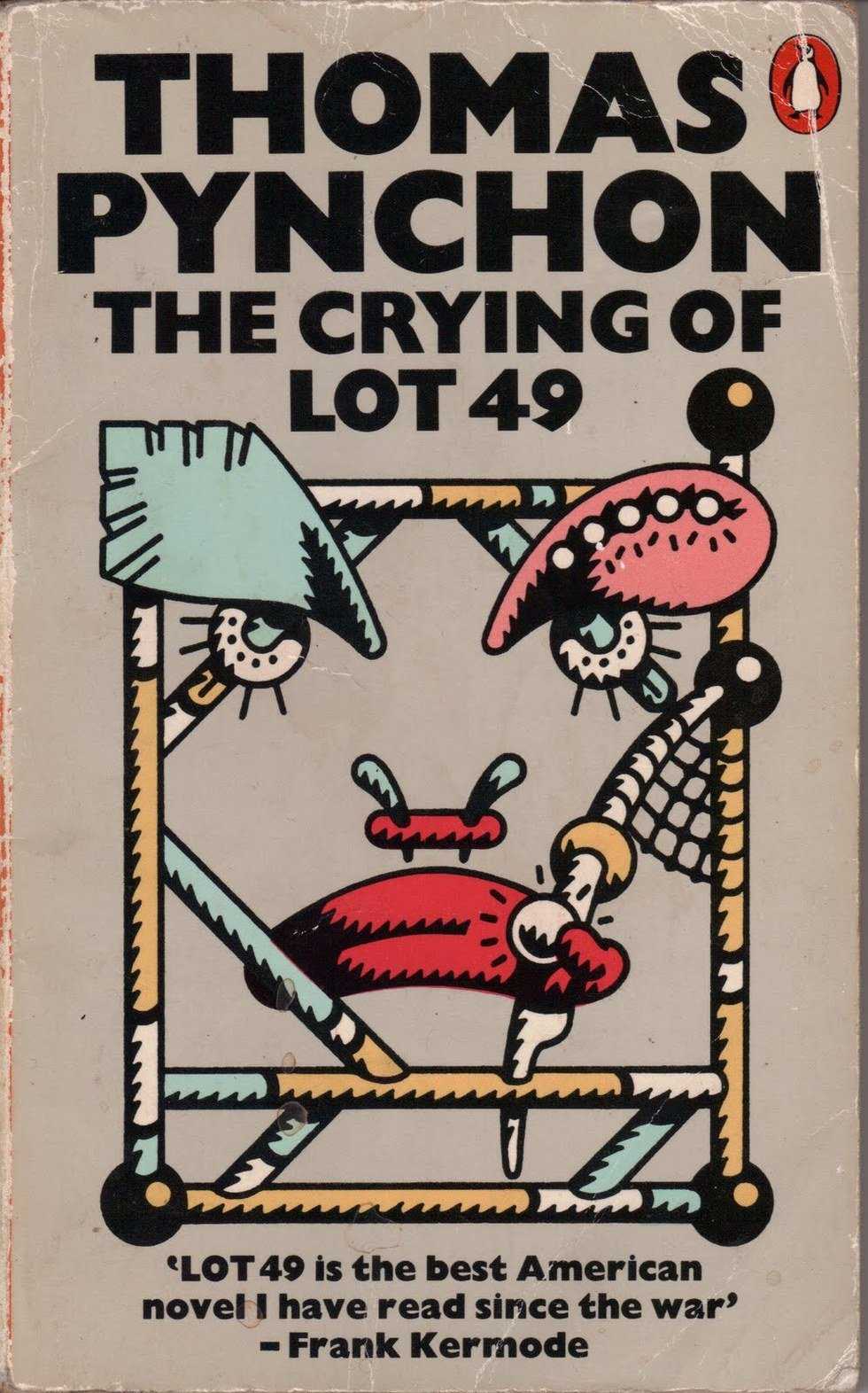
Thomas Pynchon’s short novel, The Crying of Lot 49, is one of the first books wherein the paranoia which presented itself in the extreme/surreal scenarios of modernist literature (Kafka, Lovecraft, Orwell, etc.), is transferred onto the life of an everyday person. This lines up with the culture of the time: A nation in the midst of the Cold War, where everyday people feared being accused of being a communist sympathizer, as well as the rise of manufacturing/assembly line jobs, commercialism, and TV culture.
The beginning of the book starts off, as most detective novels do, with a rich man, Pierce Inverarity, being murdered, his estate now having to be divided up, and the murderer not even being alluded to. The main character in the novel, Oedipa Maas, starts off as the rather hesitant executor of Inverarity’s estate. At the beginning, Maas’ husband Mucho describes what seems to be a feeling permeating the working class of this period: “For a couple years he’d been a used car salesman and so hyperaware of what that profession had come to mean that working hours were exquisite torture to him (see p. 6).” This sense of banality, ephemera, and the day-in day-out struggle of the working class is presented by means of satire and irony throughout the book (ironic jobs for Mucho, Mike Fallopian’s views on economic affairs, Dr. Hilarius’ freak out, Pierce’s ridiculous capitalist ventures) and contrasts very nicely with the surreality of Oedipa’s situation. This could be construed as a defense of the proletariat (authority figures are not to be trusted in this book), or possibly questioning why we fear communism/socialism/anarchism. The next couple of scenes which capture the paranoia of the time would be the scenes with Dr. Hilarius. In the first encounter with Dr. Hilarius (p. 7-8), he tries to get Oedipa to ingest what he tells her is “tranquilizer,” but what ends up being LSD. This is significant historically, culturally and socially: this was about the time LSD-25 was first synthesized, and the mid-60s was the height of the “hippy” age. With this increased use of LSD, the culture began to separate between lines: those who are “addicts, stoners, junkies, freaks,” and those who conform to more orthodox/traditional hobbies (capitalists vs. their workers). Most importantly, however, is that LSD was being tested by doctors, the CIA, the U.S military, and other organizations with power, on both willing and unwilling subjects. This comes up in the latter encounter with Dr. Hilarius, wherein Dr. Hilarius talks about his Nazi days: his experiments on induced insanity (p. 112), his attempts to give housewives LSD (p. 7-8), and later in that chapter he is even found to have been giving Mucho LSD for several weeks now (p. 117).
The book then moves towards the questions over Pierce’s death. We are suddenly presented with “clues,” which suggest something fishy is going on with Pierce’s will and the end of his life in general. These range from his vast portfolio of properties, each of which seem to have ties with the anti-mail system, the W.A.S.T.E organization, to the person he asked to divide his estate (Oedipa, not well-acquainted), to the people with whom he did business. The oddest part about these clues, however, is that they never receive any truly satisfying answers. Instead, each question leads to several new questions as the “answer”, which Oedipa must then track down and find the further “answers” to. More often than not, these “clues” end up being dead ends, in turn producing more questions, or she simply doesn’t pursue/remember to pursue the questions. This is the major piece of satire in the book: A detective novel that makes its conflict more and more clear with each page, but which in the end never fully yields to any probing from the reader. This is summed up very well in the passage on page 95:
“Each clue that comes is supposed to have its own clarity, its fine chances for permanence. But then she wondered if the gemlike “clues” were only some kind of compensation. To make up for her having lost the direct, epileptic Word, the cry that might abolish the night.”
This passage is exquisitely post-modern: It is self-aware, self-referential, foreshadowing, and very up front with the “unknowns” of life, unafraid to leave questions open. This is essentially giving the end of the novel away — as Pynchon does throughout, it seems; always reminding us that there is no light at the end of the tunnel, only more questions — as it states repeatedly that there will be no easy answers, there may be no answers at all. In the end, the only compensation for Oedipa (and for the reader) is the excitement and intrigue of the clues in front of her,the fragments of reality which Pynchon presents, for there are never any explicit answers given in this book. You live, you question, you die with only those questions and not a whole lot else.
I could talk forever about this book: the symbolic organization is ridiculously meticulous, the satire is sharp and witty, and the spoof on a detective novel works to reveal truths about prior literary traditions, as well as cultural attitudes and paranoia of the time. It was Wayne Teasdale, an advocate for improved communication between religious groups of any faith, who said, “Of course, humor sometimes holds deeper truths, and often it is the only acceptable mode of communicating uncomfortable or difficult truths to others.” The most difficult truth this book communicates (ahem, shoves down its reader’s throat), in my mind, is that in the end life will leave us all with nothing. That all things are impermanent, all things un-understandable, all communication impossible. And also, most importantly: that this is OK. There is not anything unnatural about it. Postmodernism is analogous to literature’s fall into the Cartesian pit; into nihilism, solipsism, meta-fiction, heavy irony, detest for hierarchical social structures, the end of “knowledge,” and the surrender to simulacrum and hyperreality in a newly media-saturated society. The only difference, is that Postmodernism falls with a smile on its face, and satire on its lips.