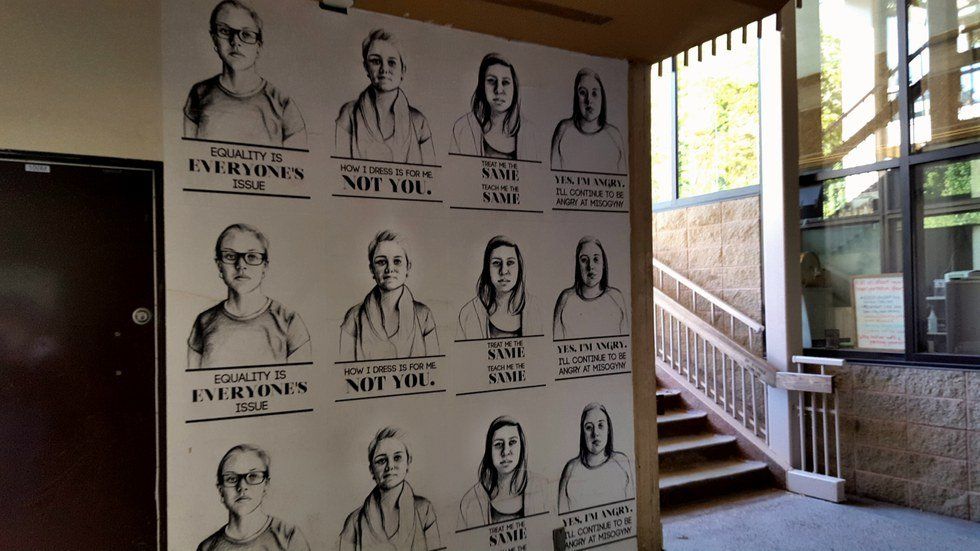
This is a mural right outside of the southern doors of the University Center at the University of Montana. I think it really sucks. It’s been there for at least as long as I’ve been a student here, and every time I’ve walked by it since my freshman year, I’ve been a little bit more annoyed by it. Not because I hate women, or disagree with anything that it has to say, I actually think that all of its statements are pretty valid. I just don’t think it helps anything.
Specifically, it’s the tone that I think does more to hurt its message than to help it. I get that the entire point of the piece is to show how angry women are about these issues, but proposing any problem with anger behind it is only going to speak to people who are already angry about the issues themselves. For people who have no opinion or, are even opposed to these phrases, seeing an angry, accusatory face along with the rhetoric is only going turn them off of it. I believe that, even if you were to continue to have the wall be dedicated to gender issues, I think that there are much, much better ways to do it. The cause, as well as the University, would be much better served if the mural was replaced with something less inflammatory.
This, however, was just my own theory. So I decided to spend some time standing next to the mural and asking students, both men and women, what they thought about it. It seems as though most people aren’t as passionate as I am against this thing, but my theory was, more or less, reinforced.
The first group I talked to, coincidentally, was a guy who was bringing his girlfriend down to the mural just to laugh at it. I asked them what they thought about it, and they were, as you may guess, generally unfavorable. Their reasons being that they thought it “comes off as whiny” and that it’s “very aggressive”.
After the two posed in front of the mural, giving it the finger, they were off, and I spent the next couple hours in front of the mural. The students that did stop to talk were mostly disinterested or lacked any real opinion of it. Most people, in fact, put forth critiques of the artwork itself before even discussing the issues it represented. Though most could agree that the images were well drawn, they thought that it was “repetitive” and “could be more effective if it was in color.” These opinions don’t really add to my main problem with the work, but I’ll take any criticisms of the piece a validation. I guess the only unbiased take away from these particular comments would be that “everyone’s a critic.”
Every single person I interviewed did agree with the sentiments of the piece itself, and the statements on it. But most also echoed a similar belief that it could be done much better. People referred to it as, “grumpy” and some were put off by the mere usage of the word “angry.” One fellow named Raid said that “Their expressions don’t really help. Even if you’re telling me a good point or facts, I’m (less likely to) accept it if you are angry.”
A point that was brought up by at least half of the people I spoke to that I hadn’t even thought of myself, was that the mural didn’t have any men on it. People said things like: “I don’t think it’s helping, because It’s talking about equality, yet there are no men up there.” Raid echoed this in saying “I think it would be better with both men’s and women’s pictures, we’re not against each other… this just divides us more.”
One guy named Derek even said that the mural “points to men as the problem.” See, the mural says nothing about men, directly, but just due to the tone and the rhetoric, he picked up a strong inference that he was being attacked by it. This, I believe, comes from a connection of the piece’s anger, and its apparent direction towards the audience, to the radical, man hating feminists that are sometimes, wrongly, used to represent the entire feminist movement, and give it a bad name.
The one person I spoke to who did feel strongly in favor of the piece was a girl named Kat who was on her way to a meeting for a women’s group on campus when she stopped to talk to me. She said she felt empowered and got a “hell yeah” feeling whenever she would see it, but acknowledged that that was because she was already heavily on its side. She said she felt that some amount of the anger was good to be represented on the mural, as it was part of the driving engine behind feminism.
However, she did agree with me on the use of anger as a tactic for debate, saying “My arguments have always been better when I’m actually starting a dialog and not coming with anger.” I asked her whether she felt the cause would better be served with a mural that had less anger and featured more than just angry, white, women, and she agreed.
Now, on any issue that is worth fighting for, there is going to be anger, and I am in no way saying that it should not be represented. My point is that a ten-by-ten-foot mural in the University Center is not the place for it. Kat even said that it would be much better placed at her group’s meeting location. If the University wants to actually help this issue or raise awareness for it in a constructive manner, then this is definitely not the way.
This mural is not helpful, and should be removed and replaced. I have no problem with the wall remaining devoted to women’s and gender issues, but I, and most of the people I spoke to, think something less divisive would serve the point astronomically better. Something that says, “We should work together” is always greater than something that says “We are mistreated, and you are the problem.” It’s like my dear old grandmother always said, you catch a shit ton more flies with honey than you do with vinegar.