
People don't really stop to think about their place in the Universe, at least, not in any meaningful, serious way. Sure, they'll go to church and vote in the next election, but they rarely stop to think how they even got here in the first place, or how anyone even got here. How did the planet get here? Where the hell even "here?"
To kickstart your mind and make you ponder the bigger questions, here's five spooky science facts to shake the underpinnings of what you believe about war, reality, history, information, and life.
The United States almost initiated nuclear war over a computer glitch
By the 1970s, the United States and Soviet Union had gotten pretty good at nuclear stalemate, having switched most of their missile command to computer systems. On November 9, 1979, technicians deep beneath Cheyenne Mountain at Colorado’s North American Aerospace Defense Command (NORAD) received alerts of multiple Soviet missile launches, prompting ten fighter planes to be scrambled for an interceptor mission and the president’s “doomsday plane” to take off. Missile silos around the country were readied for a retaliatory attack. Soon enough, operators at NORAD realized a technician had accidentally run a training program meant to simulate nuclear attack and the military quickly backed down.
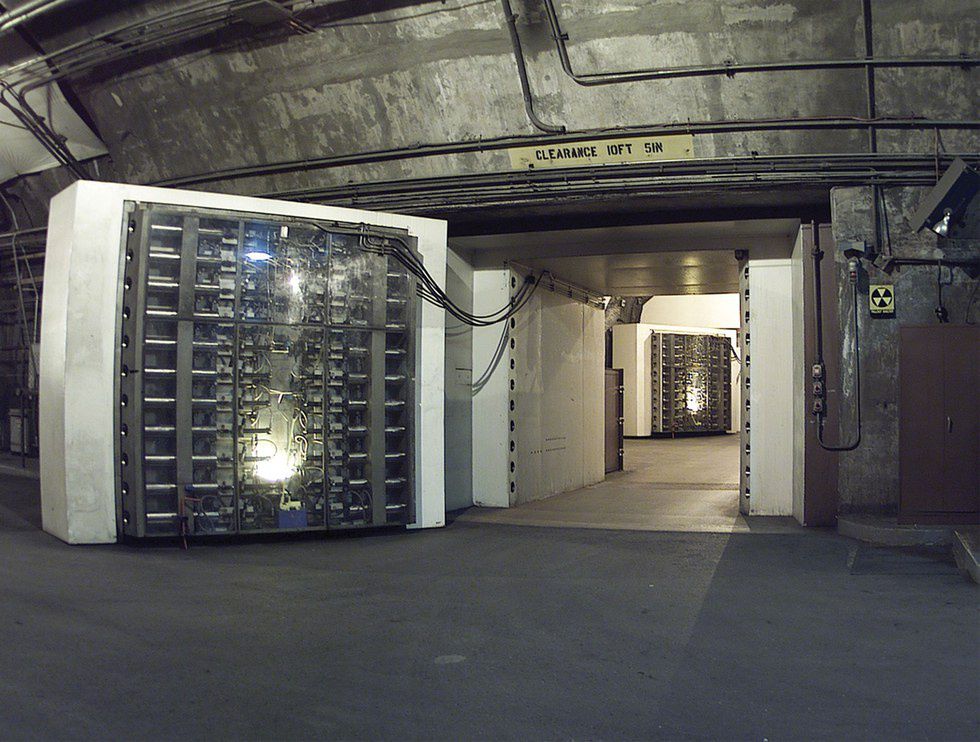
Blast door at the Cheyenne Mountain Complex of NORAD
Despite Soviet Premier Leonid Brezhnev's letter to President Jimmy Carter in the aftermath of the near-apocalypse which highlighted the sheer danger of nuclear standoff, the Cold War didn't end for another decade. Three more scary computer glitches occurred in 1979 alone, and a Soviet missile officer decided to ignore false missile launch alarms again in 1983. No one ever really learned their lesson and today the United States nuclear arsenal is controlled by an IBM Series/1 Computer from 1976 and a few 8-inch floppy discs.
Because light has a finite speed, you have never seen the present, only the past
The interesting thing about the speed of light is that you can’t exceed it: how can you travel faster than something that has no mass? The other interesting thing is that we can’t say something has “happened” until we’ve seen it. You only see something “happening” because photons of light have bounced off of “whatever’s happening” and have hit your eye, triggering a neural response. In a similar way, when Johannes Kepler witnessed a supernova we now refer to as SN 1604 on October 9, 1604, he was seeing an explosion that had occurred 20,000 years before. This is because SN 1604 is exactly 20,000 light-years away from Earth. A light-year is the distance light travels in one year, almost 5.9 trillion miles. Because light determines when we acknowledge something has happened, the speed of light is really the speed of causality.
The mythical Great Flood that started China’s dynasty system was real
Chinese mythology tells of The Great Flood of Gun-Yu, which swallowed vast lands around the Yellow River over 4,000 years ago. The current Emperor Yao appointed his relative, Gao, the Prince of Chong, to find a way to hold the enormous amount of water back, but, after several failures and a new emperor, the problem remained unsolved. But Gao’s son, Yu, proposed digging drainage ditches all along the path of the flood to dissipate the water. The plan worked, Yu was declared emperor (he would become Yu the Great) and received the first Mandate of Heaven, the defining quality of Chinese dynastic rule for the next 4,000 years.
This fantastic tale has now been (partially) verified: sedimentary analysis of the bottom of the Yellow River and similar sediment miles downstream reveals that exactly 4,000 years ago, an earthquake created a massive landslide, corking up the Yellow River and widening the nearby Jishi Gorge. A 660 foot dam of rock and dirt held for 6 to 9 months, accumulating four cubic miles of water (half the size of Lake Mead) behind the weak, temporary wall. When the rock dam catastrophically failed, a terrifyingly destructive wave swept over the land, resulting in one of the largest floods on Earth in the past 10,000 years.
Zipf’s Law statistically predicts a ton of human and non-human behavior and we have no idea why
The most common words in the English language are “The of and to a in is I that it for you.” Something odd is that “The” occurs twice as often as “of,” the second word, and three times as often as “and,” the third word. This pattern continues for all words in English. Strangely, the pattern works for any language, even ones we invented inorganically like Esperanto or languages we haven’t even been able to decipher.
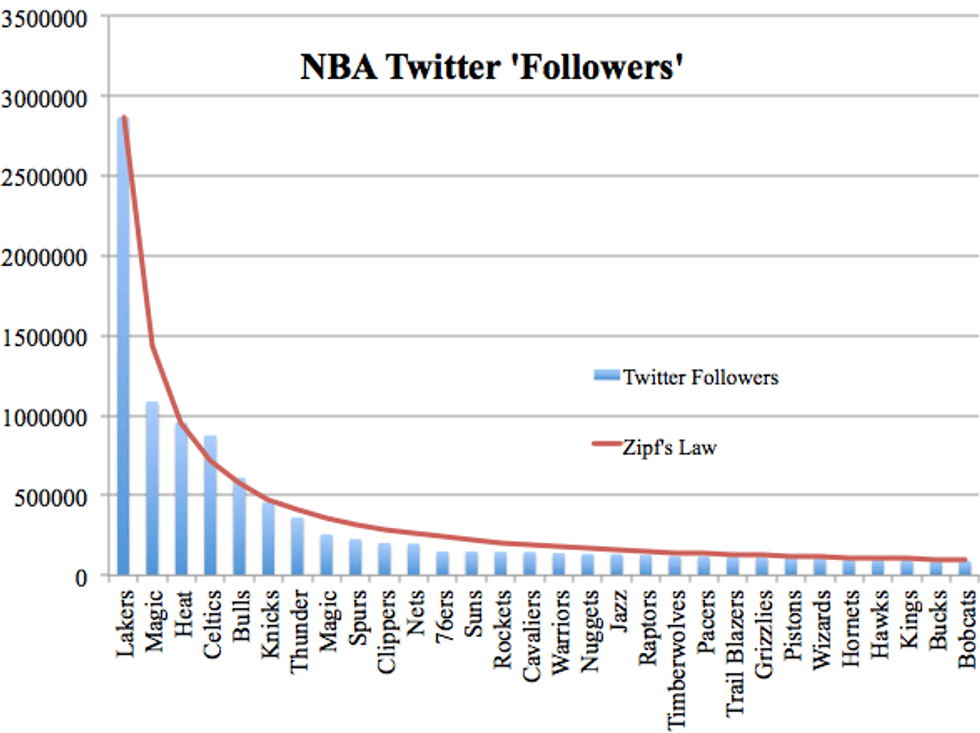
Phenomena that follow this pattern obey what’s called Zipf’s Law, which is just a statistical distribution which says that the most common event happens twice as often as the second most, three times as often as the third most, and so on. In my first example, the events are words that we use. But the weirdest part is that Zipf’s Law holds for city population size, last names, cook book ingredients, solar flare intensities, protein sequences, moon crater diameters, and much more. If you’ve ever heard that 20% of the population owns 80% of the wealth, then you’ve heard of Zipf’s Law.
Benoit Mandelbrot showed a few short years after George Zipf’s amazing discovery that even if you type random keys on a keyboard, you will produce “words” that follow Zipf’s Law. Mandelbrot and other mathematicians say this is a consequence of there being exponentially more long words than short ones. There are only 26 one-letter “words” in English, but there are 262 two-letter words. This makes longer words much more numerous than the short ones. Also, the likelihood that you press the spacebar and make a new word increases the longer a word gets, further exponentiating the mess.
Conversations, books, and pretty much all information conveyed between humans follows Zipf’s Law. Maybe it’s the consequence of humanity’s random statistical meandering and labeling. Perhaps it’s an artifact of the way brains form thought and then speech. Regardless, because of Zipf’s Law, only 100 words are used to convey half of all information.
Think the Dinosaurs had it bad? You haven’t heard about The Great Dying
Layers in the Earth’s crust reveal the history of our planet, its atmosphere, its chemical conditions, and the life that existed at the time. Layers upon layers teeming with signs of prehistoric life can be found toward the end of the Permian period, but these signs disappear in a geologic blink of an eye around 250 million years ago. The sudden die-off, referred to as the Permian-Triassic extinction event or more fancifully as The Great Dying, saw the abrupt death of 90% of all species on Earth, the single largest extinction in all of history.
What caused life as we know it to almost disappear? Many likely theories have been proposed. Here are the ones we have evidence for: the Siberian coal traps spat 1.5 million cubic kilometers of lava into the atmosphere through an enormous fissure, and this lava melted ice fields containing trapped methane. The simultaneous flooding of Earth’s atmosphere with methane and carbon dioxide starved the planet of oxygen. Once the oxygen went, everything did: sulfate-reducing bacteria that thrive in anoxic environments (those without oxygen) released hydrogen sulfide globally, acidifying the oceans and obliterating the ozone layer. The acid oceans killed 96% of all marine species and their corpses littered beaches the world over. With the ozone layer gone, UV light bathed the Earth and fried land-based life. Dark clouds of smoky ash from Siberia covered the planet, inducing a runaway greenhouse gas effect. The resulting heat turned the ocean to a toasty 40 ºC, making the chances of survival almost nil.
Why are climatologists so concerned about the greenhouse gas effect and global warming? Because it once almost ended life on our planet. Entirely. While acid rain, overwhelming heat and lack of oxygen is bad for just about every form of life we know, the fungi had a hell of a time during The Great Dying. Enormous fields of dying trees and other animals made a wonderful feast for the fungi, and the fossil record shows a huge spike in their numbers at this time. At least someone was enjoying themselves while the planet literally died around them.