
I have always been captivated by the stories and legends of the ancient Greek gods and goddesses. The dethroning of the titan Cronus by his son Zeus, the heroic Hercules and his 12 labors. Greek mythology has always been a source of both excitement and understanding. However, there is a lesser known deity whose semblance among society today is far greater than all of the Olympians combined--Phobos.
Phobos, son of Aphrodite and Ares, was the Greek god of fear and panic. It was said that he personified these emotions, having the ability to instill widespread panic so strong that it replaced logic with apprehension. It seems like today, the story of Phobos can be seen almost everywhere.
In terrorism, fear is used to intimidate a target audience in an effort to promote a certain agenda. According to Bruce Hoffman in his book “Inside Terrorism”, this audience can include “a rival ethnic or religious group, an entire country…or public opinion in general.” Nowhere can we see this method be used better than in terror groups such as ISIS or Boko Haram. In the case of Boko Haram, whose insurgency began in Nigeria in 2009, their main agenda is to promote a version of Islam in which it is forbidden to engage in the politics and activities of Western society. They utilize fear by engaging in horrendous acts, such as rigging cars to explode and abducting 200 innocent school girls.
The implications? Citizens of Nigeria have been forced to reduce their freedom, making them unable to live their lives the way that they desire. They wake up with this fear, knowing that any action in the wrong direction could mean death. In fact, a 2014 article published in The Guardian states that “the fear of Boko Haram has forced many parents to withdraw their children from schools”, which is subsequently creating uneducated youth who will eventually live in poverty.
Yet, fear can also be seen on the home front. It goes without saying that a campaign of fear has always been used by politicians to incite a large voter turnout—regardless of accuracy. During the RNC, presidential candidate Donald Trump remarked that “Our president … has made America a more dangerous environment than frankly, I have ever seen.” Such proclamations from a “presidential hopeful” must hold truth, right? Well, in typical Trump fashion, the facts were left in the dust. The truth is that violent crime in the United States has been declining. This includes robberies and murders.
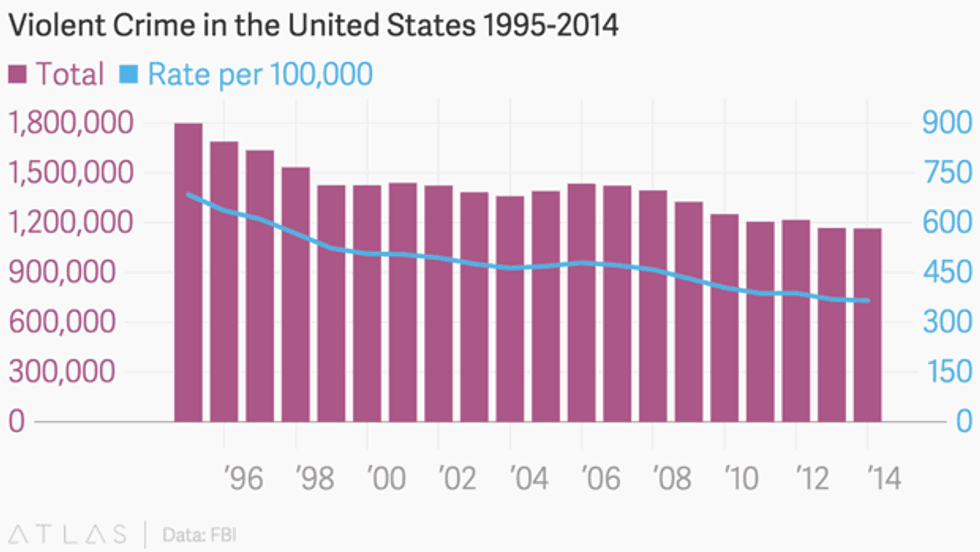
Despite blatant inaccuracies, politicians know how to use fear to their advantage, as 70 percent of Americans believe that crime is increasing, according to a 2015 Gallup poll. It seems that fear trumps truth.
But of course, fear doesn’t stop there. Fear has been used and continues to be used, in racist groups such as the KKK to make sure that all black Americans believe that they are inferior. Fear has been used and continues to be used, in homophobic churches such as the Westboro Baptist Church to make sure that all individuals who don’t identify as heterosexual believe that they will be punished for their actions. While these are extreme examples, the point still stands: fear is used to control a nation, blind a nation, and marginalize a nation.
Luckily, fear is an emotion, and so it can be monitored or even alleviated. We must be aware of those who use fear to cloud our judgments or control our actions. We can once again look to Greek mythology for guidance, specifically the story of Pandora’s box. Pandora, being curious, opened a box given to her by Zeus who told her to never reveal its contents. Once opened, all sorts of destructive emotions, thoughts, and ideas—including fear—flew out of the box. However, the very last thing to come out of the box was something beautiful…hope. Hope is used to illuminate the darkest of times. It is used to keep people going when things seem at their roughest, and, most importantly, hope is used to defeat fear. We can use hope to break the chains that bind us whenever we let fear stop us from living our lives, and for those living under the harshest of environments, they must look towards hope to keep them going. We cannot let fear control our lives. Instead, we have to hope for a better tomorrow.
References:
Abubakar Aminu. "As Many as 200 Girls Abducted by Boko Haram." CNN. Cable News Network, 16 Apr. 2014. Web. 03 Aug. 2016.
"Abuja Blast: Car Bomb Attack Rocks Nigerian Capital." BBC News. N.p., 2 May 2014. Web. 03 Aug. 2016.
DENVIR, DANIEL. "Violent Crime Is Lower Than Ever." CityLab. N.p., 19 Sept. 2015. Web. 03 Aug. 2016.
Hoffman, Bruce. Inside Terrorism. New York: Columbia UP, 1998. Print.
McCarthy, Justin. "More Americans Say Crime Is Rising in U.S." Gallup.com. N.p., 22 Oct. 2015. Web. 03 Aug. 2016.
"Nigeria: 'We Live in Fear of Boko Haram'" The Guardian. Guardian News and Media, 2014. Web. 03 Aug. 2016.
"Phobos." Tales Beyond Belief. N.p., n.d. Web. 03 Aug. 2016.
"Table 1." FBI. N.p., n.d. Web. 03 Aug. 2016.