

Have you ever thought about why your best friend is your best friend? What is it about them that has caused you to continue a friendship with them? That makes you want to hang out with them time after time even if you do nothing but laugh at gifs of cats falling from ridiculous places? What is so special about this person that you watch pointless youtube videos with at 3 a.m., the person you have countless of inside jokes with? Maybe you have something in common. You share a love of "Doctor Who," and bonded over David Tennant's sass and fezzes. Perhaps you both have a passion for drawing, or acting, or binge-watching unhealthy amounts of Netflix. Maybe it was circumstances that brought you together. They've been your next door neighbor for as long as you can remember, or you had a math class together and they were someone you could rant to about the homework. The reasons we choose our friends aren't always easy to list. They just, are. What about your significant other? Why are they so special to you? This is probably a little easier to answer. Especially if you're female. As a girl, it's pretty much effortless for me to sit and think of reason after reason after reason why I adore my boyfriend, and I know it's the same for a lot of my girlfriends. I could do it all day. But think about this with me. As a Christian, is your best friend the friend you need? Is your significant other a man or woman of God that aids you in your walk with Christ?
We are often told to choose our friends with care. Even the secular world knows this, and the Bible certainly has a say about it. Among many other examples in Scripture, Proverbs 12:26 tells us that “the righteous choose their friends carefully.” Thus, the way that those we desire to spend our time with exemplify love—to us, and to others—is important. And the way that we love our peers is equally so. We must ask ourselves, is it the love of Christ? Is it even close? Well, what’s the standard for this? How do we measure the love of those we choose to surround ourselves with, and how should we show love in return?
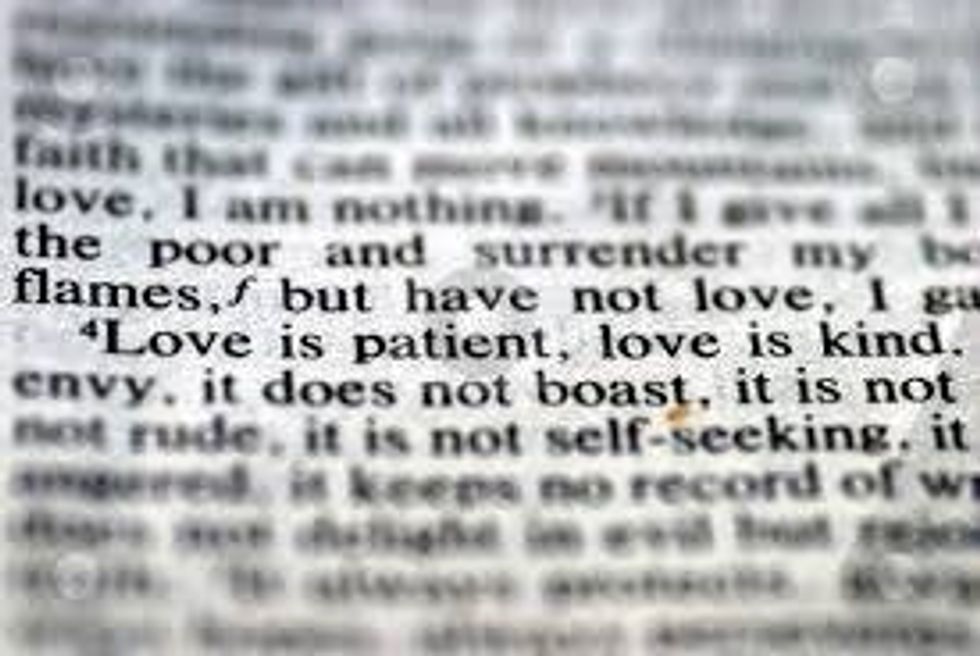
The answer can be found in 1 Corinthians 13, verses 4-7. In the New Living Translation, they read:
"Love is patient, love is kind. It does not envy, it does not boast, it is not proud. It does not dishonor others, it is not self-seeking, it is not easily angered, it keeps no record of wrongs. Love does not delight in evil but rejoices with the truth. Love always protects, always trusts, always hopes, always perseveres."
1 Corinthians 13 gives us an outline of what true love looks like. What the love Christ has for us looks like. It is the love we should have for all people. The characteristics mentioned should be exemplified in ourselves, and they should be qualities shown in all those we admire. When we give our affection to someone, especially if it is in the romantic sense, these character traits are a requirement for both ourselves and the other. If these are not present, the love will not flourish. It will not be as Christ intends it to be. It will not be, can not be, the love that we are called to show others in Christ Jesus. It is not one, not two, but all of these things that must be a part of the person we give our heart to, and even our time to.
I saw a blog post not too long ago that has stuck with me. I can't remember the name of the blog now, but it's written by a mother who is a follower of Christ. This particular post spoke of a time when her young daughter liked a boy she knew from school. The girl told her mother how she felt towards the boy, and her mother asked her if he was a boy worthy of her affections. When the girl said that she didn't know, her mother invited her to read a passage of Scripture with her. The passage was 1 Corinthians 13:4-7. After reading it, the mother told her daughter to replace every use of the word “love” with the boy's name. She then asked her if the passage was still true. As she did so, the girl found that the boy didn't fit many of the characteristics.
I've heard this passage countless times growing up. I'm sure every child who has been in church from a young age has. I even learned a song that put the verses to a catchy tune one year during a vacation Bible school I attended. I know what real love looks like; or at least what it should. But truthfully, before recently, I'd never really spent much time thinking about these verses. I had never spent time thinking about the character of those I had spent my affection on, my time on, whether this was in the platonic sense or the romantic. Yes, I knew if they were a "good person" or not, but I never really took the time to truly measure who they were. If spending time with them, or spending my affection on them, would help me grow towards Christ. Looking back, I wasted so much time, so much effort, caring for people who were not worthy of it. I wasted time chasing after friendships that wouldn't have benefited me and my walk with Christ. Not because the person themselves are not worth something, for they too were part of the world which Christ bled and died for, but because the way they loved was not something of true worth. Their love was not the love that Christ commands that we have.
No one is perfect. No one is going to show and live the kind of love that we are called to 100 percent of the time. But those who are worth our affection, those who Jesus wants us as men and women of God to love and marry, whom He wants us to form close friendships with, show it enough that it is considered part of their character. That they are known to be patient, kind, humble, selfless, merciful, honorable, and just by those around them. Not all the time, no, but that that is who they want to be. Who they give their all to be. Looking back, if I had done what this mother suggested to her daughter, I would have discovered the same that the little girl did of so many of the people I desired love from. Perhaps much of it would be because they were young, and stuck in the selfish ways of childhood. But much of it also resulted from personality, or simply the lack of desire to be these things. None of those boys would have been the one I needed to love me, to show me Christ. However, unlike the young woman who found that the boy she gave her attention to was not fitting of the standard of love by which we need measure, as I put my boyfriend's name where the word "love" once was, I find that these verses remain true. He is a man worthy of my affection. Of my love. Because the love that he has for me, and all those around him, is not the love of this world. It is the love of Christ, and I am blessed to have a man who gives his all to show the love and light of Jesus. In addition, the same is true for many of my close friends. I have learned, through trial and error, that the way that those around me show love is what truly matters. I challenge you to do this with your own friends and your S.O., should you have one. How do they exemplify the love of Christ?
Just as much as it is needed for the man I give my heart to be true to this standard of love, and for the friends I devote myself to, it is my responsibility as well. To love someone in the way that Christ desires, all of these things must be true of me. This is the part that is so convicting to me. I often think about whether I am loving those who love me like I should. Loving those who do not love me as I should. If I am being the friend that God desires me to be. But if I am honest, rarely do I measure my love by the standards set in these verses. I do ponder whether I am pointing others towards Christ, but I can’t say that I have ever asked myself if I live up to 1 Corinthians 13. Do I show patience, and kindness? Do I exemplify humility, and grace? Am I honorable, rejoicing in truth instead of wrongdoing? Do I always protect, always trust, always hope, always persevere? I long to be an example of these in all aspects of life, and especially when it comes to my relationships with those closest to me. I am not the most patient of people, and I am not always kind. I like to believe that I am humble (am I proving that I'm not by saying that I am? I've always wondered about this), and I am not one to hold grudges. It has always been easier for me to forgive than to stay angry or bitter.
But I cannot say that I am honorable. In my heart, because of the Spirit of Christ in me, I rejoice in what is right. But I do not always act as if this is so. A couple weeks ago, while we were in Arkansas visiting family of mine, my boyfriend and I were sitting on the couch that he had been using as a bed in the loft at 2 a.m. It was the third of such late nights we'd stayed up talking. My boyfriend was worried that the lost hours of sleep would start to show in the next day. I told him that if asked, I would blame it on my insomnia, and he could say that the cat, Mallory, had kept him awake with her incessant meowing. Neither of these were hard to believe, but it would still have been untrue of the particular situation. I had spoken minutes earlier of how when, a month previous, my mother had asked me over text a question I hadn't wanted to answer, I couldn't stand to lie to her. Yet here I was, saying that these untruths were justifiable, merely because I didn’t want to face the possible consequences of telling the full truth. He brought this to my attention, saying something that even now cuts me to the quick with conviction and guilt. "So you're unwilling to lie to your parents over text, but you'll do it to their face?" Immediately, I felt ashamed. I realized the contradiction of this, the ridiculousness of it, the double-standards I had set for myself. I had not seen these excuses as lies, but as exaggerations. I do have insomnia, and the cat had been making it hard for him to sleep uninterrupted the past couple of nights. But what he said made me realize that it was no different than it would have been if I hadn't answered my mother's question; lies are lies, no matter the cause or situation or how close to the truth they may be. I hung my head, feeling my face flush, and he continued, "Becca, I think it's wrong..." He said this softly, in a way that could never be called reprimanding, but that is what it felt like. An admonishment. And it was. Given in love and gentleness, but a rebuke all the same. I am grateful that he cares enough about me, about my walk with Christ, to call me out when he doesn't think I'm doing what is right. To do it in love. But at that moment, I just felt like crying. Because it was true—it was wrong, and I knew it; yet I was willing to squash this knowledge as long as it met my selfish desires to be untruthful. Because I was ashamed, so ashamed—not only of my actions and intended actions, but because it had been my boyfriend who had brought it up. That it had taken him calling me out on it to acknowledge the fault in it. I cannot say that I am honorable. But I can speak in truth when I say that I want to be. That I desire to be, and will not stop working for it. I cannot say that I always hope, or that I always persevere. I cannot even say that I always trust. These are things that I am still working on. I have been for a long time, and I will continue. These aren't easy things. But that's just it; Christ never said that love would be easy. And it sure isn't. But I'm not going to give up. I'm going to work to set aside every weight that slows me down, all the sin that clings to me so closely, and keep running with endurance the race that is set before me, in Christ. How I urge you to do the same. I promise you it's worth it. The love of Christ is so much better, so much more, than anything this world has to offer.