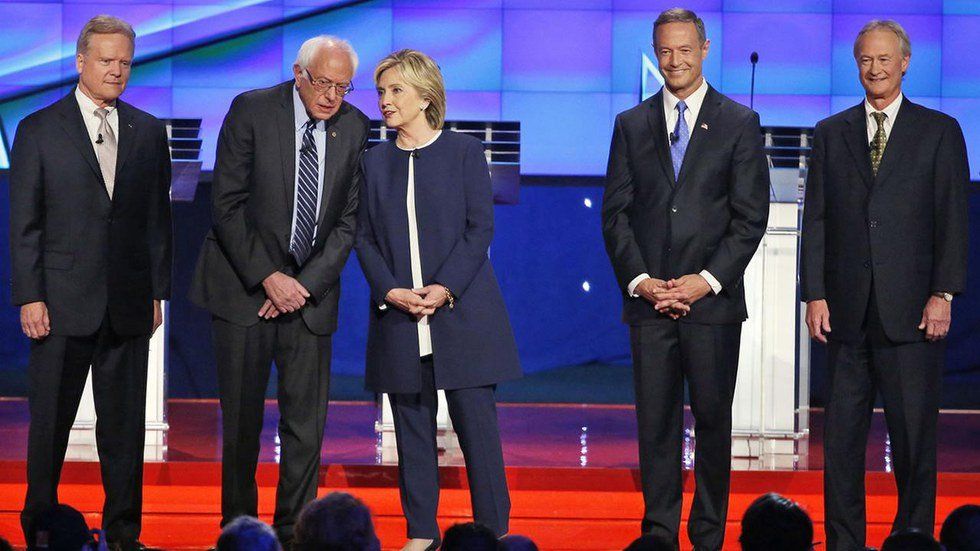
On Tuesday, October 13th, the Democratic National Convention hosted the first of soon-to-be five presidential debates. While Senator Bernie Sanders and former Senator and Secretary of State Hillary Clinton unsurprisingly received the most attention throughout the evening, the remaining three candidates, former Governor Lincoln Chafee, former Senator Jim Webb, and Governor Martin O'Malley, had their moments in the spotlight as well. Overall, the debate was a noticeably more fluid, organized, and educational affair than its Republican counterpart.
The candidates answered questions on several of the most important and provocative issues of our time, such as climate change, income inequality, and gun control. In contrast, the Republican presidential candidates answered questions regarding Donald Trump's potential control of the United States' nuclear stockpile, the alleged criminalization of Christianity, and former Governor Mike Huckabee's hypothetical litmus test for Supreme Court nominees. This clear focus on very real and pressing issues was a breath of fresh air in a presidential campaign otherwise saturated with raw political sensationalism. It also allowed the viewing audience to more easily determine specific stances or particular policy goals of each candidate, directly and unfiltered.
Throughout the evening, there was an indelible and predictable focus on front-runner Hillary Clinton and close second Bernie Sanders. Both candidates were afforded, despite claims of parity among all participants, the most talking time and frequently crossed verbal paths. Clinton criticized Sanders for not being tough enough on the issue of gun control, while Sanders responded with criticism of his own regarding Clinton's socioeconomic status and support of the controversial Patriot Act and Troubled Asset Relief Program. Ironically, it it was Sanders who provided one of Clinton's strongest moments of the night when the former Secretary of State fielded a question regarding her use of a private e-mail server during her tenure. After Clinton addressed the question, Sanders memorably declared, quite passionately, that there are more important issues at hand and the American people are "sick and tired of hearing about your damn e-mails!"
The remaining candidates desperately struggled to break through the Clinton-Sanders dogfight and voice their own opinion, with Webb repeatedly complaining about not getting a fair chance to speak. O’Malley registered a few memorable moments and snuck in some jabs at the leading candidates himself, and generally came off composed, knowledgeable, and sufficiently presidential. Chafee, however, mostly faded into the background throughout the majority of the debate, having just a few, undeniably painful opportunities to speak.
In terms of who won the debate, it is my opinion that the winner is decidedly, unquestionably, the American people and all those who chose to tune in. In a presidential campaign defined and suffocated by senseless sensationalism surrounding the Republican candidate clown-car, this debate was refreshingly informative and issue-oriented. From college affordability to income equality, climate change to civil rights, campaign finance and immigration reform, no stone was left unturned. And there are some very important, consequential stones to consider in this election.
It is simply impossible for the likes of Donald Trump, Ben Carson, or Carly Fiorina to realistically compete with the likes of Clinton and Sanders in a general election given the contemporary political atmosphere. Whether it be through easily discernible and popular policy positions, personal values, or practical experience and proven capability, the chosen Democratic nominee will categorically outclass the chosen Republican nominee. Through this debate, and the four yet to come, it will become unmistakably clear to the American people that it absolutely must be a Democrat who succeeds President Obama and continues to move this nation forward.