Recently, while looking for a way to pass the time on a nearly twenty-hour international flight, I decided to watch all the Disney movies on the in-flight entertainment (because in my opinion, there's nothing better to do when you can't sleep at 2 am due to uncomfortable airplane seats than have a Disney marathon). Tangled, Frozen, and Zootopia, all recent Disney movies that I adore, were available, so I happily loaded them into my queue and proceeded to stream. But the thing about marathoning movies back to back is that you often notice different things about them than when you see a film by itself. That's part of the fun of bingewatching. And what happened when I watched Disney's most recent box-office hits all in quick succession? I began to realize... these films all have the same female lead.
I'm loathe to admit it. Honestly, I am--the fact that I'm a twenty-one year old woman willing to have a Disney marathon in the dead of night should give you some of idea of how inordinately fond I am of the old mouse-- but the longer I stayed up watching, the more inescapable the facts became.
Let's break down this winning formula Disney's concocted. Our heroine is a plucky, optimistic yet naive girl who's been sheltered all her life, but she soon stumbles into her very own adventure where she gains a bemused streetwise male sidekick who begrudgingly helps her. Along the way her innocence will be the subject of many jokes, but her genuine attitude and her good heart will help her win over even a tavern full of criminals or the G-rated version of the Godfather. She gains courage and becomes a competent heroine, though never in a way that takes away from her cuteness or make her seem threatening.
And that's pretty much how things go for modern Disney ladies.
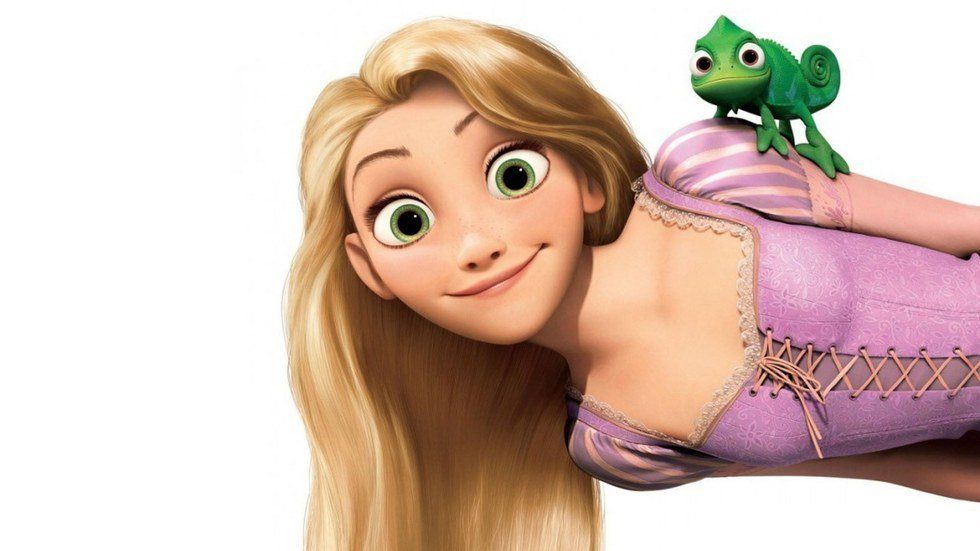
Granted, there is some nuance that helps differentiate each female lead, and I don't want to ignore that--Rapunzel's a dreamer, Anna's a goofball, and Judy's careerdriven. They aren't bad characters or even bad role-models! But they're pretty clearly all cut from the same cloth. There's a very clear status quo that Disney seems to have made it's new MO for all its new films, and there doesn't seem to be much deviation from established character types and journeys.
Part of what made this trend so strange was that the plots and the settings of these movies were all quite different-- you have everything from a giant locked tower to an ice castle all the way to a city full of talking animals. Clearly there's no limit on the where or when at Disney... just the who.
And maybe I shouldn't be surprised that Disney's developed a standard list of tropes for their movies to abide by. Obviously, it's worked out quite well for them both critically and financially, and they are a business first and foremost. If it ain't broke don't fix it. Still it makes me wonder what it is about this particular heroine and her particular character arc that has caught on so much.
She's got a lot of comedy value, especially when she's paired with her snarky guy sidekick, which is pretty huge in a kids' film. She's also easy to like, which again is pretty important. Our Plucky Disney Heroine can be strong and accomplished, showing off female empowerment, while still being flawed and vulnerable, teaching kids (particularly girls) that they don't have to be perfect. All good stuff, right?
But see, it's the flaws our girl has that really start to get to me. See, the Plucky Disney Heroine is never allowed to get angry. Dismissive and condescending remarks constantly being thrown her way make Judy wide-eyed and droopy-eared, not short-tempered or bitter. Rapunzel becomes dejected and tearful after Flynn abandons her and makes off with his stolen crown (or so she thinks, anyways), not furious at her betrayal.
Interestingly, in the deleted and extended materials accessible on Frozen's DVD/Blu-ray and soundtrack, you can see that Anna once had a song called "Life's Too Short," where she became fed up with Elsa constantly shutting her out while Elsa reached her limit with Anna's recklessness, and the two break into an angry duet during which they express all their frustrations with one another that they've been bottling up over the years. Later on the song has a reprise, where the sisters muse about how they've learned to see things from the other's point of view, in such a way that I suspect was intended to teach kids the importance of communication and empathy in a relationship. But as it is, both songs ended up on the cutting room floor, and instead we got "For the First Time in Forever (Reprise)." This song depicts Elsa as rejecting Anna out of fear for her safety rather than annoyance, and Anna is insecure and subdued after being turned away. The closest Anna comes to being angry in the rest of the film is when she punches Hans during the ending, a thirty second scene that is played entirely for laughs, despite the fact that he humiliates and nearly kills her onscreen.
Say what you will about the Disney heroines of the 90s (and trust me, you can say plenty), they were all allowed to be furious. Ariel bristled at her father's overbearing behavior, Belle got into a shouting match with the Beast, and Jasmine gave nearly every man in the movie a piece of her mind. Our new Plucky Disney Heroines are allowed to be more proactive in their stories, but they're rarely allowed to express any negative emotions beyond sadness and self-doubt. They aren't even allowed to be confident, not really.
And again, there's nothing wrong with that, per se. I tend to be insecure and unsure of myself, which is probably part of why I enjoyed these movies so much. When it's the only type of flaws any of your heroines have... well that's where the problems start to come in.
Because Disney movies get seen by a lot of people and a lot of kids. And we live in a culture where songs can proudly tell girls "you don't know you're beautiful/that's what makes you beautiful" (that's One Direction, for all you old farts like me). In other words... the fact that you don't recognize your own self-worth is what gives you worth. It codes low self-esteem and insecurity as good things, even as the boy(s) singing the song is ostensively trying to tell the girl how much he admires her. These are the type of subconscious messages we put in our media. And when the most popular kids' films in the world all have the same type of heroine with the same type of flaws, I worry that we're beginning to tell our kids that these things really aren't flaws, but natural and acceptable parts of what it means to be a girl. Disney may only be in it to make sure that winning formula keeps bringing in the green, but as a cornerstone of American culture, we have to be aware of the larger effects that telling this same story over and over again has. What we teach our kids sticks with them. And it can take them lifetimes to unlearn.
Disney's newest princess film Moana already seems a departure from the golden standard. It features the company's first Polynesian princess, there doesn't seem to be any romance storyline, and even the trailers have less of an emphasis on humor more of an emphasis on magic and wonder than previous ones have had. I take these as positive signs and am allowing myself to be cautiously optimistic. But the truth is, until I'm sitting in the theater, watching Moana actually be allowed to be angry, to be fully human... I think I'm still going to be holding my breath a little.