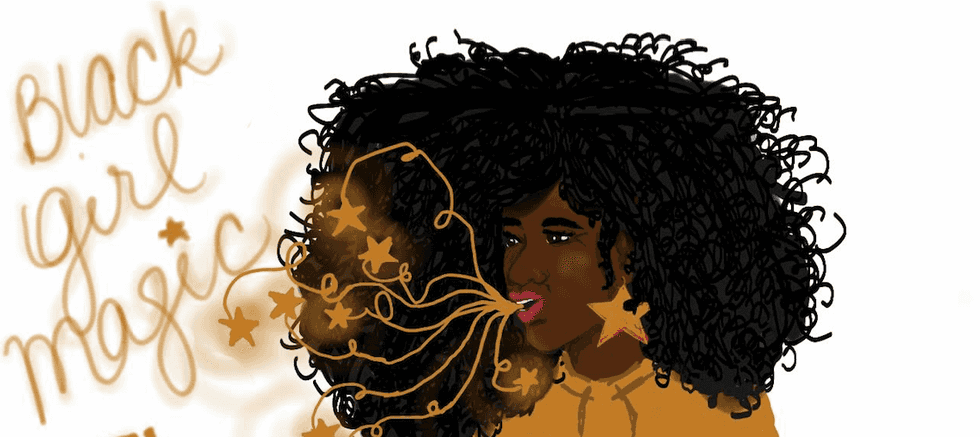
On Wednesday, Elle Magazine released the article "Here's My Problem With #BlackGirlMagic." Within hours, the Internet - i.e. Black Twitter - erupted, criticizing Elle over publishing the controversial piece. In the article, Dr. Linda Chavers expressed her belief that #BlackGirlMagic is just the "strong black woman" trope in disguise. She argued against the use of such an exaggerated proclamation because of our tendency to place ourselves, as black people, between extremes. The main message she wanted to share: "Black girls aren't magical. We're human."
Many readers felt that she took the term "magic" a bit too literally in her interpretation of the movement's message. For most, her argument didn't hold up. Many reputable publications, including Colorlines and HuffPost Black Voices, posted articles reaffirming the message behind #BlackGirlMagic. It's used more as a term of endearment - a courageous assertion from one black woman to the next as a reminder of our value in the face of a society that continually makes us feel less-than. It's a rebellious declaration and an attempt to strengthen communal ties. Many response articles made sure to point this out. None took on a compassionate tone. I could understand this response if this was written by a white woman who is on the outside looking in, but Dr. Linda Chavers is a black woman.
With shock, I watched as hundreds of people tweeted that Dr. Chavers was pushing the "white agenda" like a "coon" or an "Uncle Tom" does. It was even more startling because from what I saw, Dr. Chavers had no malicious intent behind her article other than to offer another perspective to the #BlackGirlMagic phenomenon. This was something she confirmed in her For Harriet interview posted online Saturday. Still, accusers couldn't catch the irony in the fact that they readily disparaged another black woman in our community for the sake of arguing that all black girls are metaphorically magic. It spoke to the slight resistance that I do hold towards the phrase.
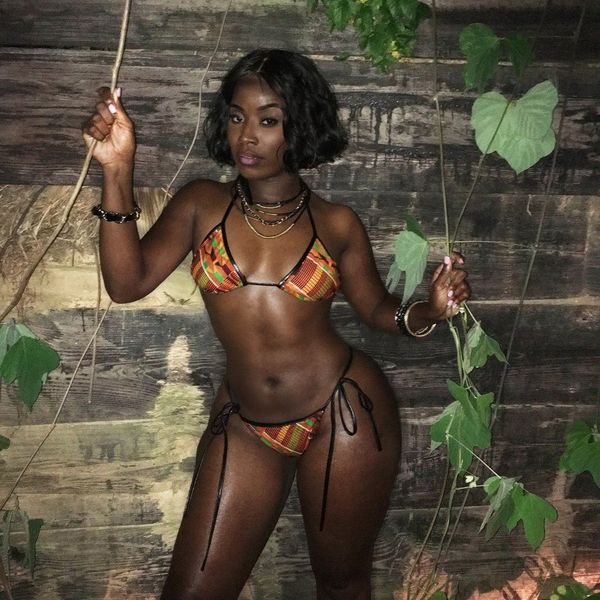
I don't think the words "black girls are magic" have ever crossed my lips because I don't think it speaks about the vast majority of black girls. The truth is that ever since the movement came to be, I saw it conflated with a certain kind of aesthetic. We all know the aesthetic I'm talking about: that black girl with the sun-kissed melanin, perfect twist-out or curled natural hairstyle, and the unwavering confidence, backed by her crew of comparable seemingly flawless black girls that all look like they came straight out of a magazine. This aesthetic has taken on a sort of untouchable standard, one that many young black girls around my age - whom I feel #BlackGirlMagic works hardest to impact - try painstakingly to achieve in order to feel and exude this magical essence easily believed to be unattainable. I feel that it has successfully created a great sense of self-confidence for these young girls while simultaneously planting giant seeds of self-doubt.
When we think of #BlackGirlMagic, the girls that we see like Amandla Stenberg, Zendaya, Willow Smith, and plenty of other tall, slender, light-skinned young black girls are believed to represent and embody the phrase. Now, visibility for any black girl is definitely a win, but must it only be these kinds of black girls?
What about the trans black girls? What about the disabled black girls? What about the fat black girls? What about the dark-skinned black girls? Are they seen as magic? Their near-invisibility and lack of association with the word creates this dangerous exclusivity that can misconstrue the meaning of #BlackGirlMagic
And does this "magical" factor have only to do with our bodies? What about the homeless black girls? What about the black girls with no degrees? Yes, it is important to make sure that we value our physical appearance. But ensuring that the magic we speak of has so much more to do with who we are as black women in all aspects, other than just looking carefree, can create this movement where each black girl feels she gets a fair amount of shine.
I'm grateful for the clarity that the response articles provided about the movement because we need to refocus the message and shift the narrative. In the aforementioned HuffPost article, fashion editor Julee Wilson mentioned a point that I rarely hear in regards to the trademark movement: “#BlackGirlMagic is about living your best life.” This means black girls are magic in all the forms we come in. It’s not about co-opting any other black girl's life to achieve a certain standard. It is very much about, as cliché as it sounds, being true to you. We can't expect young black girls to get there if there are limited images depicting what it means to be a magical black girl. All black girls need to see themselves reflected in the hashtag. So even though we attacked Dr. Chavers for looking at our so-called magic in a literal sense, there is one property we associate with magic that I feel fits really well here, and that property is its ability to heal. Magic can heal, and we speak about the magic of black girls because it heals. It heals us, others, and our entire community. This is our little bit of magic. Let’s make sure we all feel some of it.