
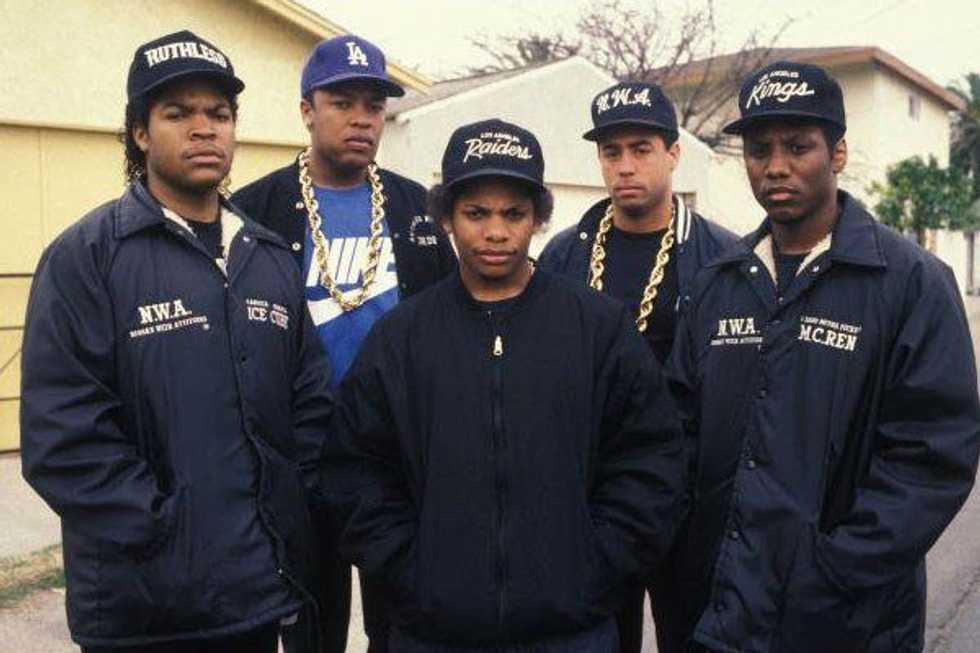
I can say for a fact that, except for one small detail that I will talk about later, the N.W.A biopic "Straight Outta Compton" was not just good, it was very good. As a child of the mid-90's, I felt a certain nostalgia as throughout the film, clips of real life events and news stories spanning almost 13 years were played. I turned one year old a mere month after Eazy-E lost his battle to AIDS, but other events such as Dr. Dre's creation of Aftermath Records in 1996 and the rise of Snoop Dogg and Tupac Shakur were touched upon, events that my parents surely would remember watching on the news as I was growing up.
For as long as I can remember, I have greatly enjoyed listening to gangster rap, with Dr. Dre's second solo album "2001," having been one of the first hard rap albums I discovered as a youth. Looking back on my childhood, I should not have gotten away with listening to that kind of music, but I also had little understanding of the very real reality that most of his lyrics were spawned from. All of my close neighbors grew up listening to albums like "2001," "The Eminem Show," "R&G," etc. and being older than me had a great influence on what I listened to, despite my parents trying to keep me from listening to it. Even one of my closest friends who was older than me told me I was not old enough to listen to N.W.A's debut album, but eventually it fell into my hands, immersing me into some of the strongest language and graphic lyricism I had ever heard. But let's get back to the point of this review, an incredible story of the most dangerous rap group ever to be in the game.
The film opens with a young Eric Wright (Eazy-E) taking care of some gangster business in the middle of suburban Compton, only to have the police show up with a massive battering ram completely decimating the trap house forcing him to make a hasty escape. Following with no opening credits, it went straight into the initial formation of N.W.A and how the six+ founding members came to become friends, with one scene in particular showing the initial recording of the infamous 1986 Eazy-E song "Boyz-n-the-Hood" that propelled him into the local spotlight. It goes on to explain how their conniving manager Jerry Heller had great influence over Eric's decisions, we witness the quick but extreme rise and fall of the collective, and finally the breaking up following Ice Cube and Dr. Dre departing in 1991 to move forward solo and start working with Suge Knight, respectively. While some beef did form between the three now separate entities following their separation, they remained close enough friends to even decide to reunite, shortly prior to E’s death. It chronicled in depth how N.W.A had a massive influence on their fans, causing rioting from time to time in retaliation for violent police work even during concerts, as well as widespread racial profiling and injustice.
What really adds to the depth of the film is the human interaction between the five main members; it did not sound scripted, but as if these men have known each other for many years just as their real-life counterparts do. Ice Cube’s actual son plays his father, and with the exception of the actor playing Snoop Dogg, who neither looked nor sounded like the real D O double G, all played expertly convincing roles.
To go along with the cultural references that I mentioned earlier was one very quick, very subtle statement that E mentioned about Ice Cube, in which he enjoyed Cube’s work as an actor in the 1991 film "Boyz-N-the-Hood," which Cube actually was a part of by portraying a young Crip member.
One of the more overarching themes of the movie was police brutality and targeting, and potent threat to the 1980’s African-American community, especially in poorer areas like Compton and Detroit. Several of the scenes show not just members of N.W.A but other African-American youths being harassed, beaten, and illegally vindicated by not just white cops, but also one black cop in particular. The Rodney King beating occurred in Los Angeles in 1992, where an unarmed Rodney King was beaten badly by four members of the LAPD, resulting in large scale rioting in downtown LA and other close neighborhoods in California. Real footage of the beating was shown on news segments that the N.W.A. members watched on television, showing their own remorse towards the injustice of the law during the time.
As the movie came to a close some two hours later, a good amount of real footage and news clips of the original N.W.A was shown under the credits. I was personally reminded of how much I enjoyed old school rap from the 1980s and 1990s, but also how far rap culture has grown since these five men pioneered it almost 27 years ago. Dedicated to the memory of Eazy-E and the legacy he left on the rap game, I would strongly recommend "Straight Outta Comtpon" to anyone who enjoyed similar films such as "8 Mile," "Notorious," and "Get Rich or Die Tryin’." Not for the weak minded or hearted; this brutally honest depiction of escaping the urban environment should strike a chord within you if you have watched the news recently, specifically the rioting in major cities because of racial profiling, as it would seem as though not much has changed since 1986. N.W.A created a voice for those who continue to struggle through this hardship.

















