
One glimpse of the latest headlines published by any reputable news outlet and it will become bleakly obvious how hostile America’s current political environment is. Our presidential candidates are at each others’ throats and the words spoken by their party members in office fail to be any more uplifting. Give any social network a quick skim and the divisive effect of political ideology on relationships becomes apparent. American politics have grown increasingly polarized and this schism is saturating interpersonal communication and interactions. Social media users have taken cues from political leaders perpetuating personal attacks.
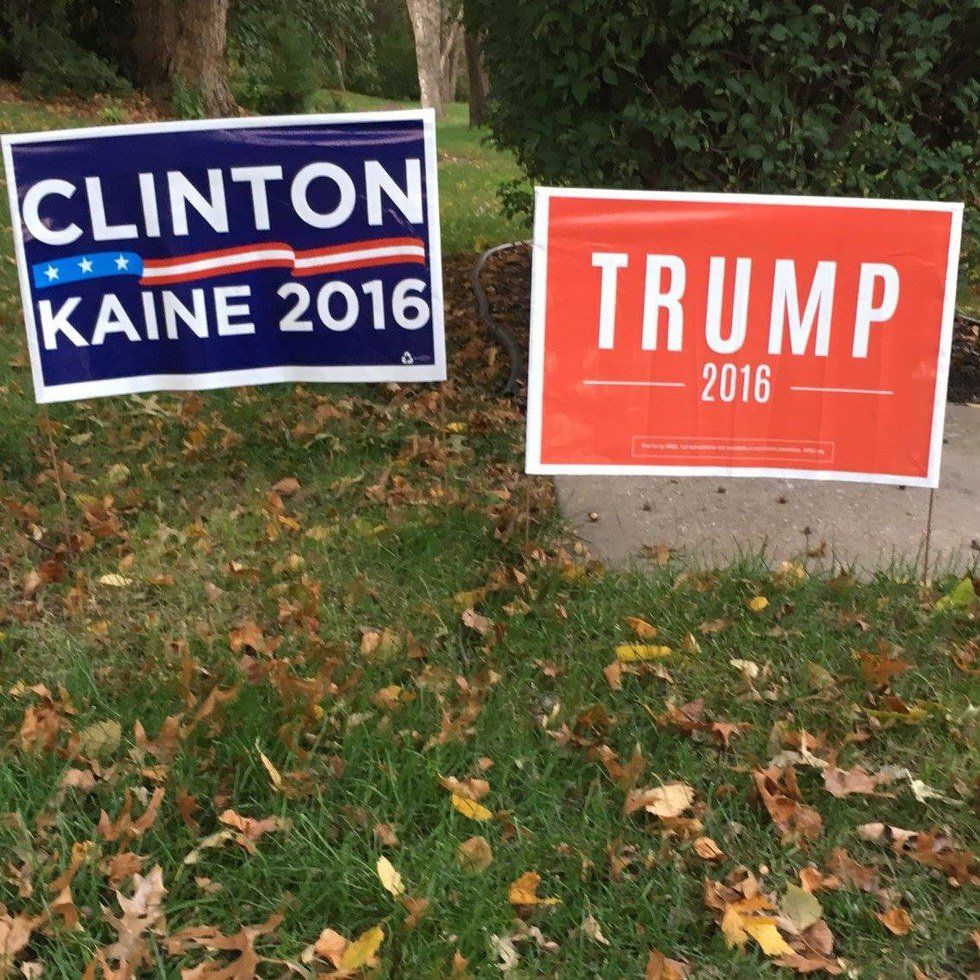
Bipartisanship in both the legislative and social arenas seems hopeless. Ergo, I was enthused to see a particular Facebook post with upwards of 73 thousand likes and 34 thousand shares this past week. In a quick blurb accompanying an image of his Clinton 2016 yard sign alongside his neighbor’s Trump 2016 yard sign, Joel Goldman shares how, despite their differing political affiliations, he and his neighbor transcended the hatred deeply imbued in most political differences. He documents the way in which, although they “disagree about everything in this election – respectfully,” they maintain such an optimistic relationship. He concludes,
So much has been written about the hate, fear, and malice stirred up during this election. But we don’t have to let that be the only narrative. Let’s start a narrative about people who disagree without hate, who respect different views and realize that as important as our votes are, we are more than for whom we vote.
So, as this election cycle culminates in a predictably bitter election night on November 8, the impetus is upon the electorate to “disagree without hate.” Our responsibility is to agree to disagree.
It is imperative to first examine why we become so malicious when we encounter inconsistencies between others’ opinions or choices and our own. First proposed by psychologist Leon Festinger in 1957, “cognitive dissonance” accounts for the mental distress that results from this conundrum. Cognitive dissonance is the tension that results when cognitions (in this case, ours and another’s) clash, which, in turn, motivates us to reduce or eliminate the dissonance in the pursuit of consonance (agreement).
Our brain deals with this in four ways: changing behavior or cognition, justifying behavior or cognition by changing the conflicting cognition, justifying behavior or cognition by adding new cognitions, and ignoring or denying any information that conflicts with existing beliefs. Regarding why we ultimately make the choice that we do, Elena E. Giorgia, in “We Agree to Disagree: The Science of Why your Political Posts Won’t Make Anyone Change Their Mind,” writes, “One possible reason is that there are far less consequences to being respectful or even offensive when debating online.” Because we lack the accountability on social media to which we are held responsible in real life, we have a tendency to resort to hostile language when our political impulses contradict one another’s online.
However, in reality, the consequences can be far greater: “Changing our mind affects our self-esteem and may lead to self-blame, possibly disrupting the relationships around us. That’s why our brain has a tendency to choose the easier path, which often coincides with reinvigorating present beliefs rather than shifting to new ones.” Due to our psychological predisposition to argue our correctness, rather than relenting and realizing another valid viewpoint, we actively perpetuate such malice.
If we are to consciously choose to agree to disagree in order to transcend our differences, which in turn perpetuate antagonism, we must also understand what exactly it means to “agree to disagree.” The term was first printed in 1770 in John Wesley’s 53rd sermon, “On The Death of The Rev. Mr. George Whitefield.” Used in the first point under his third subtitle, it emphasized the need of Christ-followers to transcend differences in scriptural interpretations in order to unify together as a means of overcoming the grief associating with Whitefield’s passing. It first evolved from the Latin term “modus vivendi,” which, literally translated, means “way of living.” This Latin term was employed as a means of encouraging conflicting parties to exist in peace.
Diplomatically, it explained an instrument of establishing a temporary international accord that would later function as a formal treaty, demanding peace between two nations or institutions. In this way, it is clear that agreeing to disagree necessitates peaceful resolution – or lack thereof – between two parties of different leanings in the pursuit of peace. In 1919, Justice Oliver Wendell Holmes wrote a dissenting opinion for the United States Supreme Court in Abrams v. United States that then translated the choice to agree to disagree into a rationale for a “marketplace of ideas,” the rationale upon which the protections of the First Amendment are based. Ronald K. L. Collin’s “Holmes’ Idea Marketplace – Its Origins & Legacy” explains the current implications of this. Professor Lee Bollinger notes, “…within the legal community today, the Abrams dissent of Holmes stands as one of the central organizing pronouncements for our contemporary vision of free speech. Scholar Sheldon Novick notes, “[The Holmes dissent] is at the root of modern First Amendment protections.” Although Holmes’ idea derives from English poet and political thinker, John Milton’s 1644 Areopagitica, it mandates that the government cannot restrict the expression of contrasting ideas because people are more than capable of accepting good ideas and rejecting bad ones. Ergo, this fundamental democratic right – in its purest form – originates from the practice of agreeing to disagree.
The concept which Holmes evokes, the marketplace of ideas, provides an excellent transition to my next point: it is okay to not reach consensus. Nicholas Clairmont, in “‘Let’s Agree to Disagree.’ I Don’t Agree to That,” insists that agreeing to disagree is the result of people wanting to bury the hatchet, implying that such is just a symptom of being too wary of conflict to force an ideological opponent to conform to one’s own viewpoint. This perspective necessitates the “it gets worse before it gets better” perspective. On the contrary, agreeing to disagree enables people to move forwards, overlooking their ideological differences and working towards a productive dialogue beyond their political contrasts.
This is often a futile effort, though, due to our confirmation biases. Giorgi describes the confirmation bias as the behavior of reinforcing one’s beliefs in the face of increasing contrasting evidence, defining it as “…the tendency to favor certain explanation that conform to our own beliefs and/or emotional response.” Arguments with the objective of changing an opponent’s stance is often pointless because of this psychological phenomenon. Hence, “getting worse” is often a moot point bound to insinuate increased hostility, rather than resolution or consensus. I rest my case, then, that agreeing to disagree is a democratic right destined to enable us to overcome the present hostile political environment.
So, I leave you with an application. Rather than ferociously arguing your vote for Clinton on a childhood friend’s Facebook post advocating for Trump, rest your case. Neither of you will change your mind. Instead of feeding a virulent political feud that will indubitably disrupt your personal relationship, agree to disagree. Like Goldman said, we are more than for whom we vote. Let us be the inherently good people that we are.