It seems lately that every time one opens their favorite news media outlet, there are some threats or crises facing the world. As Americans, we still feel the reverberations of 9/11 and the effects of the global War on Terror. Organizations and terms such as Islamic extremism, Al Qaeda, ISIS (ISIL or the Islamic State), and various despots in the Middle East have all at one time been the greatest fear of the American people. While it would be naïve to discount these fears as unsubstantiated or rooted strictly in islamophobia or xenophobia, the effects that the listed groups, and many more, managed to leave on American culture and its political system is concerning. As a people, Americans now fear their demise could come at any turn and come from any party who has ties to their decade-old enemies. People have willingly given up their rights and liberties for the sake of security under various legislative actions, the most comprehensive being the Patriot Act. The country’s gaze was firmly cast on the Middle East and quelling terror havens around the world. During this campaign though, Americans seemed to lose interest in the rest of the world and also, perhaps more importantly, they forgot about the events of the past.
President Obama has stated many times during his time in office that the United States needs to make a pivot toward East Asia and rekindle old alliances in the region. China appears to be a sleeping giant that is finally poised to strike out and claim what it wants. Its frequent incursions in the South China Sea threaten to destabilize the entire region. It is this writer’s opinion that China’s foreign policy and soft power are a much greater threat than any tool of war. The People’s Republic of China is equipped with a behemoth economy that, if threatened, could cause markets around the world to crash. Leadership is certainly aware of this reality and use it as a deterrence against any challenges to their ambitions. The country’s bravado has reached the point where Japanese and Chinese fighter pilots are flying out to meet each other, both parties waiting for their target to take the first shot. This is where it becomes vital for every American to know their duties to other countries in the world after a decade of being out of touch with the world.
The instance stated above is a specific action between two soldiers, but the ramifications the actions of those fighter pilots could bring to their world is terrifying. After World War II, the Empire of Japan was dismantled and its emperor reduced to nothing more than a figurehead. The United States then implemented a democratic government and stripped Japan of all military capabilities excluding a national defense force. This meant that America was now charged with the defense of the Japanese state, a country which had made more than a handful of enemies after embarking on its crusade to swallow up the Pacific Theater. To date, there are approximately 50,000 United States military personnel stationed in Japan. So, while two pilots on the other side of the world zipping past each other may not seem like a concern for America citizens, these warming embers of war are right at our doorstep.
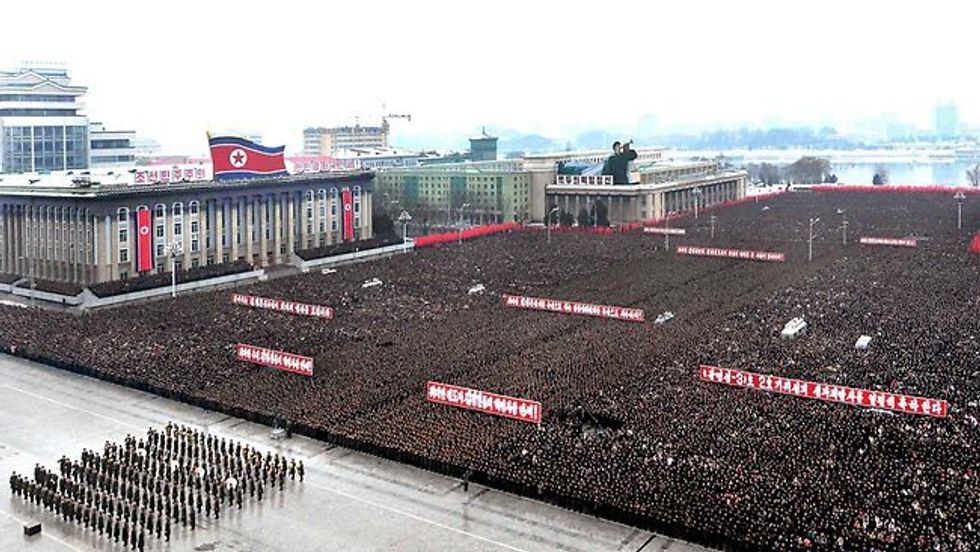
While this has been a rather roundabout method of finally reaching the greatest threat to American national security in East Asia, setting the scene and laying out the dramatis personae is critical when analyzing such a complex issue. Lurking behind this web of alliances and key players lies the flash-point tension happening on the Korean peninsula. While the American-supported South Korea has little love for Japan and the United States’ relationship with the country, leaders have expressed concern in recent years for increased support and pressure in the region as the small democracy stares down its nemesis to the north and their Chinese supporters. It is here where this author can say plainly, and with certainty, that North Korea’s leader Kim Jong-un will bring another war to the Pacific. While most Americans are more familiar with the mad despot’s attempts and threats to construct a missile capable of striking the American homeland, his motives are clearly more sinister and he is more aware of his power over global politics than we give him credit for. North Korea’s lack of global political affiliation, excluding support from China, makes the country a loose cannon and, ironically, a lynch pin to regional peace. The hermit nation forces the United States and regional powers to work around the latest shenanigans the Supreme Leader unveils.
Americans see the country as some kind of joke due to the odd and quirky stories that are leaked by journalists and refugees, but this writer believes that North Korea is the greatest threat to international peace and stability for that very reason. The country is led by a madman who, while seemingly incompetent and goofy, is savagely cruel and has a standing army numbering approximately 9,495,000. While ISIS may have a powerful recruiting machine via radicalized preachers and social media, they don’t even compare to an established nation armed to the teeth with weaponry courtesy of the former Soviet Union and China.
Recent reports claim that Kim Jong-un has ordered his troops to prepare for some kind of incursion over the DMZ. Given all that has been expressed in this article what do you think the response will be when the first rounds fire across the border? North Korea’s Supreme Leader has the power to tip the scales of relative international peace and, while he may seem absurd and full of false threats, it will only take one delusional outburst on South Korea or Japan to start another war in the Pacific. The last time the West decided to discount the ravings of an unstable leader it did not end well for the global community. While the intent of this piece is to foremost educate Americans on the reality of politics in the East, it is also meant to serve as an urged awakening. As a country we have spent so much time fighting familiar enemies and helping familiar friends that we seem to have forgotten what lies beyond our immediate line of sight. The worst kinds of problems and crises are the ones we least expect. Educate yourself and become more of a global citizen, after all, your life depends on it.