Throughout the history of economics and finances, there have been times when the prospect of productive and fiscally sustainable tomorrow were assured. And at other points, that was far from the case. Oftentimes circumstances out of our control tend to find their way into the fabric of each and every individual's lives. It does not matter if it is a short walk from your home, or halfway around the continent - circumstances of a governmental, political, social and economical nature tend to affect the majority of people. People in these troubled times look to institutions, agencies and bureaucrats for clarity, and sometimes they are able to help alleviate these issues. Other times it is intervention from the private sector that can help spur up a dormant, or rusty and slowing economic engine. Because of the issues of the past, many Americans are contented and secure in their belief in the promise of tomorrow. Although we must remain optimistic, it is important to note that although history does not repeat itself, it does have a funny way of rhyming so to speak. We must therefore learn from the lessons of yesterday to ensure our continued economic growth.
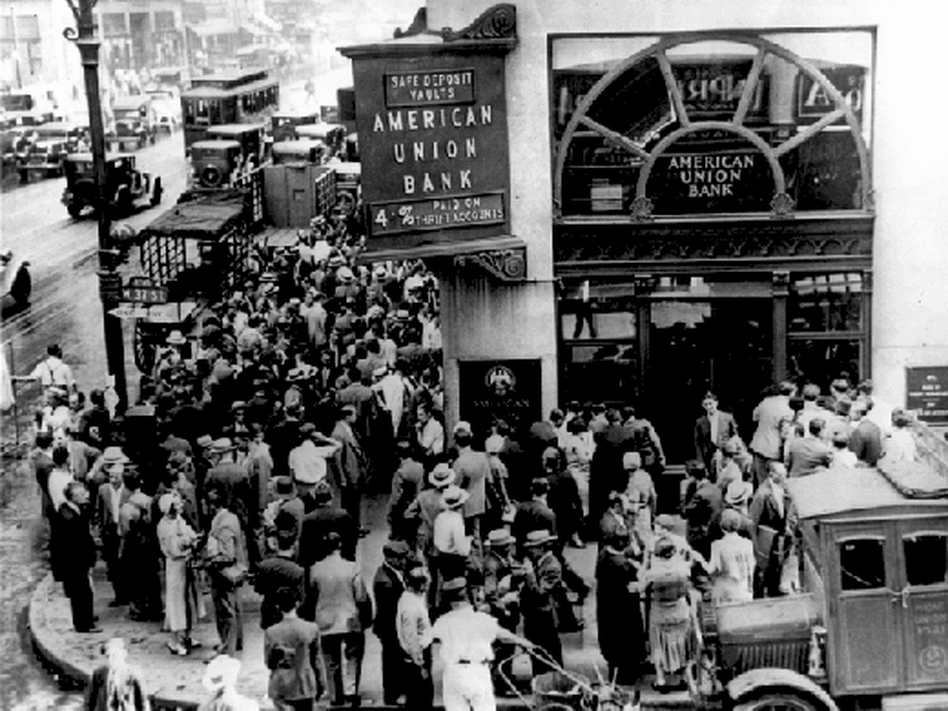
The year is 1933. President Herbert Hoover is dealing with a wave of backlash emanating from the numerous financial related crises popping up around the nation. Franklin Delano Roosevelt is assuming office in a matter of weeks. The United States’s economy is trudging along, and although there are pleas of ‘calm’ from the politicians, there is an tenseness sweeping the nation, a sense of unease. After a stock market crash in 1929, faith in the banking system was rapidly gaining mainstream traction. In 1933, this distrust in the banks came to a head when two Detroit banks failed, following this a statewide closure of all banks took place. This event spearheaded a national banking crises due to fears that, soon, people all over the nation would see their life's savings quickly disappear. In an attempt to alleviate the issues then, President Herbert Hoover organized the Reconstruction Finance Corporation which would allocate federal funds to stop these banks from becoming insolvent and try to curb the possibility of a bank run. Why, Detroit? Well, that fact is fiercely debated and although many of the banks across the nations were allied with the same issue, it seems that sometimes the element of chance plays a role in the affairs of day-day to sociopolitical and economic circumstances. But it is undisputed that the effects from Detroit had a massive reverberating effect on the entire nation. In the days after President Roosevelt's inauguration, measures were taken to promote stability in the United States economy. Roosevelt declared a federal banking holiday. Within a week he had pushed the Emergency Banking Act through Congress. Understanding that the majority of Americans would be unable to interpret the bill, or have it readily available to read, Roosevelt organized his first radio aired ‘fireside chat’ detailing the measures that were put into effect in the bill. The Emergency Banking Act organized Amercian banks into three categories, determining their soundness and ability to operate. According to The University of Washington’s economic department, "about 50% of the nation's banks, holding nearly 90% of the country's total resources, were judged to be safe and allowed to reopen by March 15. Forty-five percent of the nation's banks were placed under conservators, or regulations, and were only able to pay out a certain percentage of deposits. These banks were subject to reorganization overseen by the Reconstruction Finance Corporation, while the remaining unstable banks, approximately 5% of the nation’s total, were closed permanently without any plans for reorganization.” On Monday March 13th, banking resumed across The United States with the opening of numerous institutions in the twelve federal reserve cities, the organization responsible for the capital flow throughout the country. These banks managed to open with full functionality and a more than sufficient supply of federal reserve notes. Due to the actions of the government of the United States, and the advisory advice from citizens in the private sector (i.e John Pierpont "J.P." Morgan through his funds that helped to keep many banks solvent during the closures that ran amok during the crisis), the country was put back on the rails of financial security. Though- this was not to be the last of America’s banking related crises.
From the 1980’s to the early 1990’s, the United States was dealing with another financial crisis. This was due in part due to deregulation of thrifts in 1982, which gave thrifts greater power to invest in real estate. Though a dangerous prospect, this lead to the collapse of 2008. However, in 2008, credit card debt paid a large part to play as well. According to Investopedia “between 1980-1994, a total of 1,617 commercial & savings banks failed. $206.179 billion in assets were held in those failed institutions. In another study using FDIC data provided by Investopedia, “1,043 thrifts failed or were otherwise resolved from 1986-1995. Those institutions represented assets totaling $519 billion. The banking crisis of the 1980s was therefore a two-headed beast – one head related to the failure of savings and loans (the S&L crisis, or Savings and Loans Crisis), which represented the bulk of the assets and number of banks, and the other linked to the failure of large commercial banks.”
In 2008, a financial crisis akin to The Great Depression occurred due to a numerous array of issues swirling around the financial markets of both The United States and the global community. Due in part to deregulation of the 1980’s and ever increasing credit card debt and loans for houses in the hopes they would make a return investment - they did not, as many of these loans were given out at low rates to people that were unable to pay them back. As housing prices plummeted due to market trends, interest rates rose causing people to lose their assets by the droves. To make matters worse, credit and lending unions Fannie Mae and Freddie Mac, under fear of going under, were taken over by The Federal Government. Major investment firms went under - Lehman Brother and Goldman Sachs specifically spurred the investor fear. To make matters worse, not only were the banks looking for a bailout, but so was the Auto Industry - chiefly Chrysler and GM Motors based in Detroit. There reason being that if the auto industry were to go under, millions of jobs would be lost. So not only did Washington bailout the banks, but also the auto industry. To try and spur growth, The Federal Reserve lowered their interest rates on borrowing money, to loaning and mortgage rates to zero - to mainly give a bump to consumer and investor confidence. Although this did little to stop the global economy's downward spiral. In the wake of these events a government funded stimulus package was created. In total 787 billion US Taxpayer dollars were allocated to spur growth in The United State's ailing economy. This money was used for roads, bridges, airports and education. Although we have still not fully recovered from the events of 2008 and although many today live in deep economic disparity, we are still slowly moving towards economic equality and equal economic opportunity due to the lessons of this crises.
On the onset of our country’s beginnings, there was belief held that a central bank was needed to regulate the flow of money throughout the United States. It was not until 1913 when the Federal Reserve System was formed. Less than fifteen years later we learned that more was needed to ensure the solvency of the American economy. From the crises of 1933 we learned that deposits had to be insured by the government and thus the Federal Deposit Insurance Corporation was established. From the 1980’s through the 1990’s we learned that from some of the many governmental bureaus and regulations created to combat issues of the past it, created issues for the future. Primarily in relation to the Savings and Loan industry being exposed to high interest rates and government regulation. In 2008 due to deregulatory efforts as well as a growing mortgage bubble, fueled by loans that couldn't be paid off, the world this time faced an economic catastrophe fueled by the slowdown of economic growth. We learned here that a balance was needed in regulation, and the free markets. But we also saw firsthand from research reports to general public discontent that the overwhelming evidence concludes that there is a small minority reaping the benefits of an underrepresented majority. It seems that in the history of finance efforts to alleviate issues are always met with more issues, either by the governments doing or through greed and gaming of the system. It then seems to be a moral problem, one of untold greed and a want of wealth. In order to ensure the security of tomorrow we must have a healthy balance of private investment, government regulation, and parameters in place to avoid loan bubbles of any sort - in the scope of events, it is not capital we are dealing with, but rather people's lives.
Works Cited Page
Sources Provided by Economics Class listed in master document along with this document are to be turned in together. Other, outside, sources used are listed here below - The sources used are from accredited institutions of either education or finance.
Other Sources