Global climate change is an unprecedented premise of the 21st century. There are many factors that go into explaining the complexity of it, nonetheless proving it. Although there is overwhelming proof and scientific consensus that man made climate change, skeptics have been known to mention Earth’s much warmer and thriving planet of the past.
This has inspired this article to help break down how human induced climate change differs from natural causes of climate change. The important difference is the time it takes for the Earth to naturally warm up compared to how fast it is currently warming due to human activity.
Earth's climate has varied the past billion years and will continue to change until the sun dies out five billion years from now. Our fragile planet is very unique compared to any other planet we have discovered and for good reason—there is no solar system exactly like the one we currently live in.
The 365 days it takes to orbit our star only explains a portion of our global weather patterns. In the 1930s, a man known as Milutin Milankovitch came up with a theory on how the Earth’s orbit, tilt and axis creates global climate change during different time periods. These three factors change slowly over thousands of years, yet they make all the difference between today's climate and our last ice age that ended some 12,000 years ago.
Let’s break down these three factors.
Eccentricity (Orbit)
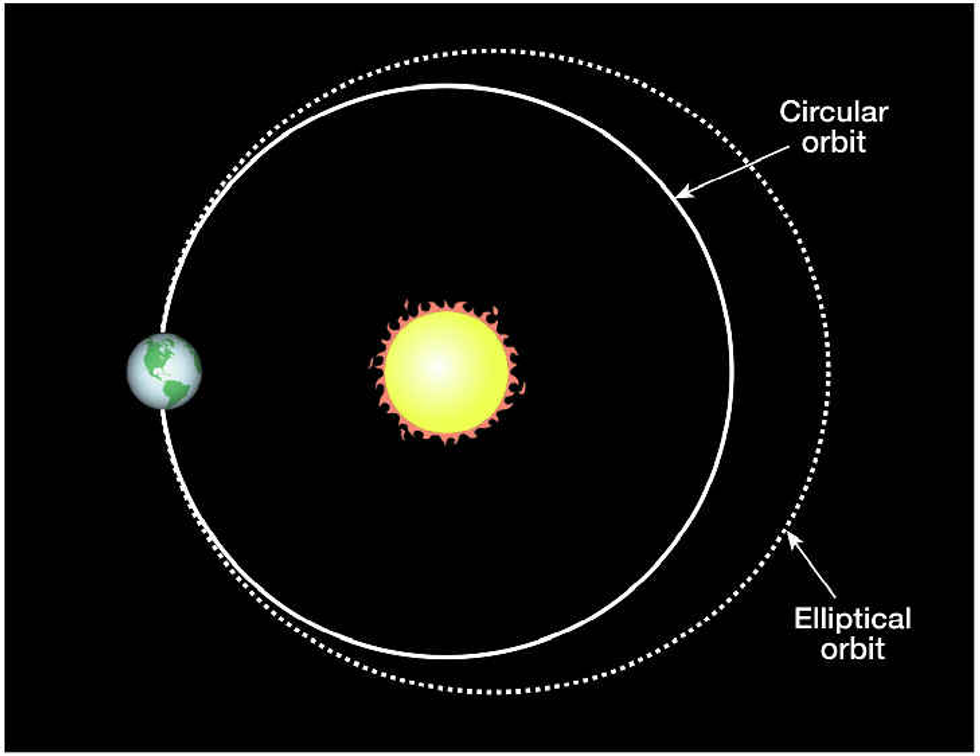
Earth’s eccentricity—the shape of the orbit around the sun—has a direct affect on the distance between the Earth and sun. Our orbit changes from elliptical (high eccentricity) to circular (low eccentricity) that cycles every 100,000 years. During elliptical, which we’re currently in, our planet receives nearly 6% more solar radiation (insolation) compared to the low eccentricity during circular orbits. This difference varies by a 5 million kilometer distance in orbit from perihelion (closest approach), occurring January 3, and aphelion (furthest departure) which occurs July 4.
http://www.geo.hunter.cuny.edu/tbw/wc.notes/14.cli...
Precession (Wobble)
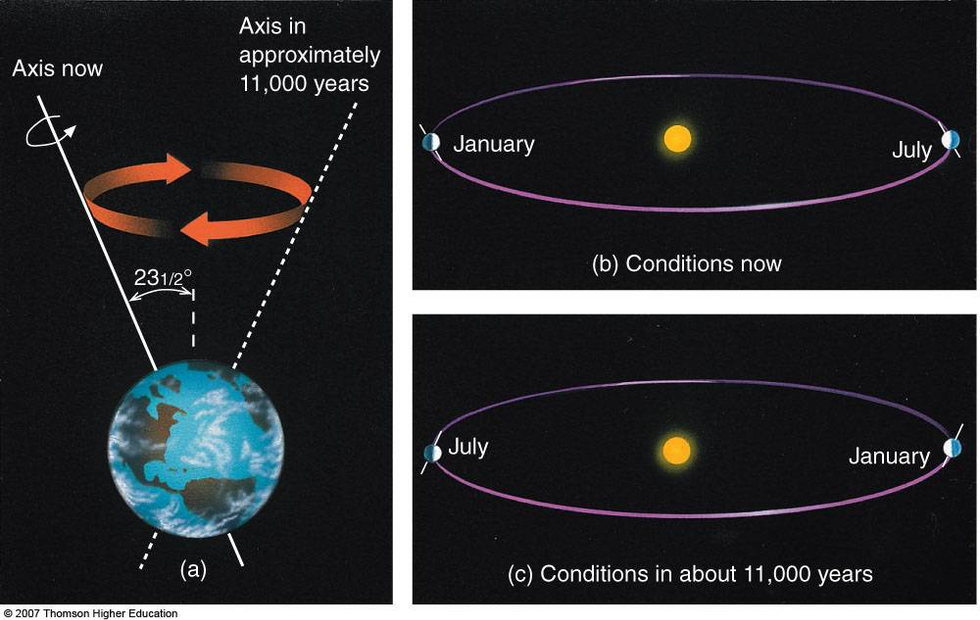
By no means does our planet spin in perfect elegance. During a 26,000 year cycle, Earth’s spin may be comparable to a spinning top winding down, just never simply stopping of course. This wobble effect is a direct cause of the more distant-larger gravitational pull of the sun and the closer-smaller gravitational pull of the moon.
The significance of precession is how the poles point towards the sun. Currently, northern hemisphere summer occurs during our furthest distance in orbit from the sun (aphelion). Every 13,000 years the northern hemisphere summer becomes winter during aphelion orbit, thus greatly changing global weather patterns in a relatively quick demeanor, geologically speaking.
http://apollo.lsc.vsc.edu/classes/met130/notes/chapter16/precession.html
Obliquity (Tilt)
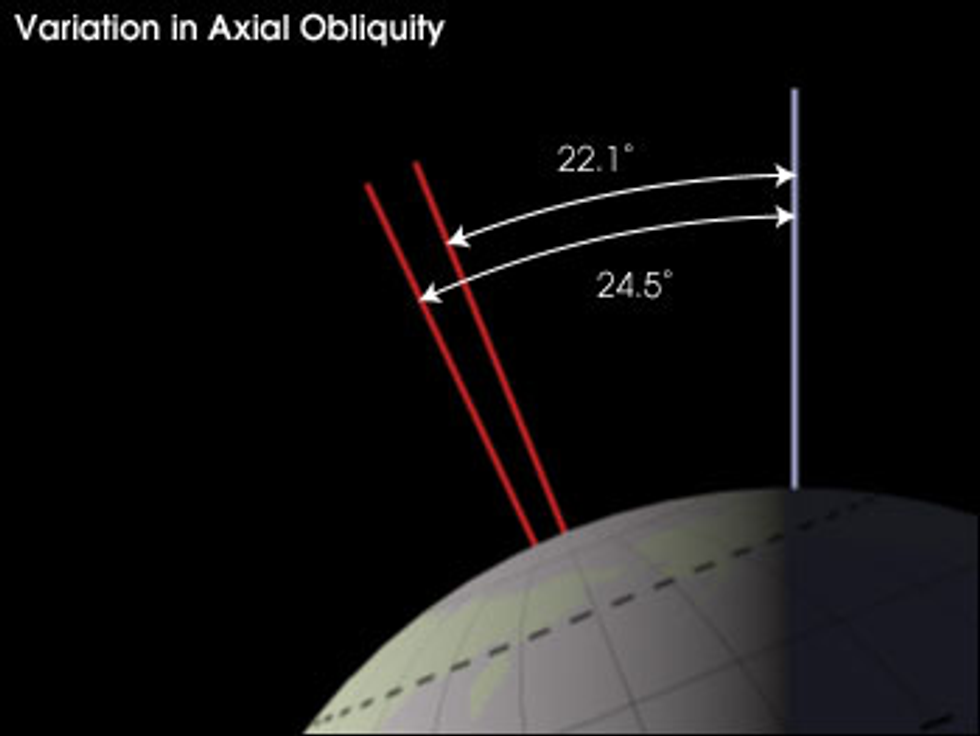
The tilt of our planet varies between 22.1 and 24.5 degrees (currently at 23.5 degrees) during a 41,000 year cycle. Obliquity is believed to contribute to ice ages more than the other two previously mentioned cycles due to periods with less tilt. More tilt creates more severe weather patterns with hotter summers and colder winters, but less tilt means cooler summers and milder winters. The cooler summers during less tilted periods cause more snow pack to accumulate over thousands of years, eventually creating massive glaciers.
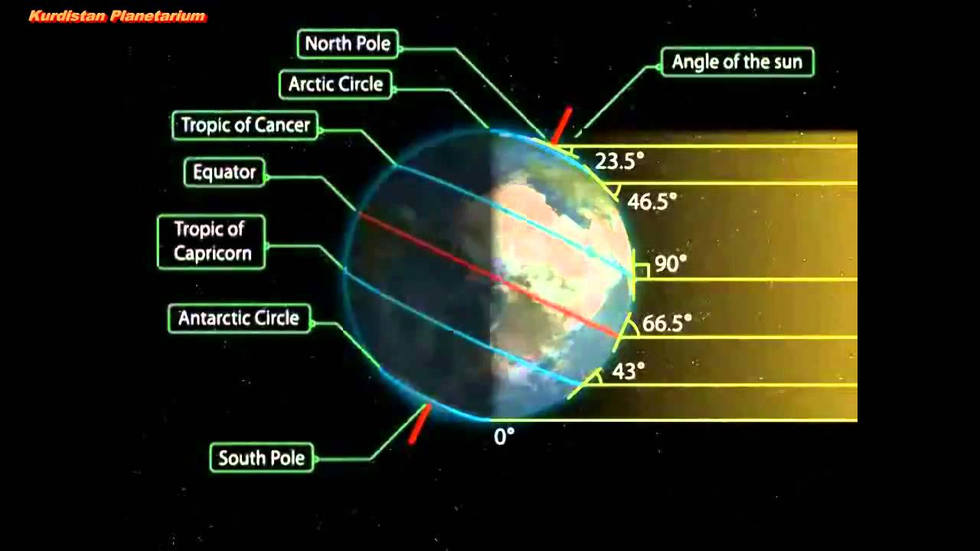
Top figure: https://earthobservatory.nasa.gov/Features/Milankovitch/
Bottom figure: https://www.youtube.com/watch?v=WLRA87TKXLM
This process is an example of a positive feedback loop. As snow accumulates over larger areas the white color reflects the incoming sun rays more than any other color. As the summers are already cooler during these periods, the reflection—commonly known as an albedo effect—creates an even cooler climate, thus adding more snow and ice to build up.
The “positive” in positive feedback loops is contradicting and rarely mean something positive will be benefited from them. For example, manmade climate change starts with extensive output of greenhouse gases such as carbon dioxide from oil and coal; deforestation of trees that help store that carbon; warming and acidifying oceans that melt glaciers, creating less albedo, in turn creating more solar absorption due to increasing dark blue water masses that make the water warmer yet.
As aforementioned, the primary difference between Milankovitch Cycles and current human induced climate change is the hastiness of the greenhouse effect caused by carbon and methane gases due to industry and transportation. It’s taken less than 100 years to increase global temperatures compared to thousands of years that naturally warm our planet.
Many factors play into climate change, both long-term and short-term. Yet when people make arguments and excuses as to why global climate change is indeed no threat to our planet, we must remember that science has created this amazingly developed world we now live in. If you know DNA testing is real or that electricity is what powers electronics, then why not believe what the overwhelming consensus of scientist believe about today’s global warming?