


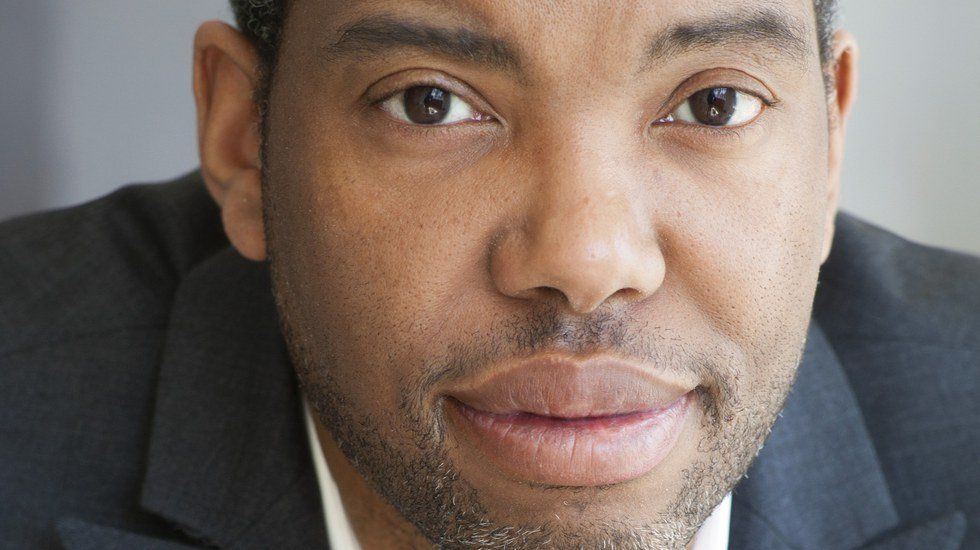
Earlier this week I was watching an episode of the ABC sitcom "Black-ish" and I found myself ecstatic to see that one of the characters mentioned Ta-Nehisi Coates as a prominent influential intellect of today. I was especially happy as last year I did a report on Coates because he is one of my favorite writers and I had been disheartened to see that only one student in my class of 30+ people knew who he is. Due to Coates nuanced perspectives that I found it a shame that Coates is not known by more people my age, so I am inspired to share my report and inform people of his excellence
Coates, born in Baltimore Maryland September 30, 1975, spent his entire childhood in Baltimore, growing up during the crack epidemic, made things rough for him but he found refuge in his stable and supportive home life. Both of his parents had a huge influence on Coates, and his career as a journalist and writer. His father, who was a Black Panther and Vietnam veteran, gave him his name, which means Nubia, which loosely translates to “land of the black. His father also founded and ran Black Classic Press, which was a publisher that focused on African-American titles, and Coates found himself reading most of the books published by his father. His mother was a teacher, who instilled a literary interest in Coates by forcing him to write essays as punishment for bad behavior. When looking at the influences of his parents, it’s no wonder that Coates became a journalist/writer whose work is so outspoken about race relations and issues regarding African-Americans.
Coates finally left Baltimore after high school, when he attended Howard University, one of the most prestigious historically black universities. Thanks to his dad becoming a librarian at Howard, Coates and his other siblings were able to attend the school with a tuition remission. Despite this, and his superior writing skills, Coates left Howard after five years to pursue a career in journalism, and he is the only one of his siblings not to have received a college degree. His first job as a journalist was as a reporter for the Washington City Paper. From 2000-2007 Coates worked for numerous different publications, but in 2008, after writing his first article for The Atlantic, and his first book, his career became much more stable and successful. The article, “This is How We Lost to the White Man” led to his appointment of a regular blog column for the Atlantic, a blog which was praised for its popularity, influence, and engaging comment section.
Aside from his journalism career Coates has also found success as a writer, in 2008 he wrote his first book, The Beautiful Struggle, a memoir which was centered around his coming of age in Baltimore and the effects his surroundings had on him. In 2015 July his second book was published, Between the World and Me, which is written as a letter to his teenage son about the realities of being black in America.
Coates biggest influence has come due to his very popular blog, and his three most notable articles “This is How We Lost to the White Man”, “Fear of a Black President”, and “The Case For Reparations. " His blog, and each of these articles represents a unique minority voice that differs from the mainstream views. The prominence that he has earned for his blog has allowed a minority voice like his to reach a big audience.
In 2008 when Bill Cosby gave his infamous “Poundcake” speech, blacks were thrown into the spotlight for not doing enough to achieve as much as other races, particularly whites. Coates accepted that there are things that need to happen within black culture so that they can achieve as much as whites. He also acknowledged and highlighted the history that undoubtedly has played a role in causing the difference in culture and the achievement gap between whites and blacks. While it is important to work hard and be responsible for your actions, Coates rhetoric reminds people that it’s negligent to ignore the role that history and government institutions play in issues like mass incarceration and the achievement gap.
This rhetoric is mirrored in his article “The Case For Reparations”. In the article he doesn’t denounce the importance of hard work and personal responsibility, but he takes a nuanced look at the case for reparations for African-Americans, instead of focusing on slavery he instead focused on the extensive racist government housing policies that kept the majority of African-Americans from owning homes and, therefore, making wealth much harder to achieve and pass down to younger generations of African-Americans.
Coates is able to introduce a unique voice and perspective into the American mainstream with this article. He makes great arguments as to why reparations for blacks should be something that is at the very least studied, if not put into effect.
Previously, I did not believe that black people should receive reparations, but after reading this article and understanding Coates perspective I am convinced now that this is something that should, at least, be studied as to how much should be given, to who, and if it will actually make a difference. Coates article “Fear of a Black President” does what many white people are afraid to do, and that is to acknowledge the role that race plays on how we view people.
Coates contributes greatly to journalism with his consistent and intelligent analyzation of issues regarding race, especially the things that people in the mainstream don’t want to talk about, for example: reparations, discriminatory government institutions, and white supremacy etc.
Coates is only 40 years old so he still has many years to continue to add to and cement his legacy. Already he has proven himself as one of the most original and perceptive black voices of our time, with the New York Observer calling him the single best writer on the subject of race today. Toni Morrison stated that he fills the intellectual void, left by James Baldwin, another black writer who was a champion for equality.
Coates unique minority voice challenges those in the mainstream to view issues from another perspective and be more cognizant of the hardships that some have faced which may not be evident to everyone. This is why he is one of my favorite writers and why I believe everyone should know about him.

















