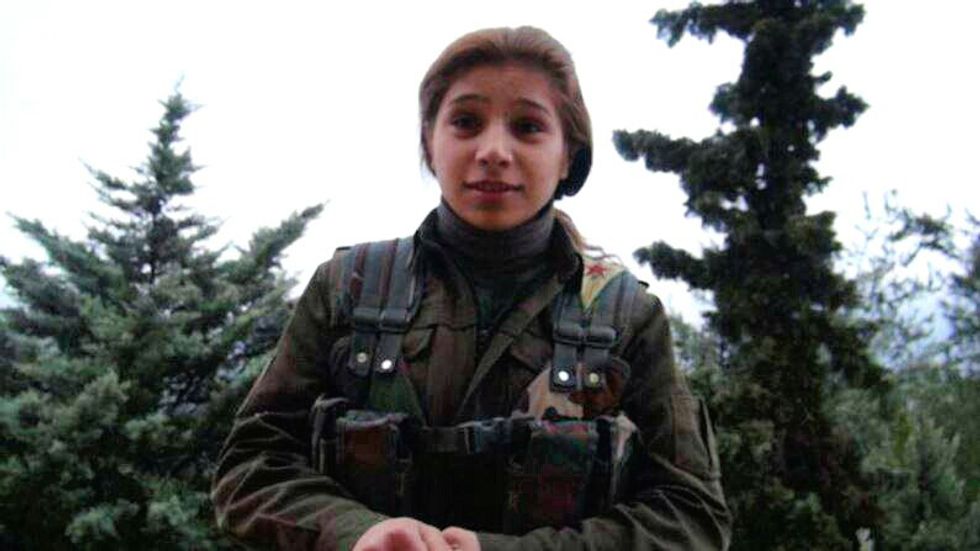
This is Newroz. At the age of 21, her family tried to marry her to a stranger she had never seen before. On the day of her wedding, Newroz abandoned her family and joined the Kurdish women’s militia.
 Few Americans have heard Newroz’s story as well as that of the other hundreds of stories coming from the Rojava cantons in northern Syria and western Kurdistan. Rojava consists of Afrin, Cizîre, and Kobani, three enclaves that make up an area slightly smaller than the state of Connecticut. The territory is heavily dominated by ISIS. In mid-2012, Assad’s forces largely withdrew from the area, and the battle was left to the Kurdish militias: the YPG (People’s Protection Units) and the YPJ (Women’s Defense Forces), the autonomous women’s militias.
In the past two years, thousands of young Kurdish women have taken up arms with the Kurds, Syria's largest minority group. Both the YPG and YPJ have been largely left to their own devices by President Bashar al-Assad's forces, which are currently battling Islamic State militants who have seized large areas of Iraq and Syria. About 7,500 women are estimated to have joined the YPJ - many as volunteers - which was set up in 2012 as part of the YPG, the Kurds' dominant fighting unit in the northern Syria region of Rojava. Their aim is to fight any group that threatens Kurdish-inhabited areas of Rojava, and the YPG has taken de facto control over a sizable chunk of Syria's predominantly Kurdish North.
While female fighters are common within the ranks of Kurdish forces, the YPJ, a women-only combat unit, is unusual for the Muslim world, where some Islamic traditionalists are of the view that women should not engage in combat. Like the followers of the Islamic State, many Kurds are Sunni Muslims, but this band of young female fighters hopes their frontline role will help establish equality between the sexes. In a private interview, a member of a YPJ unit made the statement, "We want to set an example for (both) the Middle East and the West. We want gender equality for all."
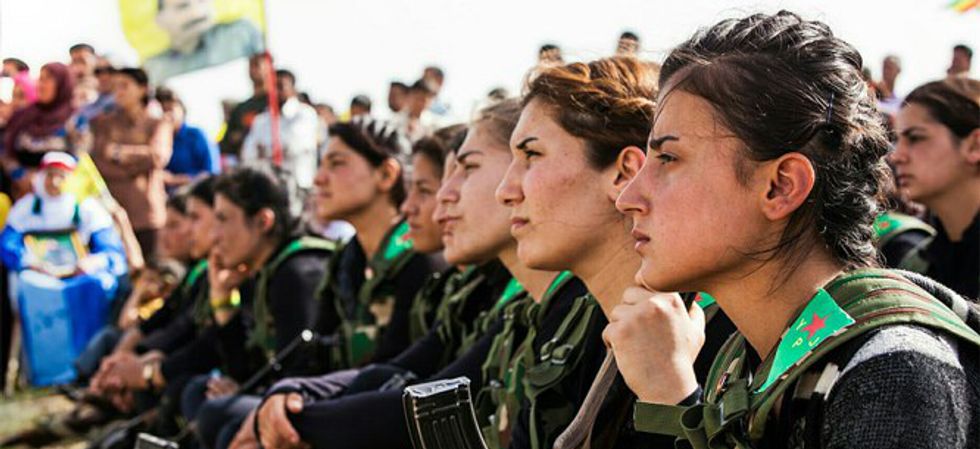
These women are some of the fiercest and most effective fighters. Many of them are widowed or have lost their families during terrorist raids. These women believe wholeheartedly in their cause and are strongly motivated on the battlefield by personal loss. However, YPJ militants are not only driven by their losses; many of the women fight as volunteers in some of the most violent portions of combat. Women are readily joining the cause in the name of liberty, feminism, and equality.
In December of last year the Thomson Reuters Foundation was able to interview some of the women who were presently on the front lines of the revolution. One of the women interviewed was Arin, a YPJ radical, born and raised by Kurdish parents in Germany. Only a year before, Arin had been working as a nurse in Cologne, Germany, but she now shares a one-bedroom apartment in a small, dusty town along the Iraqi border with six other militant women. When questioned about her personal Russian semi-automatic pistol, Arin explained she was awarded her pistol after she killed 20 Islamic State militants, earning her the reputation among her colleagues as one of the most dangerous snipers in the group.
Arin, like many others, left her family, home, and job behind to join the YPG and YPJ cause. Before leaving home and uniting with the militia, she graduated from nursing school and was working when the Syrian conflict started. Arin admitted that she had enjoyed her life in Germany, but she felt she had to do something as the news became worse. "I remember watching television when I saw women and children slaughtered by Daesh (Islamic State), and I couldn't stand it anymore," she added, using a term for the Islamic State that is widely considered derogatory.
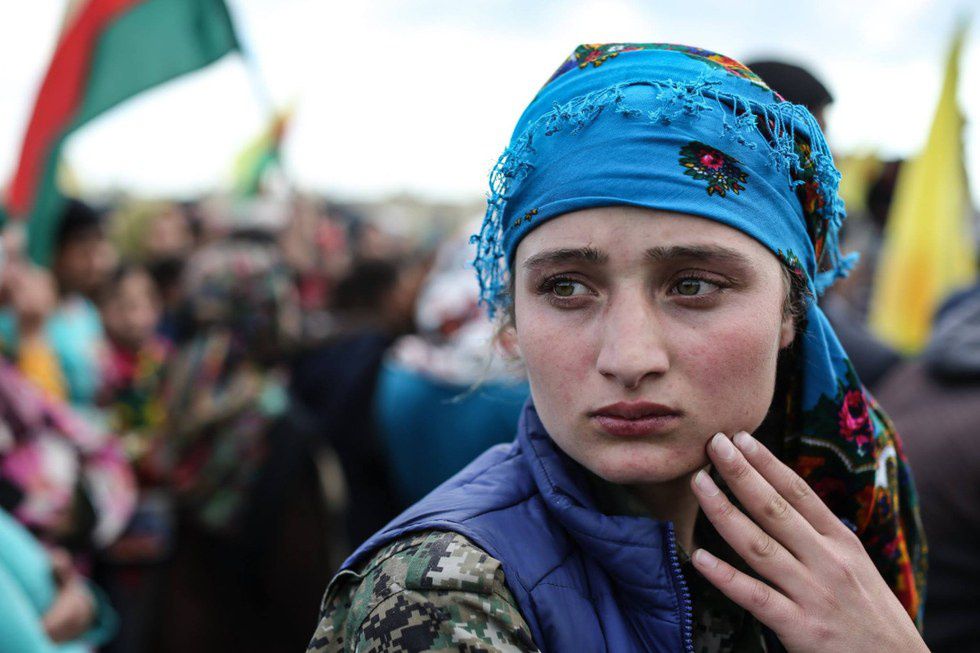
Women like Newroz and Arin have inspired many who have had the chance to hear their stories. Yet, it seems it has become even easier to forget, especially with so much going on in the world today, that there are still people who are leaving everything they have ever known to go and risk their lives in the pursuit of peace. The revolution that is expanding in Rojava is still relatively unknown to most of the world, even though YPG and YPJ forces are some of the only ones to profitably oppose ISIS forces in combat.
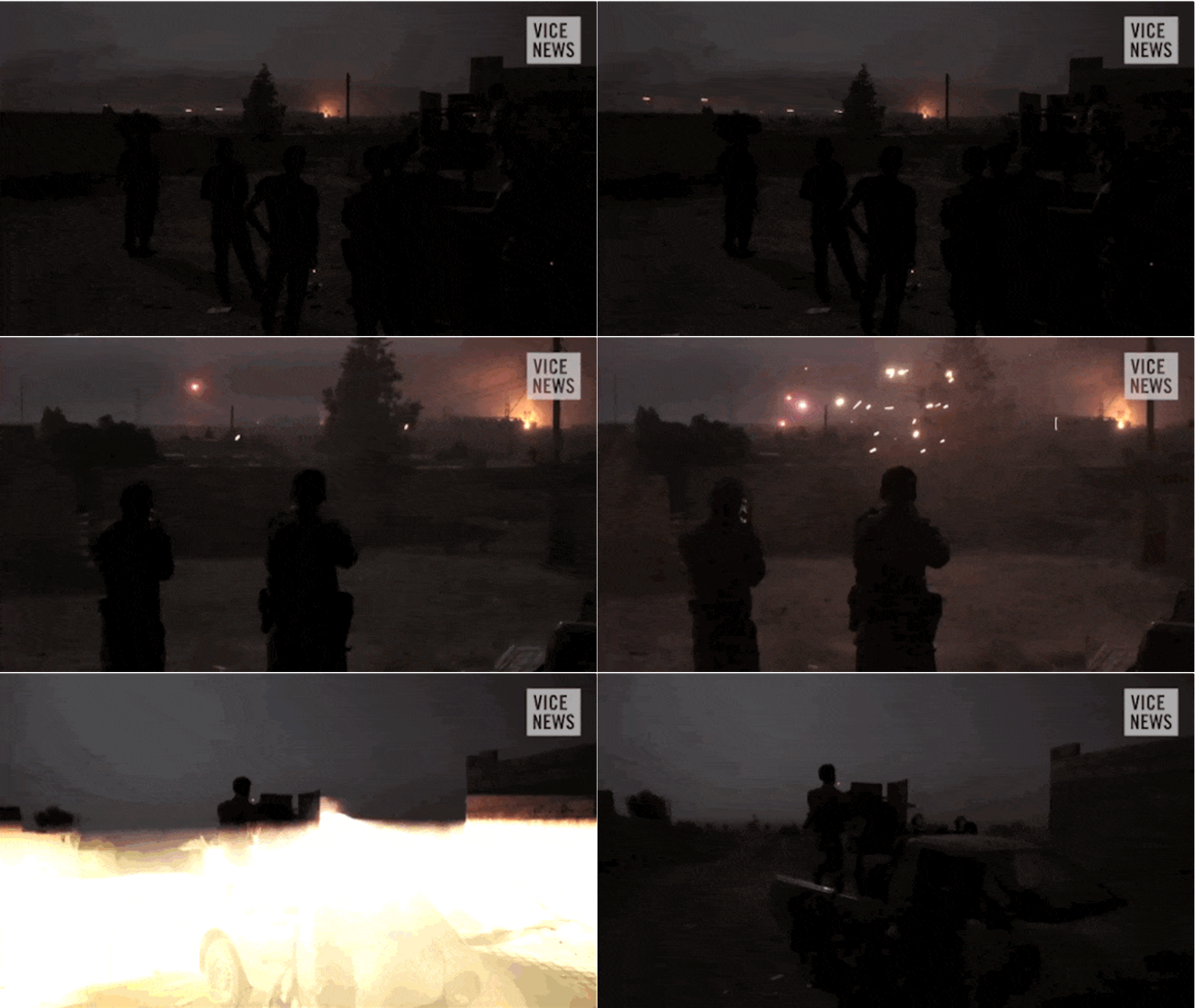
Merely days ago, VICE News was able to capture moments from a night operation against the Islamic State. In this battle for Rojava, despite IS using their elite forces in the offensive, the combination of airstrikes and YPG ground troops proved too much and IS fled its recent gains in the northeastern city of Hasakah, leaving behind only ruined buildings and mangled bodies. VICE News has been following a YPG night dispatch, providing support from Hasakah's Red Villas district to advancing Kurdish forces against IS fighters trying to defend the strategic al-Zuhor neighborhood, under waves of constant airstrikes from both the coalition and the Syrian regime's air force.
For the first time, the YPG now finds itself in almost total control of Hasakah. The regime has merged into the central government district and IS is being held at bay in the city's southern outskirts. However, even in victory there is little stability to be found in this war torn land. Yet men and women alike continue to successfully rally against enemy efforts. Even if the media isn't saying it, be advised, there are still rays of hope and progress in the midst of this crisis.