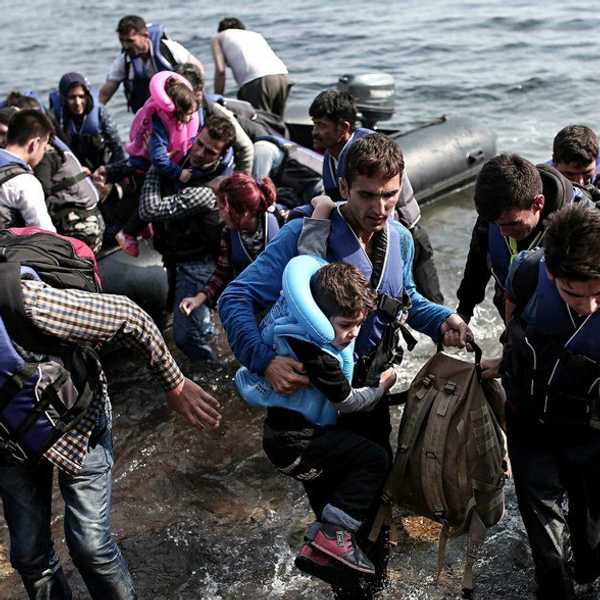
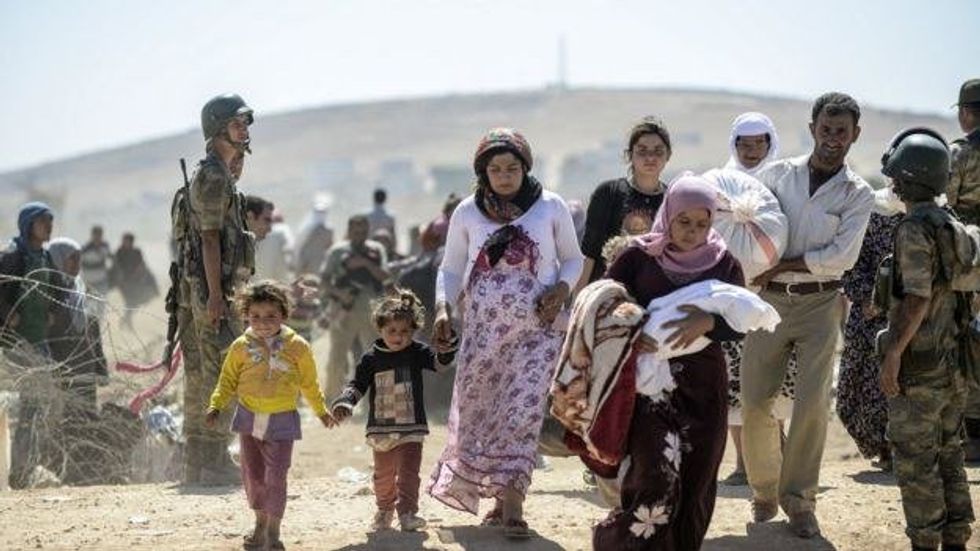
On November 13, 2015, 129 people were murdered in the city of Paris as they carried out their routine lives, dining at restaurants and attending music performances. The Islamic State, also known as ISIS, was the terrorist group responsible for the mass shooting and suicide bombing that caused this tragedy. With bitter hearts, Paris responded to ISIS by starting an airstrike on the Syrian city of Raqqa, where members of ISIS are assumed to be hiding. However, none of the terrorists involved in the attacks were actually Syrian. A few of them entered France alongside Syrian refugees, but none were from the country itself. Yet, Paris is bombing Syria, which is already in turmoil because of its civil war. The ones suffering in this situation are the ordinary citizens of Syria, who are fleeing from their homes to find safety somewhere where they do not have to worry about their homes being raided or concrete falling from the sky. Before the current state of Syrian refugees can be analyzed, however, it is imperative to understand how all these ordinary people were given the title of "refugees" in the first place.
The crisis in Syria began in March 2011. Since then, over 200,000 people have died because of the conflict between President Bashar al-Assad's government and the rebel forces who want to throw him out of office. Some of these rebel groups have become terrorist groups, with an agenda to kill anyone who prevents them from gaining the Syrian presidency. Because of this, more than 12 million people have been driven from their homes. Of those 12 million, over half are children. So how did this all start? Just like most civil wars do, it started as a fight for democracy.
In 2011, 15 students were arrested and tortured for writing anti-government graffiti on the walls of buildings in the Syrian city, Deraa. Locals were appalled and took to the streets to protest. The protests were peaceful but the Syrian government saw them as a threat and fired at the protesters, killing four of them. At the funeral for those four people, the government fired again, killing another innocent civilian (Shuppe). This was the tipping point. Soon, word spread to other parts of the country of the treatment of average citizens by their government.
It is important to note that Assad's family has held office since 1971. Unlike most regime leaders in the Middle East, however, they were not religiously extreme, so the fight against him is not due to religion. Actually, it is because of his policy and dictator-like rule. What the Syrian people wanted was their basic freedoms. Once President Assar decided to open fire on a peaceful protest, the people demanded that he resign. Of course, he refused. President Assar offered to make changes, but people did not believe him; they were used to being fed lies without having the ability to hold anyone accountable. At this point, he had many Syrians who still supported his government, but that did not stop the violence that erupted in the country afterwards.
Bombings, raids, chemical weapons, and terrorism all engulfed Syria at once. People had no choice but to flee from their homes. They could stay and die, or leave with the hope of staying alive long enough to reach another country that would accept them.
Syria is a small country. There are 22.5 million people living there, which is about the same amount of people living in Australia. They cannot move to a different part of the country because there will be traces of the war everywhere. Life for these refugees has become a nightmare as they travel for days to reach safety and are denied entry into neighboring countries. It most significantly impacts the children of the society. They can no longer get an education. Most do not receive proper nutrition. Many have lost their parents. This is the demise of their childhood, and they have no say on it. According to a Unicef report, "Syria is the most dangerous place to be a child. In their thousands, children have lost lives and limbs, along with virtually every aspect of their childhood".
The United Nations has been tracking the crisis in Syria since February 2011, but they have not done much. They report that war crimes have been committed on both sides of the war, including murder, torture and rape. They also said that, in some cases, civilian gatherings have been purposely targeted for the sake of a massacre.
The UN has only accused; it has not taken any action in Syria itself. What it is doing, however, is registering refugees and setting up temporary camps. Once a refugee is registered, the UN attempts to relocate them to a permanent home in a country willing to accept them. This sounds like good news, but, in reality, the application process takes two years to process on average. This is partly because, in addition to finding homes for refugees, the UN simultaneously tries to obtain work visas for them in the country they will be headed to.
Now that the Syrian civil war has gained significant media coverage, governments of different countries are being pressed into making decisions as to how to combat the war and what to do with all the refugees. Many have set quotas as to how many refugees they are willing to accept annually, but all of this changed on November 13, 2015, when ISIS attacked the city of Paris.
ISIS is a terrorist group. They threaten anyone who does not follow their extreme views. What they want is devotion to their interpretation of Islam, which means a totalitarian rule, stripping the rights of women and killing anyone associated with western culture. In early 2014, ISIS began taking over large parts of Iraq. The war had divided Syria and weakened its military; ISIS saw this as an opportunity and began to take over parts of Syria as well. In September 2014, the US, the UK, France and a few other countries joined forces and began fighting ISIS with planes and bombs, attacking their members on the ground from a distance. Now, not only were Syrian citizens fleeing from their civil war, but they now had to run from ISIS.
Syria is in turmoil. The issues are not being resolved. Rather, more problems and more violence are being loaded onto the table.
The Syrian civil war has been going on for almost five years now. More people are being added to the list of refugees as the days drag on. Only recently has the world learned about these refugees because the media and government finally acknowledged that there is a real problem. Steps were taken in the right direction when countries such as the UK, US, and France decided to finally open their doors to refugees. Thousands were able to find homes and start living their lives again. However, the arms of these countries were not open for long; the terrorist attack in Paris changed the whole game.
Paris officials discovered that one of the attackers was allowed into France because he carried a Syrian passport and walked in with a group of Syrian refugees. The name on his passport was Ahmad Almohammad, but this was not his true identity. The passport was fake; he had obtained it illegally, which meant more terrorists could be lurking all over Europe and North America, posing as refugees. Because ISIS has ground in Syria, England, the US and France have all launched airstrikes in attempts to tackle ISIS and weaken its establishment. On top of being in the midst of a civil war, Syria has international superpowers bombing their country to defeat a terrorist group which has little affiliation with the Syrian people.
After mourning the loss of the innocent in Paris, governments around the world quickly began to reevaluate their plans to not only to defeat ISIS, but to deal with Syrian refugees. The risk of a terrorist attack was too great, so new legislation was looked to be passed. In the US, the House of Representatives voted on a bill on November 19th, 2015, that would suspend the program that allows Syrian refugees into the US. The screening process for refugees would become longer to ensure that they imposed no risk to national security. The vote was 289-137; easily, the bill passed. President Obama promises to veto the bill. However, a majority to overthrow his veto is a possibility. Governors of 31 states are opposing any refugees from entering their states at all. Regarding other countries, Germany and France confirmed that they would be toughening up their border control, making more checkpoints and adding surveillance. This is detrimental for Syrian refugees.
The situation in Syria is not improving. After the Paris attacks, President Bashar al-Assad said on the Lebanese TV station, al Mayadeen, "What France suffered from savage terror is what the Syrian people have been enduring for over five years." He is not wrong. With countries fighting ISIS in Syria, many have not considered the impact it has on regular citizens. However, he is the main reason that the war began, and he has no problem sentencing innocent people to death. He has the power to fix things, but he craves the power and status too much to try.
With slight chance of changing Assad's mind, the outcome of the war looks bleak; it could continue for years, which means more refugees. Now, countries are closing their doors again, meaning there will be fewer places for the vast majority of the refugees to go. The death toll is guaranteed to rise. Children will become adults, and will not have the proper tools to help them be successful in the future. These refugees, young or old, will always carry the baggage of the war. With the state of the world today, there is no telling what will become of them.