

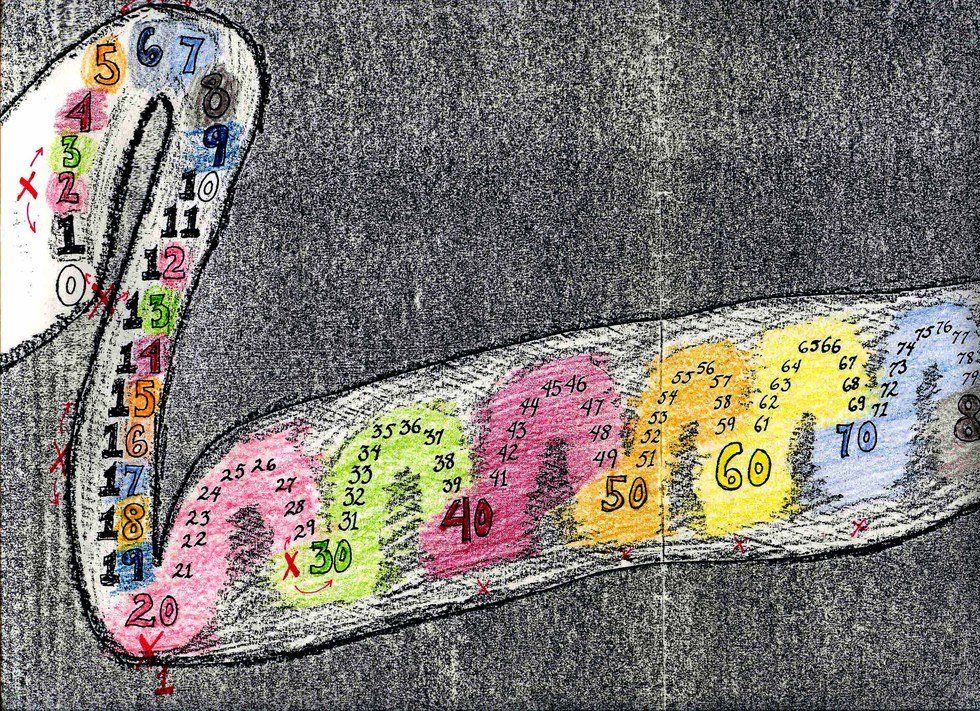
I have grapheme-color synesthesia. People who view letters, numbers, days of the week and months as specific colors The grapheme contains pigmentation solely in the mind’s eye. It occurred as far back as kindergarten, but I didn’t understand it yet. When I learned to spell my name, I would reach for crayons instead of a pencil (it did not visually satisfy me). I picked not one, but six different colors, from a Crayola-scribbled container from the center of the table I used red for A, green for S, orange for H, yellow for L, blue for E and pink for Y. My favorite color was pink when I was five, but yet I only could ever use it for the letters I or Y. And it did not stop at letters. Numbers, months and days of the week had their own pigment that only my mind could see and understand. The association always remains the same throughout a synesthete’s life.
One night, during a bout of procrastination, I fell down an Internet rabbit hole that led me to an article by Cracked, an online humor site, featuring five disorders that would get you laid (results may vary). This led me to understand what was going on in my mind. The last one featured a condition called ‘synesthesia.’ Synesthesia comprises of a sense (sight, sound, taste, smell and touch) and the enhancement of an involuntary sensation (color). The most common form is Grapheme-color synesthesia. But it also branches into various types of synesthesia, including chromesthesia (sound to color) when a person experiences color from sound; spatial sequence synesthesia (numbers that appear at different distances from one another), mirror-touch synesthesia (people that feel what other people touch the same exact way) and lexical-gustatory synesthesia (words that trigger certain tastes when heard).
Synesthesia cannot be formally diagnosed, at least not yet. Testing is difficult since potential synesthetes can only testify that they have synesthesia. However, there is a site where you can test yourself like I did. In my experience, synesthesia does not complicate my learning or understanding. As a writer, it makes reading and writing a bit more colorful and humorous. For example, one of my first short stories I attempted to write was titled A Feather in a Baseball Cap, the story of a pre-adolescent boy on a little league team whom discovers a trove of classic novels underneath the home plate of their baseball diamond. I never finished it, barely going beyond chapter one. The obnoxious teal blue of the title bugged me so much, I abandoned it.