
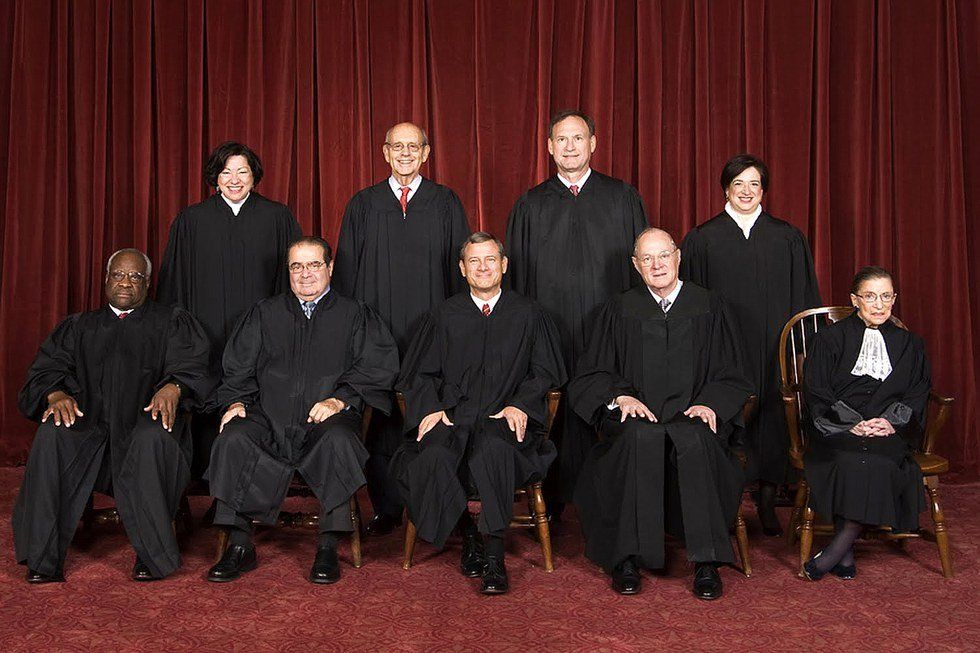
The Supreme Court of the United States (SCOTUS) has had 112 justices since its inception in 1790, only four of whom have been women. Justices are nominated by the president but have to be approved by the Senate, a process that upholds the American government's system of checks and balances among the three branches of government.
Thousands of cases are brought to the court each year, but only about 80 cases are heard. The justices that hear these cases have diverse backgrounds and interests that allow them different perspectives on the current issues of the nation.
Chief Justice John Roberts Jr. was born in Buffalo, N.Y. (GO BUFFALO!) in 1955 and went on to graduate from Harvard law in 1979. President George W. Bush nominated Roberts for Chief Justice in 2005. The youngest Chief Justice in a century, Roberts made a commitment to strictly interpret the existing laws of the nation rather than create new ones. This commitment has upset many in the Republican party, which is Robert's affiliated party. He has upheld the constitutionality of the Affordable Care Act as well as same-sex marriage. Other notable cases include Gonzalez v. Carhart and Rumsfield v. Forum for Academic and Institutional Rights.
Associate Justice Antonin Scalia was born in Trenton, NJ in 1936 and graduated from Harvard Law in 1960. Nominated for the Supreme Court in 1986 by President Reagan, Scalia is known for his humor, strict constructionist point of view, and his careful questioning during cases. Justice Scalia is also notable for his high number of dissenting opinions. His view of the Constitution has caused him to dissent on some controversial rulings over the years such as in Planned Parenthood v. Casey, a case which stated a woman's constitutional right to an abortion. Other notable cases Scalia has written dissenting opinions for include Lawrence v. Texas and District of Columbia v. Heller.
Associate Justice Anthony Kennedy was born in 1936 in Sacramento, Calif. and graduated Harvard Law in 1961. Kennedy, too, was nominated by President Reagan and took his seat on the court in 1988. Kennedy consistently supports the right of the individual, upholding Planned Parenthood v. Casey, and co-writing the opinion in Romer v. Evans, a case that upheld the rights of LGBT individuals. Kennedy further promotes the rights of the individual with his work to reform the current prison system in America.
Associate Justice Clarence Thomas was born outside of Savannah, GA in 1948 and dreamt of being a priest, but decided to go a different route after the assassination of MLK in 1968. Thomas graduated from Yale Law School in 1974 and was appointed to the court by President George H. W. Bush in 1991 with less than a full year of law experience on his resume. Justice Thomas is the second black Justice to serve on the court and is known for his silence during proceedings, not having asked a question since 2006. He is consistent to rule with the conservative opinion on a case. Some of his most famous cases include District of Columbia v. Heller and Citizens United v. Federal Election Commission.
Associate Justice Ruth Bader Ginsburg was born in Brooklyn, N.Y. in 1933. No matter what you think of her politics, it is hard to deny that Ginsburg is a respectable, resilient person. She is the first Jewish justice and the second woman to serve on the court. She attended Harvard Law and graduated from Columbia Law School in 1959. After years of personal hardship and gender discrimination in the workplace, President Clinton nominated Ginsburg to the court in 1993. She has consistently stood up for women’s rights and continues to show that she is dedicated to her position.
Born in San Francisco, Calif. in 1938, Associate Justice Stephen G. Breyer graduated from Harvard Law school in 1964. He was nominated for the position in 1994 by President Clinton. Traditionally, Breyer is known for his practical approach to his decisions, considering both the constitutional language as well as the real-life outcomes. Two notable cases of this include Stenberg v. Carhart and Glossip v. Gross.
Justice Samuel Alito, Jr. was born in Trenton, N.J. in 1950 and graduated from Yale Law School in 1975. He was appointed to the court by President George W. Bush in 2005. Justice Alito is known for his decisions being solely based on the case presented, rather than along party lines. His decisions do tend to lean to the more conservative side as seen in Snyder v. Phelps and Burwell v. Hobby Lobby.
Born in the Bronx, NY in 1954, Justice Sonia Sotomayor graduated from Yale Law School in 1979. Sotomayor has overcome discrimination based on her Puerto Rican background and it shows in her decisions. After being nominated by President Obama in 2009, Justice Sotomayor has upheld Affirmative Action cases, the Affordable Care Act, as well as same-sex marriage.
Finally, the newest justice on the bench, Elena Kagan, was born in New York City, N.Y. in 1960 and graduated from Harvard Law School in 1986. She was appointed to the court by President Obama in 2010. As the youngest justice on the court, Kagan is known to be in touch with modern American culture as can be seen in the Kimble v. Marvel Entertainment case when she cited a "Spiderman" comic book. Kagan is also known for her practical approach to the law as a result of her minimal experience with courts.
Now that you know a basic overview of the nine justices that are responsible for the interpretation of the laws of the United States, I hope you will look into them more and research all of the notable things that each justice has done over the years!