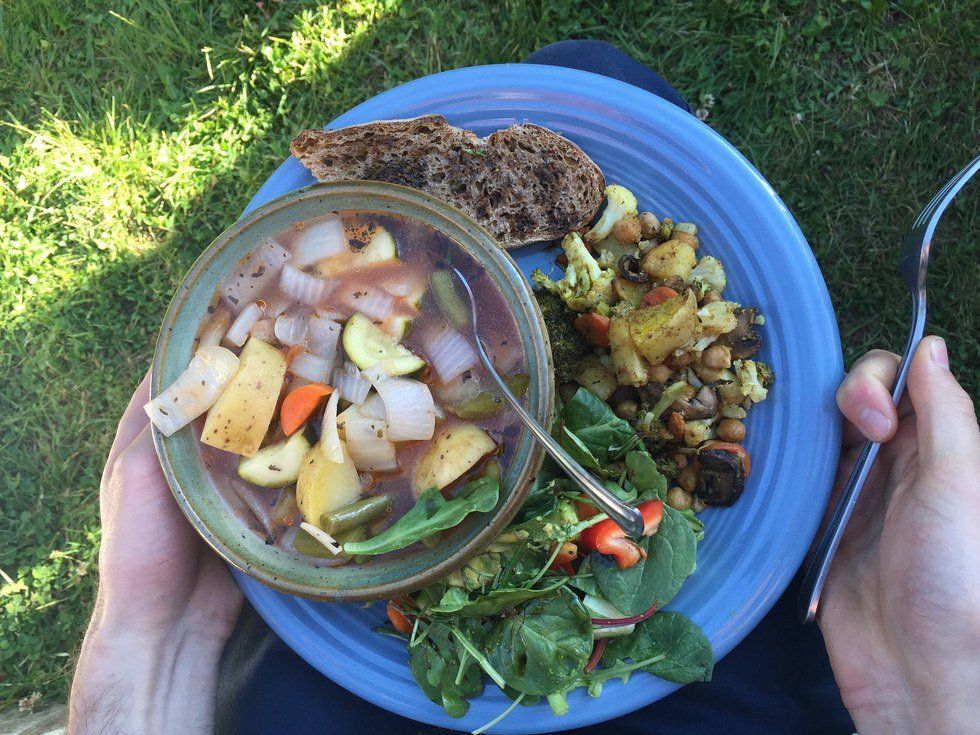
Being involved is a special feeling. Participating in a community of peers to accomplish a goal drives likeminded people together. When passion, ability and work ethics combine likeminded people create an energy that evokes change in a system. Students for Sustainable Food are a group of talented, professional, passionate, enthusiastic people who have a common goal: to bring healthy wholesome food to Western. What may seem like an impossible task is close to becoming realized through a movement called The Real Food Challenge. A challenge to college campuses across the country to create a healthy food system. By recognizing the food system encompasses workers, animals, land, communities and producers, institutions are held accountable not only to the students they serve but also the communities they support. I could not infuse the proper gusto needed for such a valiant cause on my own so I sent the Students for Sustainable Foods some questions to tease their thought and convey my interest.
1. Why did you become involved in SSF?
Rosa Rice-Pelepko: I learned about SSF through a recommendation of a close friend. I knew I wanted to be a part of a group that was conscience about our food system. IT was wonderful to find a group of folks working on a campaign to make direct changes in purchasing on campus.
Emily Bigongiari: As a high school student I was really passionate about food justice but couldn’t find many people in my community who felt the same. However, before I even started school at Western I had heard about SSF from a good friend of mine, and I knew I wanted to join. It is by far my favorite club on campus and it is so refreshing and empowering to work alongside such hardworking and incredible people.
Tristan Sokol: I was lucky to grow up in a family that was passionate about food. Coming to Western was a wake-up call to the fact that food is one of our world’s biggest issues. I can’t remember how I learned about SSF, but when I when I first went to a potluck meeting I knew that I had to come back. I want to make it known that working with my fellow SSF-ers is always a joy, and I consider myself very lucky to know such passionate, hard-working and supportive folks!
2. What does real food mean to you?
Rosa Rice-Pelepko: To me, real food is something that does not exploit the earth, people, or animals. The corporations have isolated people from the system that creates the food they eat, so people have ‘lost,’ connection to food. When you do not truly know what is going on behind closed doors, across the world, or even in your own towns, you become desensitized from the pain. The food system as it stands counts on this distance, and so part of the food movement is to expose the ties we have to so many issues.
Tristan Sokol: I have a romantic vision of real food. The most important things to fight against are what Rosa and Emma mentioned -- exploitation of animals, people and the planet. But every time we hold a potluck or work to cater a meal, we strive to protect the celebration of food and the right to crave food. If a student finishes a meal, unimpressed and unsatisfied, that celebration and romance is lost. Real food -- food that is ethical and regenerative to our planet -- has nothing to hide, and thus allows to celebrate all of its ingredients and processes. Those that grow and harvest our food should be celebrated and given the quality of life that affords them joy and pride in their work. There are many cultures that attach passionate emphasis and priority to their food habits and quality (Italian or Japanese for example), and I believe mainstream U.S. culture could gain a lot from placing a similar importance on its food.
Emily Bigongiari: My idea of real food is food that I can feel good about purchasing and putting in my body, both mentally and physically. Right now when I walk into the WWU dining halls I struggle to find what I consider to be real food, as the vast majority of products sold on campus are either exploitative to animals, farm workers, the earth, or our health. I want to be able to eat a meal and know that every step in the process it took to get the food to my plate was done as ethically and sustainably as possible. That means re-examining our relationship with animals, food producers, and the earth.
3. Have you ever visited a large agriculture farm? What were your thoughts?
Tristan Sokol: Yes. Last year I visited the Lenssen Dairy Farm near Lynden, Wa. This is one of the large operations that sells most of their milk to go to Darigold. They, in turn, dry much of it and sent it to China. The Lenssen operation had about 600 cows when we visited. The Lenssen outfit was a multi-generational one, and they were able to grow much of their own hay. However, they had their own manure lagoon (they comply with local farming regulations to reduce fertilizer pollution) and all of the cows were constantly kept in a large open-air stall. Though the Lenssen farm is not the worst possible scenario, the fact that much of their product goes to China represents a backwards and meticulously-subsidized system, one in which a foreign country has a greater buying power than any local consumer. I would also argue that because the Lenssen product is not distributed locally under their own label, local residents have less reason to demand the better treatment of the cows and their environment.
4. How has the dining hall perverted both food and the eating of food?
Emily Bigongiari: There are several issues with the dining hall food served at Western. First, there is a total lack of transparency. Most food has no labels telling students where and how the food was produced, which makes it difficult to know what industries I am supporting when I eat. When I go to the grocery store I look for Fair Trade certifications, locally grown options, and palm oil free products that I can feel good about purchasing. However, the current dining hall experience lacks any real connection to the food I eat, because I almost never know where my food has come from. And in cases where I do know the farm or producer, it is almost never a company I want to support. For example, Western serves Tyson chicken, which is known to be one of the largest farmed animal abusers in the US.
Additionally, the food served in the dining hall is simply not nourishing. As a student who lives on campus and eats in the dining halls daily, I often find myself feeling hungry throughout the day because the food served on campus is not filling or healthy. When all I have to eat in the morning is a sugary pastry, some fried potatoes, or over cooked oatmeal, it is hard for me to feel nourished or satisfied.
5. The Real food challenge aims to move $1 billion away from big food. How much is Western looking to pledge to that?
Rosa Rice-Pelepko: We are currently aiming towards the goal of 25 percent real food on western’s campus by the year of 2020. At Western, one percentage point is about $50,000. So, because we are around 12percent RF today, we want to shift $650,000 away from “big food” to REAL FOOD by 2020! This is our current goal, but it by no means ends after 2020. As we reach this landmark, we will reassess our situation and make new goals. Ultimately, we would love to see Western buying 100 percent Real Food.
6. How long have you been pushing for the RFC?
Rosa Rice-Pelepko: Five years. The WWU RFC campaign has been in the works for five years now. I personally joined the campaign Fall of 2014, when I started at Western. Back when SSF first started the campaign, administration and dining took on the goal of increasing food percentage to 20 percent Real Food by 2012. This goal was never achieved.
7. What kind of support would you like to see on campus for real food?
Kyla Garlid: Awesome ways to show support would be to come out to events, meetings, continue a dialogue about what food we are eating as a campus and as individuals, supporting other clubs and organizations that we are affiliated with and/or share our same values and fights (SRE, SFJ, ESC, SSW, SIRC etc.).
Tristan Sokol: It would be great to see more students regularly leaving comments about real, local, humane or fair food at the dining halls or taking the opportunity to talk to and question dining management. This way services and administration would feel more pressure from the general student population.
8. Would the next president be able to veto the Real Food Challenge?
Rosa Rice-Pelepko: No! This campaign has been a culmination of work from many different students, faculty, and administration combined. As we move towards our anticipated signing this April, Bruce’s approval will be the final check in committing to the Real Food Campus Commitment. I am not sure of the technical details of this situation, but to me, any new president signing on to lead our university is accepting the goals, achievements, and other works in progress as inherent to the university as they stand. Any attempt to undermine the agreements made before they arrived would be an insult to students and faculty, current or preceding.
9. Is the RFC addressing a failure in our food system or a failure to educate the public about the importance of healthy, wholesome food?
Rosa Rice-Pelepko: Both! The Real Food Challenge fights to directly shift purchasing away from the corrupt corporate food system that controls our markets. This is tackling the problem on the consumer end by directly influencing what kind of values and practices we support in the food system. When students organize on their campuses in the fight for a fair food system, we are holding a conversation about food justice. It reaches students who may have never thought about the implications of a corporate food system, and invites them to join. A crucial component of the Real Food Campus Commitment (RFCC) is that by signing on, the university agrees to forming a Food Systems Working Group. (FSWG) This is a committee led by students, made up of faculty, students, and community stakeholders. This group is responsible for strategizing on how to effectively make purchasing shifts and create innovative ideas for achieving the RF goals. When students are given this power on their campuses, it cultivates a responsibility towards their fellow students, community members, farmers, industry workers, and the earth.
10. Does your connection to food drive you to support other causes? If so what and how are they connected?
Kyla Garlid: Most definitely, supporting food justice for us means that we fight against all forms of oppression be it for the ethical and equitable treatment of animals and farm workers, people of color, women
Emily Bigongiari: Every time we eat a meal, we make a choice about what impact we want to make. How we eat has enormous implications when it comes to climate change, human rights, animal justice, and physical and mental health. I always tell people, and I truly believe this, that the easiest and most impactful form of everyday activism is to make thoughtful choices about what you put on your plate.
Tristan Sokol: My involvement in the Real Food movement has taught me how to be a better ally to those who are fighting for their rights. I’ve learned many valuable lessons about my role in systemic oppression and my responsibility to my community. My experiences with the movement have made me more active and knowledgeable as a feminist and a social organizer.
Students for Sustainable Food is campaigning to change the status quo for the better. Imagine a dining hall filled with healthy, wholesome food. Freshman would no longer complain about the dining hall and more upperclassman would buy meal plans because it would be worth the money. Imagine a world where you felt satisfied and sustained after a dhall meal. Imagine a dining experience without mystery meats, hotdogs, pizza and soda machines. Can you imagine the transformation in the student body? Instead of coming together to hate the food at the dining hall we would praise it, rep it, share it. The community would recognize our commitment to them by producing organic earth friendly food with love. We, the community of Bellingham and Western Washington University, deserve a better dining hall. Show your support for The Real Food Challenge by liking the Students for Sustainable Foods Facebook page and also come to the meetings Thursdays at 7 p.m. in Academic West.