
Are you ready to watch man walk on the red planet? Do you want to relive the emotions our grandparents did when we first stepped foot into space and onto the moon? For a few brief moments humans were multi-planetary, but those moments were indeed brief. Since then the space industry has not really advanced. Technology and telecommunications did. From 1986 to 2011 we experienced a period of innovation not seen in a century. Digital ecstasy is how I describe it - the Internet, personal computers, Google, Youtube, Facebook, smartphones, and Cloud computing. While those years feel like an insane spin of innovation, these next few decades may be even crazier. The next age of innovation is coming around the corner. It seems the work of science fiction, and for now it still is, but a few visionaries are pioneering an industry that could make our dreams of space travel a reality. This reality is not too far off - their goals are not for the year 3000, they are for 2020-2030. I bet that seems impossible, but so did landing a man on the moon within a decade in 1962. This next industry will be an incredible boom. It will provide jobs from software design, rocket design, construction, telecommunications and tourism. It will also push the limits of our technology and find new ones. In reality, such a period of innovation will only be truly comparable to the Neolithic Revolution, over 10,000 years ago. We may be alive for the next revolution in human history, that which has us in Space. This is the next big industry to develop; so far only American companies are getting involved. But the age of living in space is coming, soon. Don’t believe me? Look at the market that is developing. It developed because NASA was not getting the funding needed to get back into space, so other private companies began innovating and creating systems for NASA to get back to space, but for a lower cost than doing it themselves. The market has been growing fast. In 2014 SpaceX broke the monopoly on the United Launch Alliance. A new company officially entered the market, weakening the barriers to entry, and allowing for competition. Since then, Blue Origin launched in 2015 and joined the party. In 2018 NASA will launch the most powerful rocket ever, kicking into full gear the race to Mars, the next Space Race. Here are the companies involved in this modern day space race, the rockets they are using, and their goals.
NASA (Exploratory Vehicles and Research)
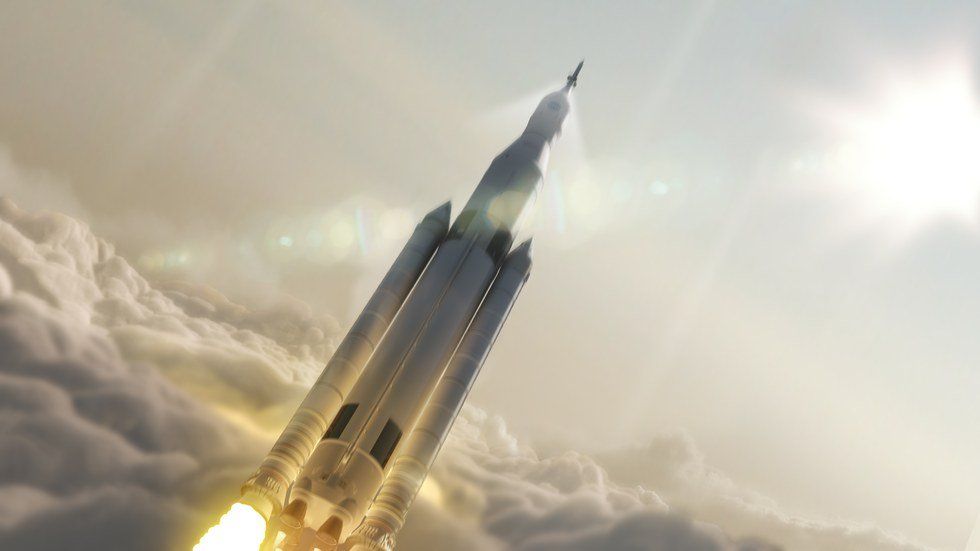
NASA alone is not, per se, competing with other companies, considering the fact that it contracts the companies in this list and that it is state owned. Even to manufacture the rockets that NASA alone designs, NASA has contracted Lockheed Martin and Boeing to build rockets since the Saturn V. In 2014 NASA even contracted SpaceX. Although it is not competing, it still has designed a new rocket for interplanetary exploration, and thus is still the standard from which to compare these new private companies. The SLS or Space Launch System is NASA’s next big rocket. Towering at 211 feet the the rocket will feature two SRB’s (Solid Rocket Boosters) from the Space Shuttle, as well as 4 liquid oxygen and hydrogen rockets on its first stage. It is expected to have 20% more thrust than the Saturn V, at around 42,000 kN. It will be the most powerful rocket ever constructed and it will need to be to get us to Mars. The expected first launch date is November 2018. NASA intends to be on an asteroid in 2024, and Mars 10 years later - only one martian year away before we can all officially say that the endeavor to get to Mars will have truly begun. At the top of the SLS will be Orion, a new space capsule fitted with modern avionics technologies. Orion will be able to hold up to 6 crew members, much like the Space Shuttle. Orion is being fitted for beyond low Earth orbit, meaning we're going back to the moon, and then Mars.
NASA's new SLS Rocket:
United Launch Alliance (LEO Transportation, Deep Peace cargo)
The ULA consists of Boeing and Lockheed Martin in a joint venture to provide for space launch systems to contractors, most commonly NASA, ESA and telecommunications companies. Both Boeing and Lockheed Martin have been in space with NASA since the beginning. Boeing built the lower stage on the Saturn V, Lockheed Martin built the upper stages. Boeing designed and built the Space Shuttle Orbiter. Both are also part of the new SLS system. Needless to say, these companies have a history of success in space. They are also the companies that have grown with NASA and have been parented by it. ULA has been around since 2006, and for a while was considered a monopoly until the next company on this list ended that. The ULA uses the Delta Rockets, which are a rocket family that consist of heavy loaders. The Delta IV Heavy has a thrust rating of 6,200 kN, certainly not much compared to the Behemoth SLS or Saturn V, but enough to be a big cargo lifter. The other class of rockets is the Atlas Rockets, with the biggest being the Atlas V, which has a thrust rating of 1,600 kN. Boeing, part of ULA, is also developing the CST-100, a command service module much like the Orion spacecraft but fitted for LEO, intended to be contracted by NASA. Though none of these rockets are new, these will be used in the next few decades to ship heavy cargo into space. More powerful versions of the Atlas and Delta are likely. An Atlas rocket is what lifted Curiosity into space.
ULA's most powerful rocket, the Delta IV Heavy:
And here's Boeing's (part of ULA) new capsule the CST-100:
SpaceX (LEO cargo and people transportation, interplanetary transportation)
You have likely heard of this company by now. This is one of 3 companies Elon Musk has invested his money into and started. SpaceX has been his baby since its inception in 2002. The ultimate goal of SpaceX is to get to Mars. SpaceX has the Falcon rocket series, including the Falcon Heavy, which has a thrust rating of 7000 kN. The Falcon rockets also have an incredible capability of being reusable. The bottom stage of the Falcon rockets can land on a barge in the ocean. The first testing of such a landing for CRS-7 did not end well, with the rocket tipping over, but then CRS-8 did it. A vertical rocket actually landed on a barge and will be reused. SpaceX relies heavily on mathematics in order to program its rockets to be able to land after launch. The Falcon rockets currently work the the Dragon space capsule and they are used for low Earth or IT operations. In 2014 SpaceX was contracted for NASA to lift supplies to the International Space Station. This broke the monopoly that ULA had over the space industry. It opened doors for a new space age, a privately owned one.
SpaceX's Falcon landing on a barge after launch, CRS-8:
SpaceX recently unveiled their plans for an Interplanetary Transportation System. The ITS will have an insane launch vehicle thrust of 127,000 kN. This is almost 3 times the planned launch thrust of the SLS launch vehicle. The interplanetary transport system will be able to hold up to 200 people, as well as haul a lot of space cargo. The interplanetary system is set to land on Mars by 2025. Musk intends to begin sending probes to Mars as early as 2018. And while these dates seem insane, so did the 7 years JFK gave NASA in 1963. This is well within our current capabilities. The rocket will also feature a reusable lower stage. The overall goal is to set a population of 80,000 people on Mars and begin a 1000 year terraform process. Musk hopes that by using these heavy launch vehicles and setting up a network in space, we can reduce the per person cost of sending people to Mars to $200,000. That's far lower than the current cost of $10 billion.
SpaceX's ITS Rendering:
Blue Origin (LEO Cargo)
Blue Origin is actually the oldest company on this list other than NASA. Founded in 2000, the company begin with the goal of sending cargo into low Earth orbit. However, the company had relatively little growth since 2000 until Jeff Bezos’ other project, Amazon.com, took off. This, much like with Musk's SpaceX, is Bezos’ baby project. But in 2015, the Blue Origin rocket New Shepard took off for the first time. Much like SpaceX, Blue Origin rockets can land vertically for reusability. However, New Shepard is the weakest rocket on this list, at about 490 kN. Its main competitor, SpaceX, has a rocket with 7000 kN for comparison. Because of this, Blue Origin has an intention to use this rocket for tourism. The goal is to decrease the costs of getting into space so all of us can pay for a few minutes of looking at the blue marble.
Blue Origin announced a new rocket whose rocket engine is made in partnership with the ULA and will be far more powerful than New Shepard, which will really bring Blue Origin into this new space race. New Glenn will have a thrust rating of 17100 kN. This is enough to make this rocket a heavy cargo lifter for low Earth orbit. It too will have a reusable lower stage but will be much more powerful, with more lifting capability than its competitor. This rocket is expected to launch in 2020. And with it, fierce competition between SpaceX and Blue Origin, as well as the ULA, will kick into full gear.
Sierra Nevada Corporation (LEO Transportation)
Now SNC is not actually in the rocket market, so it isn't competing with SpaceX, Blue Origin, or ULA. SNC is developing a spacecraft that will sit at the top of the rockets made by those companies. It will be competing with Boeing’s CST-100, and Boeing is part of the ULA. This company has a space shuttle derivative called Dream Chaser. It's a space plane that is reusable and can land just like the space shuttle did. These types of landings are far softer, thus Dream Chaser is best suited for sensitive cargo. It also can hold up to 5,000 kg. The space shuttle for comparison could hold 16,000 kg on trips to the ISS. Dream Chaser will certainly be one to look out for.