Soviet Russian history is saturated with an endless supply of weird stuff from flying tanks to thick novels about pouring concrete. It would come as no surprise, then, that the creator of the infamous GULAG system started out as a prisoner himself.
About as iconic as vodka and the KGB, the GULAG (“Glavnoye Upravleniye LAGerey” or “Main Camp Administration”), was a network of forced labor camps in the Soviet Union that flourished under Joseph Stalin’s rule. They were used to put the country’s large volume of prisoners—from petty criminals to middle-class farmers —to work. Though often thought to be the invention of the Bolsheviks, the GULAG system was the descendant of Russia’s long tradition of exile. Except for the most violent offenders, the majority of criminals and political prisoners before the 20th century were sent to settlements in Russia’s eastern tundra. Sentences were typically short and were served in small, rarely overcrowded settlements that resembled the rest of Russian society: class structures were in place, men, women and children were separated and many could purchase things like food and clothing. Stalin himself was exiled as a revolutionary.
The system didn’t disappear after the Bolsheviks took over. Many prisoners were freed and replaced with POWs from the preceding civil war and others thought unsupportive of Russia’s new Puppet Masters. Camps continued to be used and expanded. One such camp was SLON (this Russian acronym translates to “elephant”), a large, historic monastery-turned political prisoner camp in northeast Russia. In the 1920s and ‘30s, this was Soviet Russia’s biggest camp and future birthplace of the GULAG system.

In steps Naftaly Frenkel. Much like the rest of his life,
his origin story seems like one out of a novel or a comic book. He was a Jewish
man that seems to have come from nowhere. Noted historian Aleksandr
Solzhenitsyn thought he was born in Constantinople and claims of him being a
former American auto worker can be found floating around the internet. If the
prison records are to be trusted, Frenkel was born in Hafia in modern-day
Israel. He was arrested in 1923 for “illegally crossing borders," but according
to historian Anne Applebaum, he might have been arrested for being a “merchant
who had become too successful for the Soviet Union to tolerate,” as the regime
was obsessed with income equality. He was then sentenced to 10 years at SLON.
_back.jpg)
Because nothing in Soviet Russia makes sense, SLON had a suggestion box. In a prison. According to legend, Frenkel acquired a pencil and paper and, seeing the conditions of a crappy Russian concentration camp, wrote a detailed essay on how to improve it . He suggested practices like feeding prisoners based on productivity, with more productive prisoners receiving more food and less productive receiving less. He identified the problems with each of the camp’s industries and explained how they could be turned into lucrative sources of profit. These suggestions, which would eventually become hallmarks of the GULAG system, caught the attention of the warden, the Checka (the first of many secret organizations that would proceed the KGB) and eventually Stalin himself. Frenkel went from prisoner to guard, and in a year was already in the process of gaining release.

Frenkel’s meteoric rise continued after his initial 15 minutes of fame. He became a commander of the very prison in which he
was supposed to be confined. His business sense served him well and SLON
thrived not only as a prisoner camp but a commercial enterprise as well. He was at
times ruthless, eliminating any semblance of rehabilitation and removing relics
of the old Russian camp system like news publications. He oversaw construction
of the massive Stalin White Sea–Baltic Canal with prison camp labor, during
which 12,000 to 25,000 people died. As a communist henchmen, he floated from job to job. Unlike nearly
all of his colleagues, he survived Stalin’s Great Terror that took out even
loyal Communists.


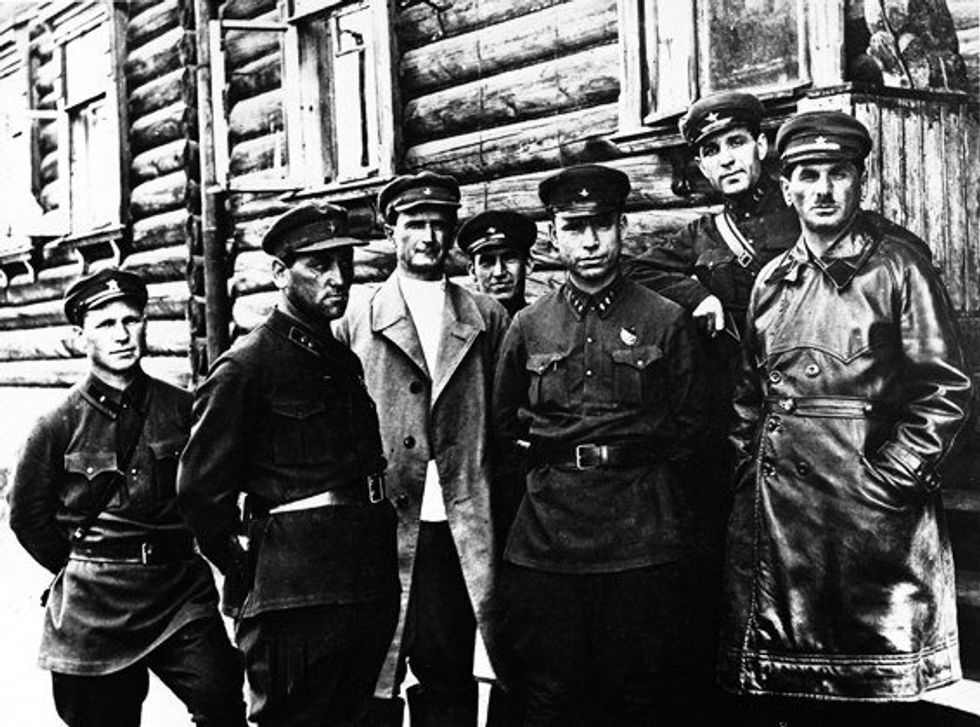
 Those close to Frenkel remember him being as odd as his
life story. He never wrote anything down,
performing
complicated calculations in his head
like an evil genius. He looked like
one, too: always with a leather cap and coat, a toothbrush/Hitler mustache and
a sinister complexion to cap it off. He seemed to know everything and was unable to
hold a conversation with any other businessman for very long because they knew
nothing he didn’t already know. He knew so much about the world and his
colleagues, that in 1928, some party members accused him of operating spies. An
anti-Semitic official remembered as “Comrade Yashenko” even considered
murdering him out of jealousy.
Those close to Frenkel remember him being as odd as his
life story. He never wrote anything down,
performing
complicated calculations in his head
like an evil genius. He looked like
one, too: always with a leather cap and coat, a toothbrush/Hitler mustache and
a sinister complexion to cap it off. He seemed to know everything and was unable to
hold a conversation with any other businessman for very long because they knew
nothing he didn’t already know. He knew so much about the world and his
colleagues, that in 1928, some party members accused him of operating spies. An
anti-Semitic official remembered as “Comrade Yashenko” even considered
murdering him out of jealousy.
Frenkel’s story, though extraordinary, is not unlike the other coincidence-laden lives of those who survived the Stalin regime, like Georgy Zhukov or Lavrentiy Beria ( almost). His cunning may have saved his skin, but he was directly responsible for the deaths of thousands as a supervisor and indirectly for millions as an innovator. But, as the jokes often go, in Soviet Russia, convict imprisons you.