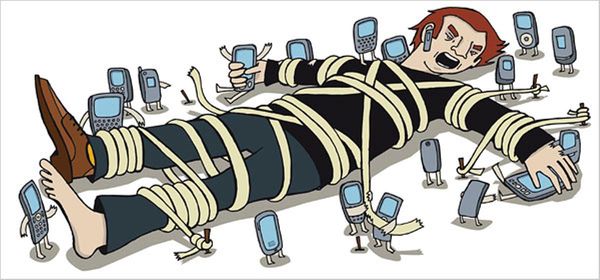


Can you take a guess at what the average attention span of a human is nowadays? When it was last checked in 2000, we had an attention span of twelve seconds. Now, it is around eight seconds, less than that of a goldfish. Why is it that our brains seem to be more easily distracted than they were 15 years ago? Let me give you a hint. It is small, rectangular, and almost always staring back at you for hours at a time. That’s right, your smartphone. Those devices that some say they couldn’t live without are slowly but surely decreasing your attention span and other parts of your body.
The smartphone is doing more than just affecting your attention span. Smartphones emit blue light which is harmful to the eyes when they are exposed to it for a long period of time. This can lead to retinal damage which may progress into macular degeneration. This means that the more you look at your phone, day and night, you are increasing your chances of losing your vision. The blue light always messes with your body’s production of melatonin. When you are about to go to sleep, your body releases melatonin to help you fall asleep. Blue light interferes with that process causing your sleep pattern to be messed up, which leads to a variety of sleeping disorders and other health issues. Health issues that can occur includes insomnia, depression, and obesity to name a few.
A common way people try to stay healthy is to go work out at the gym. It is extremely common for people to bring their smartphones with them to keep them distracted while on the cardio machines. Playing music is a great way to keep the body going during these rigorous exercises, but those who use it to text or chat on the phone are not as likely to get as good of a workout. A study done by Kent State's College of Education, Health and Human Services showed that talking on the phone decreased your average speed than if you weren’t, and texting was the worse, decreasing both heart rate and speed. The reduction of heart rate and speed means that the person is not developing good cardiorespiratory fitness, which can lead to a variety of cardiovascular diseases, such as hypertension and high cholesterol.
We all know that we can’t give up our smartphones entirely, not with the kind of demands society has on us nowadays. There is a fine line, however, between using it for what you need and using it excessively. The best advice is to limit your phone use to certain amounts each day. Try to only check your phone for important emails and texts, and limit social media activity to only 20 minutes a day. Also, plug up your phone at least 30 minutes before you go to bed and out of reach so you won’t be tempted to check it at night. If you plan on taking it to work out with you, limit it to only using it for music; otherwise, leave it at home or in the car. Taking these measures will help reduce your chances of decreasing brain function and increasing health issues that could have been easily avoided.