
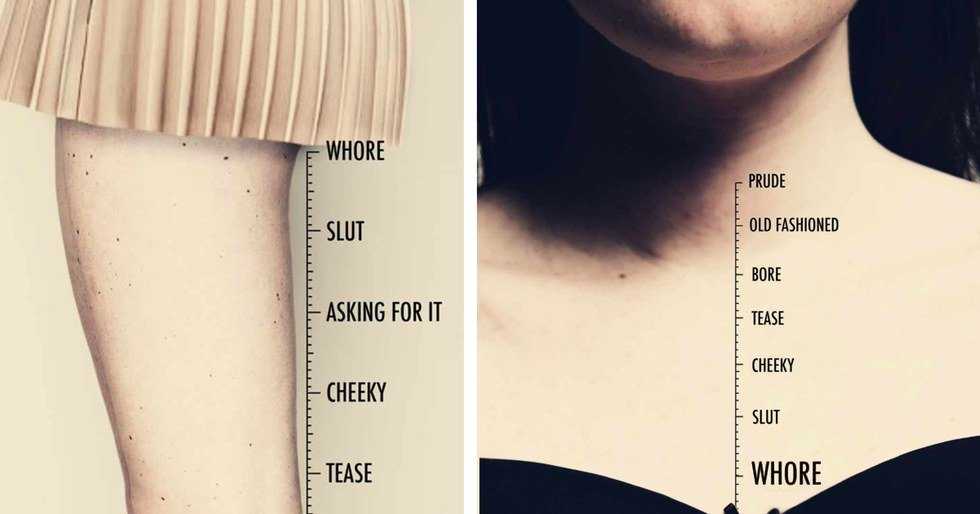
My most vivid memory of high school happens to be my worst.
Being 14 years old, I was in an experimental age when it came to style. It was the awkward age of "If I wear this will people laugh at me?" or "Is this too revealing for school?" But I tended to wear what I wanted, regardless of what other people thought, as long as I felt comfortable. It was in May of my junior year when that almost changed.
It was uncomfortably warm out, so I decided to wear a skirt, tank-top and boots. My mother had no problem with it as I walked out the door. My teachers had no problem with it as I sat through class, but someone did have a problem with my outfit that day.
I was walking home and crossing a light when it happened.
A woman, probably the same age as I am now, stopped her car, rolled down the window and shouted, "You Whore! You Slut!" and drove away.
I was so traumatized that I didn’t walk home for the rest of the year.
At first I thought it was my fault. Maybe my tank-top was cut too low, maybe my skirt that came almost down to my knees was too short, maybe I had to just cover up more when I left my house. Now, in 2016, I see that it wasn’t my fault at all—it was society's.
I admit that I used to enjoy watching "Fashion Police" on E! I liked seeing the fashion and used to laugh along when someone would wear something so outlandish that you questioned their sanity, but something rubbed me the wrong way. I realized that it wasn’t about fashion—it was about who could make the best joke, who could get away with saying the most shocking comment. It's television shows like that which make societal judgment OK. And I found that I was judging right along with them; judging people I didn’t even know.
It's not just on television though. Fashion shaming is all around us and we are instilling it in our children when they are as young as 12 years old. I remember in middle school, receiving a list of what was inappropriate to wear to school. For girls there was a two-finger rule for tank-top straps, a four-finger rule above the knee for skirts and shorts and no shoulders showing. For boys—don’t wear hats in class.
I understand that girls should be dressed appropriately for school, but where are the lines drawn? Why are girls who are just entering puberty being viewed as sexual objects that need to cover up? Are a young girl's shoulders really that distracting to her male classmates? I say the line is drawn when we sexualized a 5-year old for wearing a spaghetti strap rainbow dress last year and made her change into a t-shirt and jeans, or when Idaho teenager Evette Reay was suspended on her last day of school for wearing a dress that was just a little too short (see below).

In today's society, we are making it loud and clear that what a woman wears comes before her education, that her body is something she should cover up and that she is ultimately a distraction for men.
This is a dangerous mindset we are teaching young girls and boys. We are showing them that, when a woman wears clothing that shows her shoulders and thighs, she should be publicly shamed. That she is showing off her body for purely sexual reasons, not because it might be hot outside.
Women shaming other women, men shaming other men, men shaming women, authority figures shaming women and men—all of this leads to one thing: the normalization of rape culture.
When we judge someone's character by what he or she is wearing, it creates a dangerous world in which women are not taken seriously when they are sexually abused, because they are dressed in a way that society perceives as "slutty." Institutions like schools need to start looking at women as people who want an education and look past want they are wearing.
We are more than distractions.