


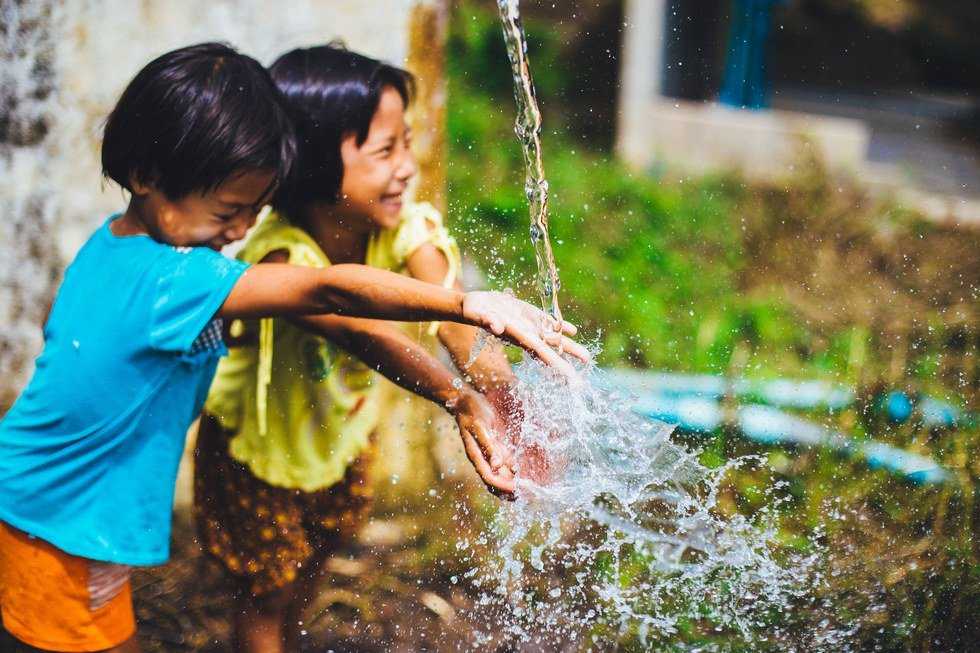
The children in the preschool room I work in have had ongoing discussions around who is whose friend, who can be whose friend, and what it means to be a friend. They fight and argue and disagree, they "unfriend" each other and in a few minutes or less, they befriend them again as though nothing ever happened! Overhearing their conversations made me think about how the children's approach to friendship is so simple, so pure, so authentic, and how we, as grown-ups, make those relationships into a complex affair.
Many of us have "issues" with our friends that are similar to the ones that young children have with theirs, but somehow the grown-up "issues" turn out to be more complex and take a lot longer (or never) to resolve. I am not sure about you, but oftentimes when some people have discussed their "friend worries" with me, I have found myself saying, "How old are you, five? Why are these things even problems? And why are you still talking about it and not resolving it!?" I would like to share some examples from the classroom to help you think about similar (grown-up equivalent) situations you may have been in and how quickly, or at all, were you able to resolve it.
Two 4 year old boys, JB and DB (initials of names), were working on putting together pieces of wood to make a robot. While DB was exploring JB's work, he accidentally broke a part of it and had an expression that seemed to say, "Uh-oh!" When JB noticed the breakage, he said, "Hey DB, you broke my robot. Now you have to say sorry!" DB instantly responded, "Oh yes! I am sorry JB! It was an acci..." Without allowing DB to complete his sentence, JB smiled and said, "That's okay, you are still my best friend!" and gave him a hug!
In another instance, LF was at the art table using the markers to colour in a coluring page. AA joined him and asked if she could use some of the markers. LF thought for a second and then said, "Yes, you can use the markers. Because that is what friends do, they share!" I asked LF if he always shared with all his friends and he said, "No. Sometimes I like to play with some things and I don't really like to share them because I want to play with them. But then I change my mind after some time and then I share with my friends because they want to have it."
One day, TCM and WDC were playing with each other but then had a disagreement about who would be the "mom" and who would be the "sister" in their play. They both wanted to be the "mom" and they went back and forth saying, "No I am the mom!" until a point where TCM said, "I don't want to play with you WDC, you are not my friend anymore!" WDC, with a sad face, came to me and said, "TCM is not my friend anymore! She hurt my feelings!" I asked her if she had spoken to TCM about it and she said that she hadn't. She was about to talk to TCM when TCM reached out to her and said, "I am sorry I hurt your feelings WDC, you are my friend!" and they went back to playing as though the conflict never happened!
There are several examples where the children continue to explore their definition of friendship but in each of the instances, there has always been a happy ending and the children have always resolved their problems and continued to be "bestest friends ever!" So the thought worth considering here is that, if it is so easy for children (who may have been "wronged") to forgive, forget, and move on, why do grown-ups struggle with doing the same? At what point and why do we begin to lose that purity, simplicity, and authenticity that was once an integral part of a friendship and replace it with complexity, and superficiality? Does it become so important for us to keep our pride and our ego that we do not care to fight for the relationship that once used to be a significant part of our lives?
Working with young children has helped me realise that if a friendship is true, there is no problem so big that cannot be resolved. It has helped me realise that I never want to wake up one day thinking, "I didn't fight for a friendship that was worth fighting for!" Because at the end of the day, we are human beings, and like all human beings we are social and it is these social relationships that provide us with the support we need, help us grow, and help us make meaning of the complex world that we are a part of! So think about friendships like you would when you were little, and take the time to mend fences with people whose presence will add more meaning to your life that their absence ever will. Because if you think about it, (to paraphrase JB) saying sorry can make everything okay and you could still have a "best friend"!
















