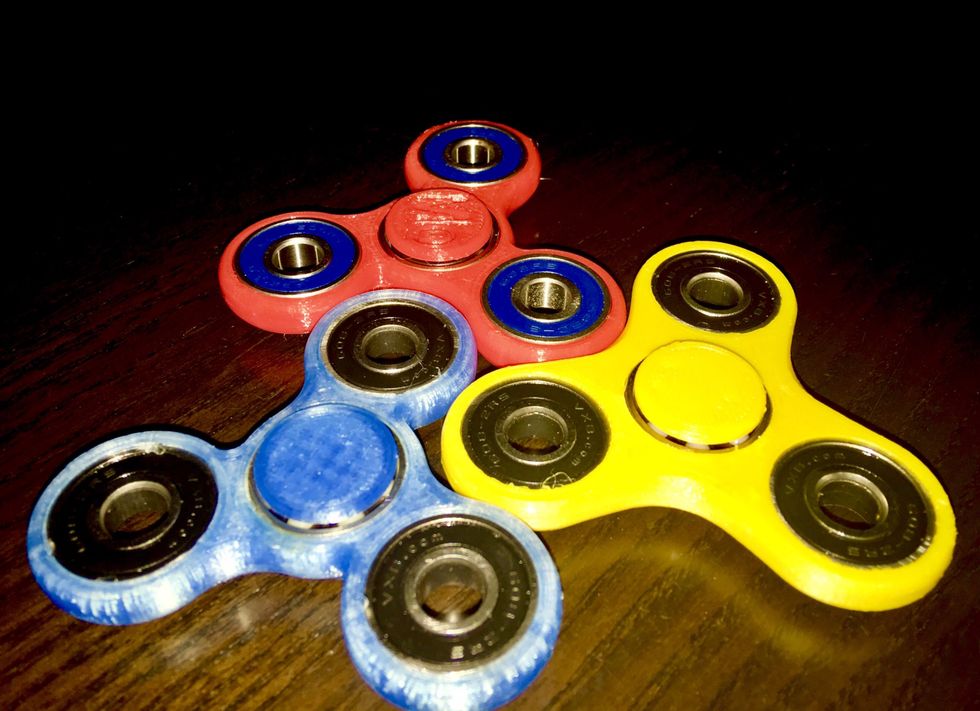
Fidget spinners. They've been all over social media and selling at the speed of light. Originally advertised as a device to help people with ADHD remain focused, as well as to help those with anxiety to relieve stress, these toys have become more of a fad than anything else. Videos showing “Fidget Spinner Tricks” can be found all over YouTube, and people have truly been dedicating time to mastering the “art of spinning.”
Personally, I think the obsession is kind of ridiculous. For a person like myself, who has no problems with attention or anxiety, the spinners are entertaining for about 20 minutes before I get bored of the monotonous motion. So in the case of all those people who buy the spinners simply to “have fun,” I just don't understand the overwhelming appeal.
I’m not judging those who do enjoy fidget spinners. Simply, from my perspective, I am not able to see how they may be helpful or appealing to certain people. For me, it is a spinning toy. For others, I see how fidget spinners can act as a comfort object or something that captures attention. However, in the case of those who only see fidget spinners as this “cool” craze they just have adopt, that’s where my personal judgement comes into play.
We as a society commonly follow the story line of undermining mental disorders in order to fit our own ideas. Although fidget spinners are truly harmless, I think a distant comparison can be made to the recreational use of the ADHD prescription, Adderall. Adderall is abused constantly by those who absolutely do not need it, and likewise, fidget spinners have created a new “aesthetic” that isolates them from their original purpose.
For example, my younger cousins were extremely proud to show me their collection of half a dozen fidget spinners, all different colors and textures. When I asked them why they like them so much, they responded “Well, everybody likes them. And they’re so pretty and fun!” I left my their house with my very own rainbow chrome fidget spinner which I had been gifted, and couldn't help giving it a few spins and trying some “beginner tricks” which my young spinner prodigies had shown me. Even as this shiny toy distracted me, I couldn't help thinking that these toys play a very small, innocent role in the rhetoric of undermining real mental disorders, even if we can’t see it.
I simply think it's important to be aware. Yes, fidget spinners are harmless. Yes, the trend will probably blow over within the month. But spending hours trying to learn how to spin a shiny object on one finger and transfer it from hand to hand just to impress our friends may not be the best use of one's time.