


In December 2015, President Obama chose to use his clemency power to release 95 federal drug offenders. One of those 95 was Sharanda Jones.
In August of 1999, Jones was convicted of one count of conspiracy to distribute crack cocaine and was sentenced to life in prison without the possibility of parole. For the remainder of her natural life, Jones’ sentence was not eligible for a reduction, even under conditions of "good behavior." This was her first offense; a non-violent drug-related crime had the power to take away her ability to be a parent to her daughter or one day regain control of her life.
While in prison, Sharanda Jones maintained a positive attitude. She participated in various classes offered by the Bureau of Prisons that were related to personal development and self-improvement. Sharanda also participated in a faith-based program called the Life Connection Program. This allowed her to complete community service and participate in various activities that are aimed at establishing goals for re-entry into society. Jones established her own goals for re-entry even though at the time, she lived with the reality that her goals would likely be unattainable.

Draconian drug laws have allowed for irresponsible sentencing; the policies such as the one’s concerning Sharanda’s case have contributed to a phenomenon peculiar to the United States: mass incarceration.
President Obama stated that his choice to commute sentences such as that of Jones', was a step forward in upholding our ideals of justice and fairness. It is not until more recently that Congress began to recognize that a fully waged war on drugs had problematic consequences. Even some members of the Republican party have begun to see the unjust outcomes that our nation's drug laws have produced.
Chris Christie stated that he felt the criminal justice system is broken, acknowledging that our nation holds 25 percent of the world's prisoners. (Keep in mind that the U.S. makes up less than 5 percent of the world population.)
Mandatory minimums, as well as other policies characteristic of the war on drugs, have contributed to the court's inability to decide cases in the context of rationality; all aspects of the criminal justice system are constrained by drug laws that have resulted in the building of more and more prisons. It is arguably more important to recognize the racial disparities these policies have produced.
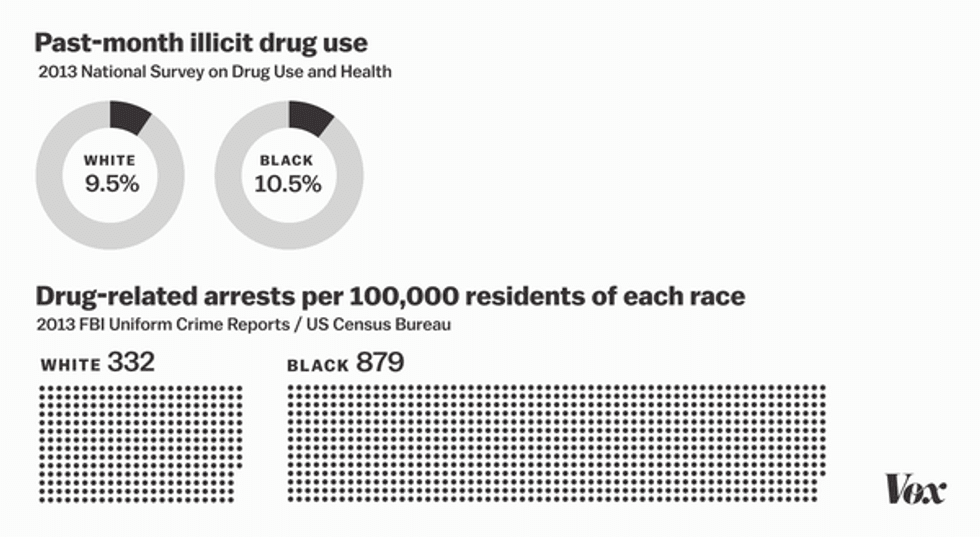
There is a disproportionate rate of people of color in the criminal justice system that are affected by these laws, with people of color often being sentenced more harshly for the same crimes as whites. Vox reported that a 2013 National Survey on Drug Use and Health found whites (9.5 percent) and blacks (10.5 percent) had nearly the same rates for past-month illicit drug use. However, the disparity in arrest rates by race are huge:
Over the past few decades, research has proven that the drug laws that were introduced during the Nixon era have done nothing to end drug use or sales, essentially rendering them useless. Drug Policy Alliance (DPA), the nation’s leading organization dedicated to promoting sensible drug policy reform, states that they advocate for policies that are grounded in science, health, and human rights.
The DPA contends that they advocate for reforms that reduce the harms of drug use and drug prohibition while promoting the sovereignty of individuals over their minds and bodies. An example of a recent policy that is supported by the DPA is the Sentencing Reform and Corrections Act, which would reduce mandatory minimum sentences for drug offenses, expand the discretion of federal judges to sentence people below mandatory minimums, expands re-entry programming and early release, among other things.
Sharanda Jones spent 15 years and eight months of her life isolated from society, unable to perform fully as a parent, participate in the economy or vote. She fully admits that her crime was unfair to those who were on the receiving end of the drug deal. However, it is hard not to ask, like Sharanda had for so long if relegating her identity to permanent incarceration could be considered justice.