

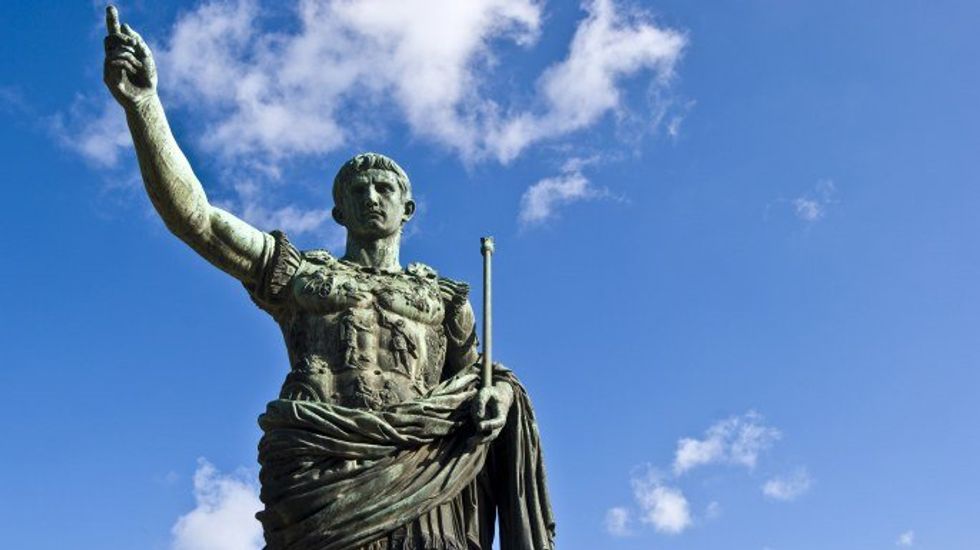
In William Shakespeare’s Julius Caesar, the reader witnesses the Bard’s version of the assassination of one of the world’s greatest rulers and the subsequent power struggle in Rome. Caesar’s role is actually rather small, but it holds vast implications for our spiritual lives and one of the great temptations of mankind: enthroning ourselves as our own gods.
From a Christian worldview, an idol is anything good or bad that we put in God’s rightful place in our lives. The ability of the individual to make himself or herself that idol is as old as mankind: pagan cultures are steeped in the tradition of considering their ruler divine.
The Egyptians, for instance, believed that their Pharaohs were actually one god amongst a host of gods. This had not changed in Roman times, which we will explore a bit later, but my point is that this sin is as old as sin itself and can be committed explicitly or implicitly, consciously or unconsciously.
The latter options of those two contrasts is what Shakespeare illustrates in the downfall of Julius Caesar. The conspirators, led by Cassius and Brutus, plot to lure Caesar to the Forum where they will murder him in front of all the senators. In Act 2, Scene 2, Caesar’s wife Calphurnia describes to him a disturbing dream she has just awoken from in which a statute of Caesar runs with blood from a hundred holes like a fountain. At her behest, he agrees not to go to the Forum, only to have his mind changed by Decius with the following information:
DECIUS:
…And know it now: the senate have concluded
To give this day a crown to mighty Caesar.
If you shall send them word you will not come,
Their minds may change….
The promise of a new crown combined with the possibility of losing it if he does not respond posthaste convinces Caesar to walk to his doom. The lust for power and personal accolade led to Caesar’s bodily death, but for the rest of us, it more often leads to our spiritual death.
This is an even worse consequence because our Lord died the worst death in history, the death we deserved, to give us life “to the full” (John 10:10) through total dominion over our lives. Our spiritual lives are our whole lives – any personal conquest of any area of our lives out of selfishness denies God the Lordship He died for.
What is frightening about this scenario is that people around us know who our gods are. In Act 2, Scene 1, the scene immediately preceding Caesar’s exchange with Decius and his wife, Decius describes to the rest of the conspirators how he will convince Caesar to come to the Forum:
DECIUS:
…I can o'ersway him; for he loves to hear
That unicorns may be betrayed with trees,
And bears with glasses, elephants with holes,
Lions with toils and men with flatterers;
But when I tell him he hates flatterers,
He says he does, being then most flattered.
Let me work;
For I can give his humour the true bent,
And I will bring him to the Capitol (Emphasis added).
Our gods are apparent to those we know and frequently those we do not know. If you are professing to be a Christian but have made yourself your God, you have wrecked your witness (at least temporarily). Beyond that though, the living God has a word for those who think of themselves as gods in Ezekiel 28:
…In your great pride you claim, ‘I am a god!
I sit on a divine throne in the heart of the sea.’
But you are only a man and not a god,
though you boast that you are a god….
Will you then boast, ‘I am a god!’
to those who kill you?
To them you will be no god,
but merely a man.” (Ezekiel 28:1, 9)
This was a warning to the king of Tyre through the prophet Ezekiel, but to us today, it speaks to the kind of crop we will reap when we sow seeds of personal divinity.
Remarkably, the next Roman emperor did not learn this lesson. Caesar Augustus built the temple of Caesar in Caesarea Philippi (notice the city is also named after Caesar) amongst many other temples to pagan gods. It is here that Christ chose to ask the greatest question of his disciples in Matthew 16:15, “‘Who do you say I am?’” In that setting, this question embodies the two-edged sword nature of the Word of God, cutting straight to our hearts.
Christ is asking each of us, “Who am I to you? Am I greater than all these other gods, including the god of yourself, to you?” Peter gave the right answer in verse 16: “‘You are the Messiah, the Son of the living God.’” At this moment, Christ was everything to Peter; He must be everything to us as well.
“He must become greater and greater, and I must become less and less.” – John 3:30 (NLT)