

Christianity has had a long and complicated relationship with femininity. It should come as no surprise that Christianity, like many religions, has been caught up in patriarchy, favoring male voices, male experiences, and male figures over and above feminine and non-binary ones.
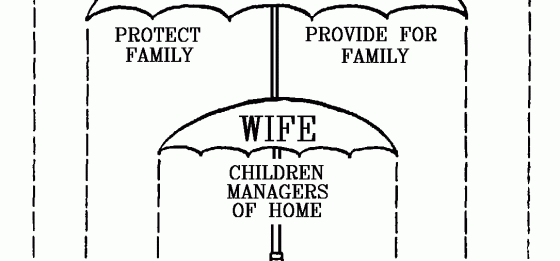
A quick glance at the tradition reveals this to be true: God has typically been conceptualized as male, often explicitly in contrast to other traditions which believe in a Divine Feminine. Worshipers pray to and rely on Jesus, a man, whose 12 apostles were all male. The Bible was written almost exclusively by men, who had the opportunity to record their historical, ethical and theological viewpoints while women did not. Biblical stories primarily feature male protagonists and heroes while women are relegated to the background. Some biblical passages refer to women as property, while others call for women to be subordinate and silent in the church. Many denominations still forbid women from being preachers or pastors, and some even restrict women from aspiring to careers outside of homemaking. Women are often expected to adhere to a higher standard of sexual purity than men, and shamed more severely when they don’t; and so on.
Oftentimes the sexism encountered within the church is more dangerous than a purely secular sexism, because it is sacralized and given legitimacy through recourse to God. For example, to rebel against or challenge such patriarchal notions is to bring the wrath and displeasure of the creator of the entire universe down upon your head. Since the Bible is seen by many Christians as a pure representation of God’s will for the world, Christian leaders can point to an abundance of texts, doctrines, and stories in order to legitimize their own problematic viewpoints and claim God’s concomitant support.
This is another reason why we need to move on from the idea of the Bible as “Word of God”: it legitimates sexism while claiming such sexism is really a positive, God-given design for the world that if followed, will yield true joy and satisfaction for men and women alike.I remember an aspiring male pastor tell me that women should see it as a privilege and blessing that God wants them to be submissive. In the fight against sexism, the Bible is a major obstacle- but it doesn’t have to be. Because the Bible is a complex and multivocal document, it can be read in ways that are actually quite subversive and forward thinking, especially when placed in its historical context.
For instance, let’s look at the claim at the beginning of the Bible that both men and women are created in the image of God. Within the context of ancient Mediterranean societies, the phrase "the image of God" often referred to the (male) ruler of a tribe or society who was understood to be the clearest representation of divinity, the very image of God who had divine legitimation for their actions. Thus when the Bible asserts that all mankind, both male and female, are the image of God, there is a profoundly democratic critique of other societies being made: we are all representations of God, all images of the divine, not just the mighty and powerful, and have just as much right and access to God as a ruler might.
Yet there are some often unnoticed gender dynamics occurring here as well. For if women are also images of God, then there is a critique of patriarchal power being made- men and their experiences, lives, and positions are not the sole representation of God, despite male power and privilege. In other words, men do not solely get to speak on the behalf of the divine, as if they are its sole representatives. If we read this text more broadly with a critical eye towards the Christian tradition, we can thus assert that women’s lives, beliefs, and experiences must be included equally alongside men’s, because they bear the stamp of God just as equally.
Moreover, this text could subversively shape the way we think of God as well. For if women are made in the image of God, isn’t it thus acceptable to think of God as a woman? Why must we only speak of God as "he" when texts like this suggest it is possible to think otherwise? Thus it would appear that patriarchal Christianity is quite out of step with the spirit of this text.
Sexism within the church isn’t going to be toppled through the simple examination of a Bible passage, however. Instead, it will require concerted, organized effort on the behalf of activists and everyday believers who truly believe that men and women are equal. Structures of leadership must be re-thought, biblical texts must be re-read, doctrines and beliefs must be re-evaluated, and even God must be re-approached with open eyes, all in the name of a profound conviction in the equality, the God-imagedness, of all people, regardless of gender.
There’s no better time to start than now.